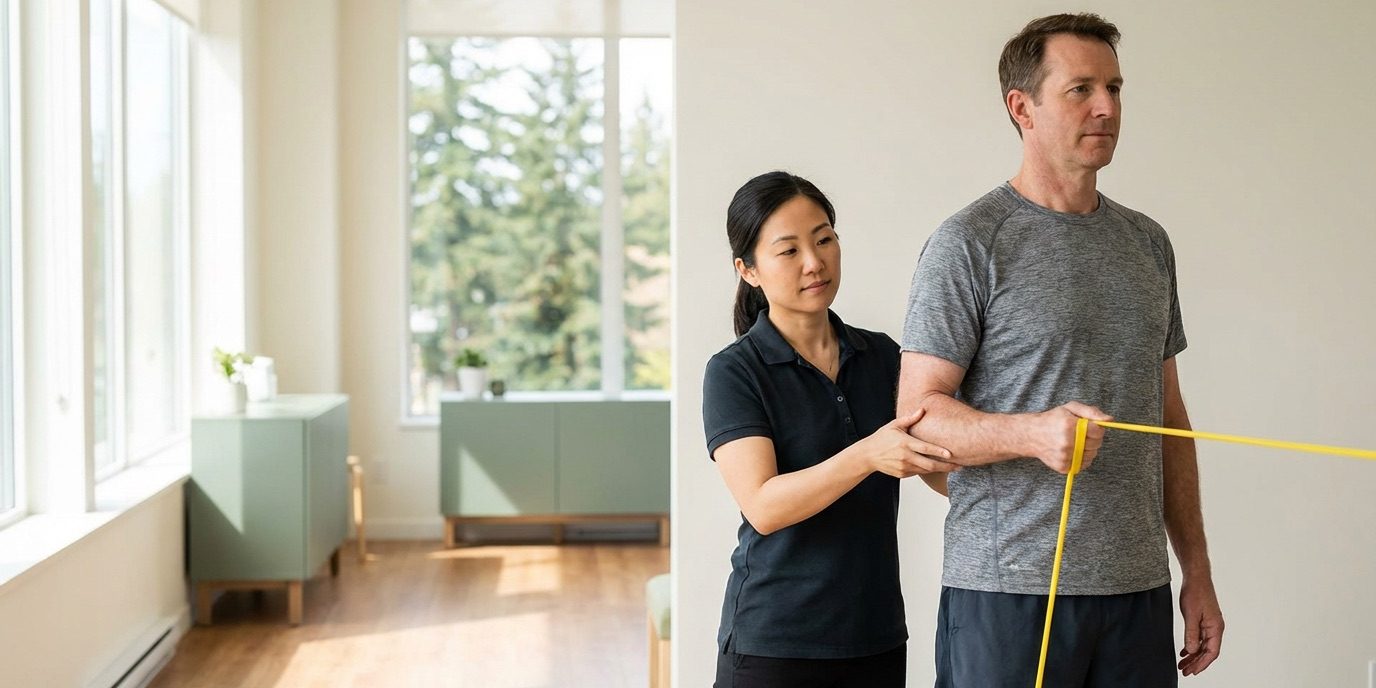
The rotator cuff is the single most-injured group of structures in the shoulder, and the symptoms can be deceiving. Some people feel a sharp catch when reaching overhead. Others wake at night unable to find a comfortable position. Some manage daily life until they try to lift a suitcase or swing a racket and feel the shoulder give way. At Artemis Wellness Clinic, our physiotherapists and registered massage therapists work together on rotator cuff rehab — from early conservative care through to post-surgical return to function. We are located at 5911 No. 3 Road #130, two minutes from Brighouse SkyTrain Station, with direct billing to ICBC and most major extended health plans. Book at Jane App or call 604-242-2233.
What Is the Rotator Cuff?
The rotator cuff is a group of four muscles and their tendons that wrap around the head of the upper-arm bone (humerus) and stabilize it inside the shoulder socket. They are:
- Supraspinatus — across the top of the shoulder, the most commonly injured of the four
- Infraspinatus — across the back of the shoulder
- Teres minor — below the infraspinatus
- Subscapularis — across the front of the shoulder, against the shoulder blade
These muscles do two jobs at once: they provide small-range rotation movements, and — more importantly — they hold the ball of the humerus centred in the socket while larger muscles like the deltoid generate the bigger movements. When the rotator cuff is weak, irritated, or torn, that centring action fails, and the larger muscles end up pinching tendons against the surrounding bone.
This is why “shoulder pain when lifting overhead” is so often a rotator cuff problem. The tendons get pinched in the small space under the acromion (the bony shelf at the top of the shoulder).
Common Rotator Cuff Conditions
Several specific patterns fall under “rotator cuff injury”:
Tendinopathy / tendinitis. The most common presentation. The tendon — usually the supraspinatus — becomes irritated and degenerated through repetitive overuse, poor mechanics, or age-related changes. Pain on overhead reaching, side-lying on the affected side, and a painful arc of motion between roughly 60 and 120 degrees of arm elevation.
Partial-thickness tear. A tear that does not go all the way through the tendon. Often presents like a worse version of tendinopathy, with weakness on resisted testing.
Full-thickness tear. A complete tear, ranging from small (under 1 cm) to massive (over 5 cm). Full tears can be traumatic (from a fall or sudden lift) or attritional (the tendon wears through over years). Conservative care is appropriate for many full tears; surgery is considered when conservative care has failed or when the tear is large in a young, active patient.
Subacromial impingement syndrome. Pinching of the supraspinatus tendon and overlying bursa under the acromion. Often the doorway through which other rotator cuff problems progress.
Calcific tendinopathy. Calcium deposits within the tendon, causing severe acute pain. Resolves over weeks to months in most cases with conservative care.
What Causes Rotator Cuff Injury?
Rotator cuff problems usually arise from a combination of factors rather than a single moment:
- Repetitive overhead work or sport — painters, mechanics, electricians, swimmers, racket sports, throwing athletes
- Sudden traumatic load — catching yourself in a fall, lifting heavy luggage, motor-vehicle accident
- Postural strain — forward shoulders and a rounded upper back narrow the space under the acromion, predisposing to impingement
- Age-related tendon degeneration — common after age 40, accelerated by smoking, diabetes, and certain medications
- Glenohumeral instability — looseness of the shoulder joint that overworks the rotator cuff for stability
- Sleep position — chronic side-lying on the same shoulder can perpetuate symptoms
For ICBC patients, rotator cuff injury after a motor-vehicle accident is common, particularly from bracing against the steering wheel or door at impact. Read more about ICBC physiotherapy in Richmond.
When to See a Physiotherapist
Consider booking an assessment if you are experiencing any of the following:
- Shoulder pain that lasts more than two to three weeks
- Pain or weakness when reaching overhead, behind your back, or out to the side
- Night pain that wakes you, especially when lying on the affected shoulder
- Sudden weakness after a fall, lift, or motor-vehicle accident
- Recurring “catching” or “clicking” with weakness
- Limited range of motion that interferes with dressing, driving, or work
Sudden severe weakness with a clear traumatic onset — especially if you cannot lift your arm at all — should be assessed early to determine whether imaging and surgical consultation are needed.
Our Approach at Artemis
Rotator cuff care is one of the conditions where physiotherapy and registered massage therapy work best as a team, with most patients seeing both during the active recovery phase.
Physiotherapy
Our physiotherapists start with a detailed orthopedic assessment — special tests for the supraspinatus (Empty Can, Drop Arm), the infraspinatus (External Rotation Lag), and the subscapularis (Bear Hug, Lift-Off), plus impingement tests (Neer, Hawkins-Kennedy). The goal is to identify which tendons are involved, whether instability or impingement is the dominant pattern, and what stage of healing we are working in.
Treatment typically combines:
- Manual therapy — joint mobilization to restore glenohumeral and scapulothoracic motion
- Progressive loading exercise — graded resistance to rebuild tendon capacity, starting with isometric holds and progressing through eccentric and concentric loading
- Scapular control retraining — teaching the shoulder blade to position correctly during arm movement
- Postural and ergonomic education — particularly important for office workers and drivers
- Modalities — heat, ice, occasionally TENS, used selectively rather than as the main treatment
Registered Massage Therapy
Our registered massage therapists address the soft-tissue restrictions that develop around the injured cuff — tight upper trapezius, pec minor, posterior capsule, and the larger deltoid. Releasing these allows the shoulder to move into the positions the physio program is asking for, accelerating the strength and mobility gains.
Coordination With Surgery
For patients who go on to rotator cuff repair surgery, we coordinate with the surgeon’s protocol to manage the post-operative phases:
– Phase 1 (weeks 0–6): sling protection, gentle passive motion, swelling and pain management
– Phase 2 (weeks 6–12): active-assisted and active range of motion, scapular work
– Phase 3 (weeks 12–24): progressive strengthening
– Phase 4 (months 6–12): return to sport or full work duties
For frozen shoulder that develops after rotator cuff injury (a known complication), our team is experienced in the combined care that pattern requires.
Insurance and ICBC Coverage
Rotator cuff care at Artemis is covered under standard physiotherapy and RMT benefits across most plans:
- ICBC — covered for motor-vehicle-accident-related shoulder injuries when included in your treatment plan. We bill ICBC directly under your claim number — no out-of-pocket cost for pre-approved sessions.
- Pacific Blue Cross, Sun Life, Manulife, Green Shield Canada, Canada Life — direct billed when your plan includes physiotherapy or RMT coverage.
- WorkSafeBC — covered for workplace shoulder injuries with an open claim and approved treatment plan.
If you are unsure whether your specific plan covers physiotherapy and RMT, our front-desk team can verify before your first appointment.
Recovery Timeline — What to Expect
Rotator cuff recovery is patience-intensive. The trajectory depends on the diagnosis:
- Mild tendinopathy / impingement: typically improves over 6–8 weeks of structured care, with full strength returning over 3–4 months.
- Partial-thickness tear, conservative management: 3–4 months for daily-life function, 6 months for full strength and sport return.
- Full-thickness tear, conservative management: 4–6 months minimum; outcomes depend on tear size and patient demands.
- Post-surgical rotator cuff repair: 6–12 months for full return, with the bulk of strength gains coming in months 4–9.
Patience matters here. Rushing strength work before the tendon is ready is the most common cause of relapse and chronic shoulder pain. Equally, doing too little for too long results in stiffness and weakness that takes longer to undo. The role of your physiotherapist is to find the right loading at the right time.
Frequently Asked Questions
Do I need a doctor’s referral to see a physiotherapist or RMT for shoulder pain?
No. Physiotherapy and registered massage therapy in BC are direct-access — book without a referral. ICBC and WorkSafeBC patients should have an open claim number.
Do you direct bill ICBC for rotator cuff treatment?
Yes. For ICBC, we bill directly under your claim number with no payment required from you for pre-approved sessions. Both physiotherapy and RMT are recognized within standard ICBC treatment plans.
Do I need an MRI to start treatment?
No. Most rotator cuff problems can be diagnosed clinically with a thorough physical examination. MRI is reserved for cases where surgical planning is being considered or when the clinical picture is unclear. We will refer you for imaging if it would change the treatment plan.
Can I keep working out while my rotator cuff heals?
Usually yes, with modifications. Lower-body and core work continues; upper-body work is adjusted to avoid provocative ranges and loads. Your physiotherapist will give you specific guidance based on your assessment.
How many sessions will I need?
Most patients see meaningful improvement in 6–12 sessions over 8–12 weeks, with home-program adherence being the biggest variable. Post-surgical rehab typically involves 20–30 sessions across 6–9 months.
Will I need surgery?
Most rotator cuff injuries — including many full-thickness tears in patients over 60 — do well with conservative care. Surgery is considered when conservative care has not produced enough function, when the tear is large in a young active patient, or for traumatic acute tears. We are not a surgical clinic — when surgery is appropriate, we refer to an orthopedic surgeon and resume care after their post-operative protocol.
Can I do RMT and physio in the same week?
Yes — this is common at our Richmond clinic during the active recovery phase. The disciplines are complementary, and our practitioners coordinate so the work builds on itself rather than overlapping.
What about acupuncture for rotator cuff pain?
Acupuncture can help with pain management during the early phases of rotator cuff recovery, particularly for patients who do not tolerate medication well. It is not a stand-alone treatment for the underlying tendon problem, but it integrates well with physiotherapy and RMT.
Do you have evening or weekend appointments?
Yes. Real-time availability shows in our Jane App booking page.
Book Rotator Cuff Treatment in Richmond
Artemis Wellness Clinic
5911 No. 3 Road #130, Richmond, BC V6X 0K9
Two minutes from Brighouse SkyTrain Station, directly across from Richmond Centre
Phone: 604-242-2233
Online booking: artemis.janeapp.com
ICBC, WorkSafeBC, Pacific Blue Cross, Sun Life, Manulife, Green Shield Canada, and Canada Life direct billing available. Evening and weekend appointments included.