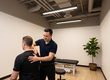

The first time vertigo hits, most people think they are having a stroke. The room spins, the floor tilts, sometimes for less than a minute, sometimes for hours. After it passes, you feel exhausted and afraid to turn your head. For the majority of people who experience this, the cause is not dangerous — it is mechanical, treatable, and in many cases improves with proper assessment and treatment. At Artemis Wellness Clinic, our physiotherapist is trained in vestibular rehabilitation, including the Epley and Semont maneuvers for benign paroxysmal positional vertigo (BPPV), and our broader team treats the cervical and post-concussion patterns that often co-exist. We are located at 5911 No. 3 Road #130, two minutes from Brighouse SkyTrain Station, with direct billing to ICBC and most major extended health plans. Book at Jane App or call 604-242-2233.
Vertigo, Dizziness, and Imbalance — Are They the Same Thing?
These three terms are often used interchangeably, but clinically they describe different sensations and they point to different underlying causes:
- Vertigo is the false sensation of motion — usually spinning, sometimes tilting or rocking — even when you are still. It is the symptom most strongly linked to inner-ear (vestibular) problems.
- Dizziness is a broader term that can include lightheadedness, near-fainting, or visual disorientation. Causes range from blood pressure changes to anxiety to medications.
- Imbalance is feeling unsteady on your feet or veering when walking, typically without spinning. Common in older adults and after head or neck injury.
A good vestibular assessment teases these apart. The treatment approach for true vertigo (especially BPPV) is very different from the approach for cervicogenic dizziness or post-concussion symptoms.
What Is BPPV?
Benign paroxysmal positional vertigo is the single most common cause of vertigo in adults. The word salad simplifies to:
- Benign — not life-threatening
- Paroxysmal — comes in short bursts, usually under a minute
- Positional — triggered by specific head positions (rolling over in bed, looking up, bending forward)
- Vertigo — the spinning sensation
BPPV happens when small calcium-carbonate crystals (otoconia) inside one of the inner-ear’s semicircular canals come loose and shift into a position where they trigger the vestibular system to send false motion signals to the brain. The classic trigger is rolling over in bed and feeling the room spin for 20–40 seconds. Symptoms often appear suddenly, with no warning, and patients often describe it as “the worst spinning I’ve ever felt.”
The good news: BPPV responds to a series of specific head and body movements (the Epley maneuver, the Semont maneuver, and others) that physically reposition the displaced crystals back into the part of the inner ear where they belong. When the right canal is identified and the maneuver is done correctly, studies report that many patients improve after one or a few sessions. Individual results vary.
Other Common Causes of Vertigo and Dizziness
Not all dizziness is BPPV. Patterns we assess regularly at our Richmond clinic include:
- Cervicogenic dizziness — driven by upper cervical (neck) joint dysfunction. Often follows whiplash or prolonged poor posture. Read about whiplash treatment in Richmond for related care.
- Vestibular neuritis or labyrinthitis — inflammation of the vestibular nerve, often after a viral infection. Causes severe vertigo lasting days, gradually settling over weeks. Vestibular rehab may help the recovery.
- Vestibular migraine — overlaps with migraine headache patterns, with episodes of vertigo with or without headache.
- Post-concussion vestibular dysfunction — common after motor-vehicle accidents and sports impacts.
- Mal de débarquement syndrome — persistent rocking sensation, often after sea or air travel.
- Bilateral vestibular hypofunction — both inner ears under-functioning, causing imbalance and visual blurring with head movement.
Some causes of dizziness require medical work-up rather than physiotherapy — sudden severe vertigo with new neurological symptoms, hearing loss, or a single ongoing episode lasting more than 24 hours warrants a same-day medical assessment.
When to See a Vestibular Physiotherapist
Consider booking an assessment if you are experiencing any of the following:
- Brief spinning sensations triggered by rolling over in bed, looking up, or bending forward
- Recurring dizziness lasting more than two weeks with no clear cause
- Imbalance or unsteadiness after a motor-vehicle accident or head injury
- Persistent dizziness after a viral illness or ear infection has resolved
- Neck pain or stiffness alongside dizziness, particularly after whiplash
- Dizziness that limits driving, working, or daily activity
For ICBC patients with concussion or whiplash-related dizziness, vestibular rehabilitation is typically covered within your treatment plan.
How Vestibular Physiotherapy Works at Artemis
Our physiotherapist follows a structured assessment-and-treatment process for vertigo:
1. Detailed History and Screening
The character of your symptoms — whether they are spinning vs swaying, brief vs sustained, position-triggered vs constant — gives the diagnosis before any test. We screen for red flags that need medical referral and confirm whether physiotherapy is the right starting point.
2. Vestibular Testing
A standard vestibular assessment includes:
– Dix-Hallpike maneuver — to identify posterior-canal BPPV
– Roll test — to identify horizontal-canal BPPV
– Head impulse test — to assess vestibular nerve function
– Smooth-pursuit and saccade testing — to assess oculomotor control
– Cervical spine examination — to differentiate cervicogenic dizziness
3. Treatment
For BPPV: a canal-repositioning maneuver, most commonly the Epley for posterior-canal BPPV. The maneuver takes 5–10 minutes. Many patients feel their symptoms ease after the maneuver, and for some the symptoms clear over the next 24–48 hours; responses vary from person to person.
For cervicogenic dizziness: manual therapy to the upper cervical joints, soft-tissue release of the suboccipital region (often combined with registered massage therapy for deeper release), and graded exercises to retrain head-eye coordination.
For post-concussion or vestibular hypofunction: progressive vestibular-ocular reflex (VOR) exercises, gaze stabilization, balance retraining, and graded return to provocative activity.
4. Home Program
Most patients leave the first session with 1–3 specific exercises — often Brandt-Daroff exercises for residual BPPV, or simple gaze stabilization exercises for vestibular adaptation. Adherence to the home program is the strongest predictor of how quickly symptoms resolve.
Insurance and ICBC Coverage
Vestibular physiotherapy at Artemis is billed as physiotherapy, so it can usually be claimed under your plan’s physiotherapy benefits:
- ICBC — covered for motor-vehicle-accident-related dizziness, vertigo, or vestibular dysfunction when included in your treatment plan. We bill ICBC directly for your pre-approved treatments under your claim number. If part of a fee is not covered by ICBC (a user fee), we tell you before your treatment.
- Pacific Blue Cross, Sun Life, Manulife, Green Shield Canada, Canada Life — direct billed when your plan includes physiotherapy coverage; you pay only the part your plan does not cover (co-pay, deductible or amounts above your plan maximum).
If you are unsure whether your specific plan covers vestibular rehabilitation, our front-desk team can verify before your first appointment.
Recovery Timeline — What to Expect
The trajectory depends on the cause, and individual results vary:
- BPPV: often resolves in 1–3 sessions over 1–2 weeks. A single Epley maneuver is sometimes enough; recurrence rates vary, and a small percentage of patients need follow-up if a different canal becomes involved.
- Cervicogenic dizziness: typically improves over 4–8 weeks of combined manual therapy and exercise.
- Vestibular neuritis or labyrinthitis recovery: 4–12 weeks of progressive vestibular rehabilitation, with many patients returning to normal function.
- Post-concussion vestibular dysfunction: highly variable — 6 weeks to 6 months — and benefits from structured progression rather than rest alone.
- Vestibular migraine: usually requires combined medical management of migraine triggers plus vestibular rehab; 3–6 months for stable improvement.
Self-Care Between Sessions
What you do between visits is often the deciding factor in how quickly your symptoms settle:
- Move your head and eyes regularly. The instinct to hold your head still actually slows recovery in most non-BPPV cases. Vestibular adaptation requires controlled exposure to the movements that provoke mild symptoms.
- Sleep with your head slightly elevated for the first few nights after a successful Epley maneuver — this reduces the chance of crystals shifting back into the canal.
- Avoid sudden head extension (looking up to a high shelf, leaning back at the dentist) for 48 hours after BPPV treatment.
- Stay hydrated and eat regularly. Low blood sugar and dehydration are common amplifiers of vertigo and dizziness.
- Track triggers in a short symptom diary. Time of day, what you were doing, what positions provoke symptoms — this information shortens the diagnostic process at follow-up visits.
- Limit caffeine and alcohol during the active recovery phase, particularly if migraine is part of the picture.
- Build back to driving and exercise gradually. Most patients can resume normal activity within days to weeks; pushing too fast often produces a setback that costs more time than the gradual approach.
For post-concussion patients, a structured graded return-to-activity plan is now generally recommended over the older “rest until symptoms resolve” approach.
Frequently Asked Questions
Do I need a doctor’s referral to see a physiotherapist for vertigo?
No. Physiotherapy in BC is direct-access — you can book without a referral. If we identify red flags during assessment, we will refer you to your GP or to the appropriate specialist before continuing physiotherapy.
Do you direct bill ICBC for vestibular treatment?
Yes. We bill ICBC directly for your pre-approved treatments under your claim number. If part of a fee is not covered by ICBC (a user fee), we tell you before your treatment. Vestibular rehabilitation is recognized within standard ICBC physiotherapy treatment plans.
Is the Epley maneuver safe? Will it make me feel worse?
The Epley maneuver is safe when performed by a trained physiotherapist after proper assessment. You will feel the same spinning briefly during the maneuver — that is expected and confirms the canal involvement. Many patients feel better after the session, sometimes with mild residual unsteadiness for about 24 hours; responses vary from person to person.
How many sessions will I need?
For uncomplicated BPPV, 1–3 sessions over 1–2 weeks is typical. For cervicogenic dizziness or vestibular hypofunction, 6–12 sessions over 6–12 weeks is more common.
Can I drive after a vestibular treatment session?
For BPPV maneuvers, we usually recommend not driving immediately afterward — bring a friend or take SkyTrain. For follow-up vestibular exercise sessions, driving is typically fine.
Will neck massage help my dizziness?
If your dizziness has a cervical component (and many cases do, especially after whiplash), then yes — massage to the suboccipital region and upper cervical fascia can be a meaningful part of the care plan. We often combine RMT and physiotherapy for cervicogenic dizziness.
What about my migraines — are they connected to my vertigo?
Often yes. Vestibular migraine is increasingly recognized and frequently overlaps with chronic migraine headaches. Coordinated care between physiotherapy, medical migraine management and, where appropriate, acupuncture is often helpful.
Do you have evening or weekend appointments?
Yes. Real-time availability shows in our Jane App booking page.
Book Vertigo and Vestibular Treatment in Richmond
Artemis Wellness Clinic
5911 No. 3 Road #130, Richmond, BC V6X 0K9
Two minutes from Brighouse SkyTrain Station, directly across from Richmond Centre
Phone: 604-242-2233
Online booking: artemis.janeapp.com
ICBC, Pacific Blue Cross, Sun Life, Manulife, Green Shield Canada, and Canada Life direct billing available. Evening and weekend appointments included.