The Rain Starts, You Move Less, and Everything Stiffens Up: Staying Mobile Through a Vancouver Autumn
I’m Dave Tam, RMT, a Registered Massage Therapist and the Clinic Director at Artemis Wellness Clinic in Richmond. Every autumn, the same patient walks through our door — different name, same story. The lower back has started to nag. The neck is tight by mid-afternoon. Nothing happened: no fall, no accident, no heavy lift gone wrong.
When I ask what changed, the honest answer is usually the weather.
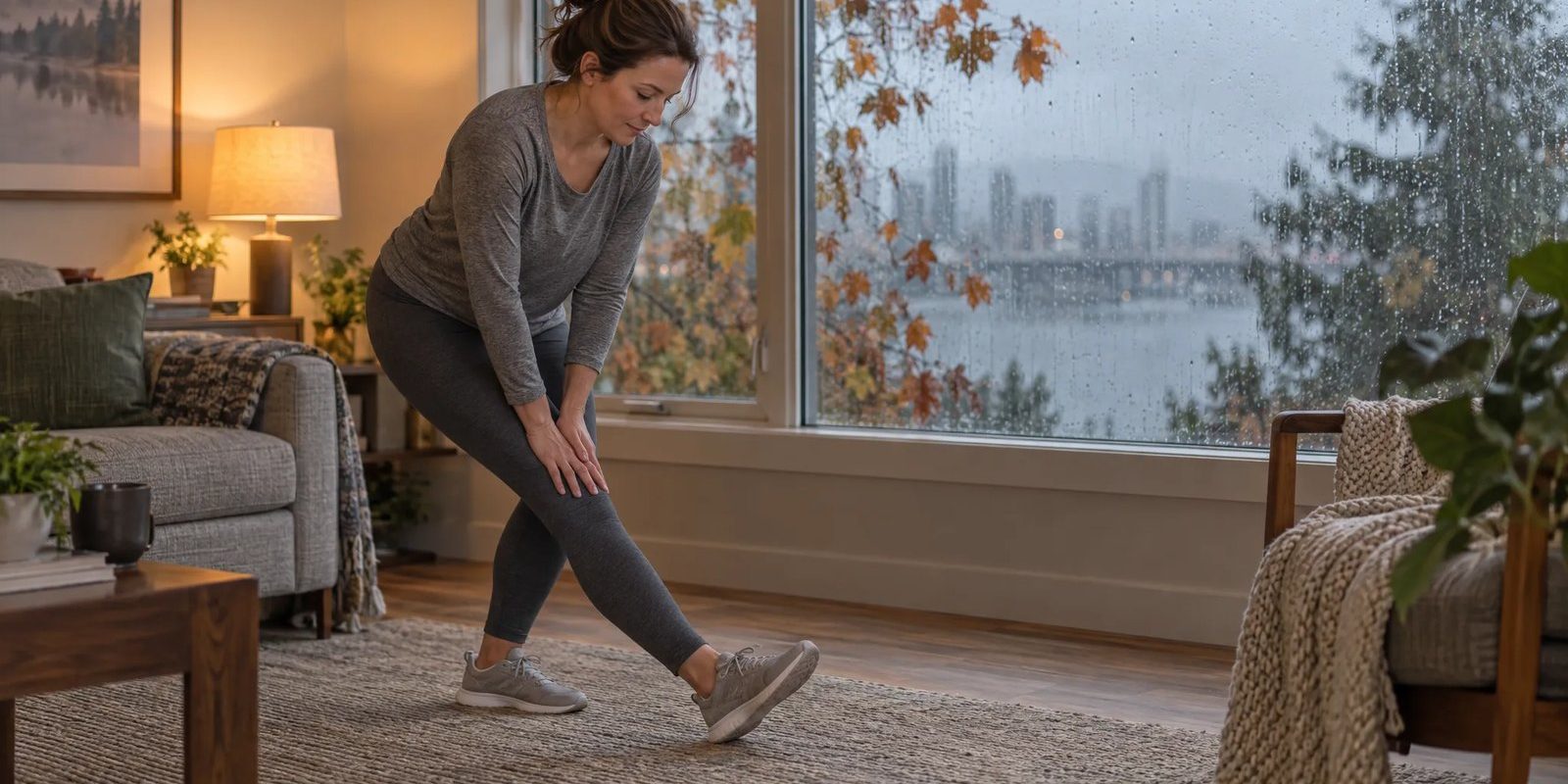
When the rain and the dark arrive in Metro Vancouver, the evening walk stops. The rides along the dyke stop. Weekend sport shrinks or disappears. Sitting goes up and stays up for months. Two or three weeks in, bodies feel stiffer, weaker and sorer — and the ache seems to arrive out of nowhere.
Why does everything ache once the rain sets in?
Because muscles, tendons and joints are built around what you ask of them, and in autumn we quietly ask for much less. Here is the loop in plain language. You move less. Within a couple of weeks, muscles lose a little strength and tissues lose some of their easy range. So movement starts to feel worse — the first ten minutes of a walk ache, the stairs announce themselves. Because it feels worse, you move even less. Round it goes. That is deconditioning, and each lap makes the next lap easier to take.
Damp, cold air gets the blame, and cold does make tissue feel less pliable. But in my experience behaviour matters more than the barometer: it’s dark by late afternoon, it’s raining, and the walk did not happen. That is encouraging — behaviour is something you can change this week.
What kind of movement holds up in a wet Vancouver autumn?
The kind you will still be doing in February. Ambition is rarely the problem here — attrition is. Four things tend to survive.
Move indoors on purpose. Mall walking is genuinely useful: shopping centres are dry, flat, lit and warm. Pools suit sore joints, because the water carries some of your weight. Your own stairwell is a free cardio machine. And fifteen minutes of home strength — sit-to-stands from a dining chair, step-ups, carries with grocery bags — does more for autumn stiffness than people expect.
Go shorter and more often. Three ten-minute walks beat one heroic hour you keep postponing. Frequency keeps tissue used to moving; duration is a bonus.
Walk in the rain with the right gear. A real shell with a hood, shoes with grip, and dry socks waiting at work turn a miserable walk into an ordinary one.
Keep one outdoor habit alive. Saturday morning on the West Dyke Trail, or walking to the SkyTrain instead of driving. Holding one habit through the dark months is far easier than rebuilding everything in March.
What can I do at my desk when I can’t get outside?
Take a micro-break every 30 to 45 minutes. Mine has three parts and takes under a minute:
- Shoulders up to your ears, hold five seconds, drop — three times.
- Five gentle chin tucks (draw the chin straight back, not down).
- Twenty seconds looking at something far away — out a window, down a hallway.
Set a repeating timer; you will not remember on your own. If the neck and shoulders complain loudest, our guide to acupressure points for neck and shoulder tension adds spots you can press at your desk.
Do I really need to warm up longer when it’s cold?
Yes, and most people cut it short in the season it matters. Cold muscle is less elastic and blood flow takes longer to rise, so five easy minutes in July should be closer to ten in November. Walk before you jog.
The other half is easing back in rather than jumping to summer volume. Play badminton all summer, stop for a month, then book a two-hour court, and the soreness afterward is predictable. Restart at roughly half your old volume and build back over four to six weeks.
How do tension and autumn sleep feed each other?
I asked Mandy Tam, R.Ac, our acupuncturist, to take this one, because she sees the sleep side of autumn before the rest of us do.
Patients rarely book for sleep. They book for a tight neck, then mention they have been waking at 3 a.m. since the clocks changed. The two travel together: less daylight and less activity make sleep shallower, shallow sleep leaves muscles guarded and sore, and soreness makes it harder to settle at night. It is Dave’s loop on a different track.
Acupuncture may help with both ends of it — easing muscular tension directly, and giving many patients a stretch of real rest during treatment. Results vary, and I would rather say so than promise you a good night. I also ask about daylight, caffeine after two, and screens in bed — those are often doing more than anything I can needle. Acupuncture complements your medical care, does not replace it — if sleep has been broken for months, raise it with your family physician.
What helps the stiffness that builds from sitting?
Ethan Choi, R.Ac, R.TCMP, DOMP, works with the stiffness that accumulates rather than the kind that arrives suddenly.
Autumn stiffness is usually not one angry joint. It is a whole region that has stopped sharing the work — a mid-back that no longer rotates, hips folded at ninety degrees all day, a rib cage that barely moves when you breathe. Then you reach into the back seat for groceries and something complains.
Osteopathic manual therapy works through those regions gently, restoring motion where it has been lost so load spreads out again. Treatment may help you move more comfortably — and that comfort lasts longer when you use the motion we restored.
Where do physiotherapy and kinesiology fit in?
If autumn aches have turned into an injury that limits what you can do, physiotherapy is the place to start: assessment, a clear picture of the problem, and a loading plan.
Kinesiology is built for the exact problem this article describes. A kinesiologist’s job is the indoor activity plan — what you will actually do on a wet Tuesday in your apartment or at a Richmond community centre, at a volume that fits you now. Our conditions we treat page shows what we assess across disciplines.
When should I see a physician instead?
Most autumn stiffness is the deconditioning loop. Some is not.
See a physician for pain that wakes you at night; numbness, tingling or weakness down an arm or leg; pain following a fall or accident; a hot or swollen joint; chest pain or breathlessness on exertion; or any new severe symptom. You can also reach a registered nurse at any hour through HealthLink BC at 811. This article is general information, not medical advice, and it does not replace an assessment by your own health care provider.
Does treatment actually help, or do I just keep coming back?
Hands-on treatment can be genuinely useful in autumn. Registered massage therapy may help ease the guarding that builds over weeks of sitting, and many patients find they leave moving more freely and sleeping better that night. Comfort is what makes movement possible again.
But what holds the gains is the movement between visits. A treatment that makes walking comfortable is worth what it earns you, and what it earns you is a walk. Go back to nine hours in a chair and the stiffness returns on schedule. Results vary, and the patients who do well through winter are almost always the ones who kept moving between visits. That is more honest than selling you more appointments.
Visiting our Richmond clinic
Artemis Wellness Clinic is at 5911 No. 3 Road #130, Richmond BC V6X 0K9 — three minutes on foot from Brighouse SkyTrain. Massage therapy, acupuncture and TCM, physiotherapy, chiropractic, kinesiology and osteopathic manual therapy are under one roof, so you can start with one and add another. Book online at artemis.janeapp.com or call 604-242-2233. We direct bill many extended health plans; your insurer sets the rules and we cannot promise what will be reimbursed.
Frequently asked questions about staying active in autumn
Why do my joints feel stiff in the rainy season?
Partly cold tissue, which is less pliable, but mostly reduced activity. Within two to three weeks of moving less, muscles weaken slightly and joints lose easy range. Stiff joints in rainy season weather are usually that, not damage.
How much indoor exercise is enough through a Vancouver winter?
Aim for most days rather than perfect days. Three short walks, a stairwell session, or fifteen minutes of home strength all count — frequency protects range of motion better than the occasional long workout.
Is it safe to walk outdoors in the rain?
For most healthy adults, yes — with a waterproof shell, footwear with grip, and dry clothes to change into. Take care on wet leaves and painted crosswalk lines.
Should I stretch or strengthen for autumn stiffness?
Both, but with fifteen minutes, choose strength over static stretching. Stretching may help you feel looser briefly; loading the muscle is what makes the range stick.
Can massage therapy help with seasonal aches?
It may help ease muscular tension and make moving more comfortable, which many patients find useful when restarting activity. It supports movement rather than replacing it.
Do I need a referral to book in Richmond?
No referral is needed to see a Registered Massage Therapist, acupuncturist, physiotherapist or kinesiologist in BC. Some extended health plans ask for one before reimbursing, so check your policy first.