Autumn in Vancouver: How the Change of Season Shows Up in Your Body
By Mandy Tam, R.Ac — Registered Acupuncturist and co-founder, Artemis Wellness Clinic, Richmond BC
Around the middle of September, my treatment room fills with a version of the same conversation. Someone sits down, shrugs, and says, “I don’t know. I just feel off.” Sleep has gone patchy, energy sags in the afternoon, an old shoulder ache speaks up again. The throat feels dry, the skin tight, everything an effort.
If that sounds familiar, you are in good company. I watch this shift arrive in Metro Vancouver every year, as reliably as the rain. Some of it has a plain explanation; some belongs to a much older way of describing the seasons — the tradition I trained in and practise within. I want to give you both, honestly, and then some things you can do.
Why does autumn feel different here?
The light goes first: shorter evenings from mid-September, until many of us leave and come home in the dark. Then the rain settles in, cool and damp for months. Walks and weekend hikes fall away, heating comes on, and we sit more — not by decision, but one rainy evening at a time.
What does traditional Chinese medicine say about autumn?
In traditional Chinese medicine each season has its own character, and autumn is associated with dryness and with what the tradition calls the Lung system. In the classical texts that is not the organ on a radiologist’s scan but a broader category covering breathing, the skin, and a person’s energy as the year turns inward.
The advice that comes with it is practical and unglamorous:
- Go to bed earlier and rise with the light.
- Keep the neck, throat and shoulders covered in the wind.
- Let activity turn gentler and more inward — less sprinting, more walking.
- Favour warm food and warm drinks over cold ones.
This is a traditional framework — a lens that organizes centuries of observation, together with the seasonal habits handed down with it. The habits themselves are sensible and practical, and the lens gives patients language for something they had already noticed. I use it alongside your doctor’s view, never in place of it. More about acupuncture and TCM in Richmond BC.
What is actually happening in your body?
Less daylight shifts your body clock. Morning light is the main signal setting your sleep and wake timing. Wake in the dark, see little bright light all day, and that signal weakens, so sleep timing drifts. Mood tracks the light for many people too.
Indoor heating dries the air. Warm, recirculated air pulls moisture from your skin and airways — usually the real reason behind the dry throat and morning cough that arrive with the furnace.
Activity drops. Fewer steps and more sitting add up fast; muscles that moved comfortably in August get far less input by November.
Cold muscles are stiffer. Tissue is less compliant when cool, so the stretch that felt fine in summer feels short and guarded on a damp morning.
Why does my body stiffen up as the weather turns?
Dave Tam, RMT, our Clinic Director, sees the result on the table every year.
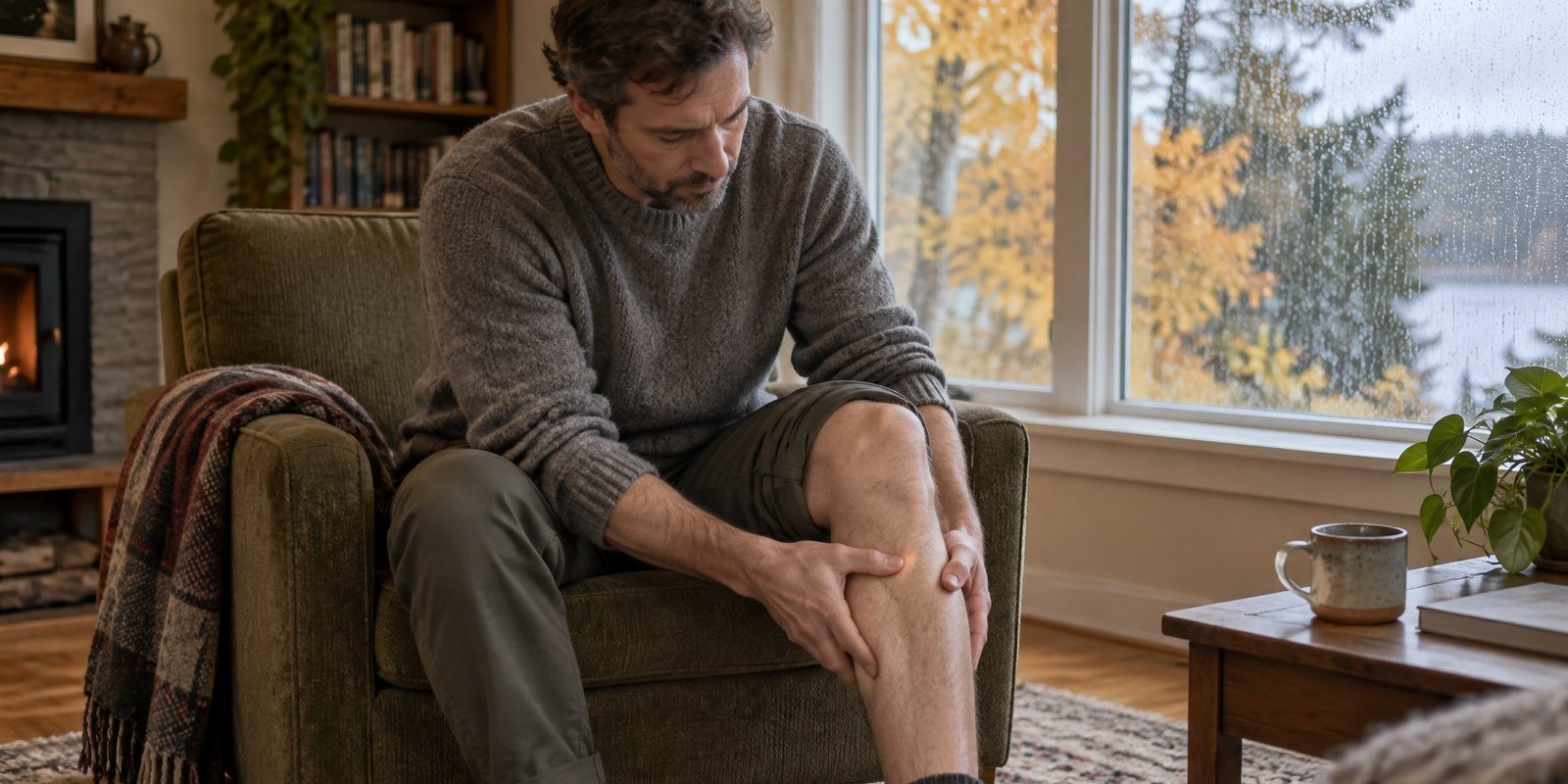
“The pattern is consistent,” he says. “In summer, people move through a full range without thinking about it. In autumn that variety disappears, and tissue adapts to what you ask of it. Then we hold ourselves differently in the cold: shoulders lifted, head forward, jaw tight against the wind.
“Hands-on work warms the tissue, settles the guarding, and gives back range you can use. Many patients find a treatment makes a stiff area easier to move for a while; what holds the change is what you do between appointments. Results vary, and I would rather say so up front.”
More on registered massage therapy in Richmond.
Can osteopathic manual therapy help with autumn stiffness?
Ethan Choi, R.Ac, R.TCMP, DOMP, meets the same complaints from another angle.
“I look at how the whole body is organizing itself,” Ethan says. “Someone arrives in November with a stiff mid-back, but often the ribs are moving less because breathing has gone shallow in the cold, and the hips are tighter because the long walks stopped. Osteopathic manual practice works with those relationships using gentle hands-on techniques. It may help with stiffness and with how freely you move, especially when people feel creaky rather than injured. Results vary, and I say so.”
Ethan also holds regulated credentials as a Registered Acupuncturist and Registered TCM Practitioner with CHCPBC. Here is a longer explanation of what osteopathy is, and is not.
What habits actually help through a Vancouver autumn?
Hold your sleep and wake times steady. As daylight shortens, choose a wake time and keep it, weekends included.
Get outside in daylight. A short walk at lunch on a grey day gives far more light than any indoor room. Many patients find this the change that helps most.
Cover your neck and shoulders in the wind. A scarf keeps you from hiking your shoulders against a cold gust, and that guarding is a real source of neck ache.
Answer the dryness directly. Warm fluids through the day, and moisture back in the air — a humidifier, or a lower thermostat setting — often do more for a dry throat than anything I offer with needles.
Keep moving, in smaller doses. Ten minutes twice a day beats a plan abandoned in week two.
Our clinic offers acupuncture only and does not prescribe Chinese herbal medicine. Soups, congee and root vegetables are ordinary everyday foods, not prescriptions.
Which acupressure points can I use at home?
At-home acupressure is a comfort habit, not a treatment. Press firmly enough to feel a dull ache, never sharp pain, for thirty seconds to a minute.
LI4 (Hegu). Back of the hand, in the muscle between the thumb and index finger. Find the second metacarpal — the long bone running from the web of your hand toward your index finger knuckle — and press gently against its thumb side at about the midpoint. LI4 is traditionally avoided during pregnancy. If you are pregnant, or think you might be, skip this point.
GB20 (Fengchi). The two hollows just below the base of the skull, between the upper ends of the sternocleidomastoid and the trapezius, roughly level with your earlobes. Rest your thumbs there and let your head weigh into them.
ST36 (Zusanli). Four finger-widths below the lower edge of the kneecap and one finger-width to the outside of the shin bone’s crest, in the muscle rather than on bone. Measure with your own fingers.
More in our acupressure self-care guide, plus a separate piece on acupressure points for sleep.
What if it is more than a seasonal slump?
A slower, heavier feeling in autumn is common. Low mood that persists for weeks — where things you normally enjoy stop appealing, where an ordinary day is genuinely hard — deserves a conversation with your family doctor. You do not have to wait for spring.
If you are in crisis, or worried about someone who is, Canada’s 9-8-8 Suicide Crisis Helpline is available by call or text, any hour. There is no wrong reason to reach out.
See a physician if you have: persistent low mood or loss of interest lasting weeks; unexplained weight loss; a cough lasting more than three weeks; fever; breathlessness; or any new, severe or unexplained symptom. For a mental health crisis, call or text 9-8-8, Canada’s Suicide Crisis Helpline, at any hour. For non-urgent health questions, call HealthLink BC at 811. This article is general information, not medical advice.
How does a multidisciplinary clinic approach the season?
Autumn complaints rarely belong to one discipline. Broken sleep, low energy and a stiff neck often arrive together: acupuncture may help with part of that, while hands-on work is often the better answer for the neck. We also offer physiotherapy and kinesiology, and either may be the sensible place to start. Everything we offer complements your medical care, does not replace it.
In my experience, the people who move through a Vancouver autumn most comfortably protect their sleep, get outside while it is light, and keep moving in small ways.
Artemis Wellness Clinic
5911 No. 3 Road #130, Richmond BC V6X 0K9 — about three minutes on foot from Brighouse SkyTrain Station.
Phone: 604-242-2233
Online booking: artemis.janeapp.com
I see patients in English, Mandarin and Cantonese; here is more about my background and approach. If you are unsure who to start with, call and describe what is going on.
Frequently Asked Questions About Autumn and Your Body
Does acupuncture keep me from getting sick in the autumn?
No. I would not make that claim, and I would be cautious about anyone who does. For vaccination and infection questions, ask your family doctor or pharmacist.
How should I think about the TCM view of autumn?
It is a traditional system of description rather than a modern physiological model, and the seasonal habits it recommends — earlier nights, staying warm, gentler activity — stand on their own merits.
Do you prescribe herbs for the season?
No. We offer acupuncture only. If you take herbal products from elsewhere, mention them to your doctor and pharmacist, since some interact with medication.
How many treatments would I need?
There is no standard answer. It depends on what you arrive with, how long it has been going on, and what you can change at home. Results vary, so I would rather discuss it in person.
Can I use these acupressure points if I am pregnant?
Skip LI4, traditionally avoided in pregnancy. Check with your maternity care provider first, and tell every practitioner you see.
My main problem is sleep. Where should I start?
Begin with a consistent wake time and morning daylight. If poor sleep has lasted more than a few weeks, raise it with your family doctor; there are well-established approaches for insomnia.