
Your First Physiotherapy Appointment in Richmond: What to Expect, What to Wear and What to Bring
Last reviewed: October 2026.
The short answer: what happens at a first physiotherapy appointment
At a first physiotherapy appointment, your physiotherapist asks how the problem started and what you want to get back to, then checks how you move: range of motion, strength, balance and the movements that bother you. Most people leave with an explanation of what was found and a starting plan, often with hands-on treatment and home exercises.
At Artemis, you will see Colin, our Registered Physiotherapist, licensed with the College of Health and Care Professionals of BC (CHCPBC); anyone can check a licence on the CHCPBC public registry. No doctor’s referral is needed in BC. See physiotherapy in Richmond.
Choosing 30, 45 or 60 minutes
At Artemis you can book physiotherapy for 30, 45 or 60 minutes, and each length can be a first (initial) visit or a follow-up. A longer first visit leaves more time to talk and assess, which may help if you have several sore areas or a long history. Our front desk can help you choose.
| Length | Price on Jane (as of October 2026) |
|---|---|
| 30 minutes | $110 |
| 45 minutes | $145 |
| 60 minutes | $170 |
Direct billing: see the FAQ below, our physiotherapy cost guide and direct billing page.
What to bring to your first physiotherapy appointment
Bring photo ID, your extended health plan details and, if you were hurt in a crash, your ICBC claim number and BC Personal Health Number (PHN). Also bring any imaging or surgery reports, a list of your medications, and the shoes, brace or support you use for the sore area.
- Extended health details. Some plans still ask for a doctor’s referral before they reimburse, so check your booklet; in April 2024 insurers said they were reducing this requirement (CLHIA). More in our referral and coverage guide.
- ICBC claim number and PHN. As of October 2026, in the first 12 weeks after a crash ICBC pre-approves up to 25 physiotherapy treatments (the first assessment counts as one), with no doctor’s referral and no ICBC approval needed (ICBC). See our ICBC physiotherapy guide.
- Imaging or surgery reports. Most people can start without a scan; BC physiotherapists currently cannot order diagnostic imaging (Physiotherapy Association of BC).
- Medication list, shoes and supports, such as running shoes or a knee brace.
What to wear to physiotherapy, by body area
Wear comfortable clothes that let your physiotherapist see and gently move the sore area: shorts for knee, hip or ankle problems, loose athletic wear for back pain, and a tank top or sports bra for neck or shoulder pain. Bring your usual shoes if your leg, foot or back is the problem.
| Sore area | What to wear |
|---|---|
| Knee, hip, ankle or foot | Shorts, plus your usual shoes |
| Lower or mid back | Loose, stretchy athletic wear |
| Neck, shoulder or upper back | A tank top or sports bra |
| Elbow, wrist or hand | Short sleeves |
Related reading: knee pain, lower back pain and neck pain.
What happens during the visit, step by step
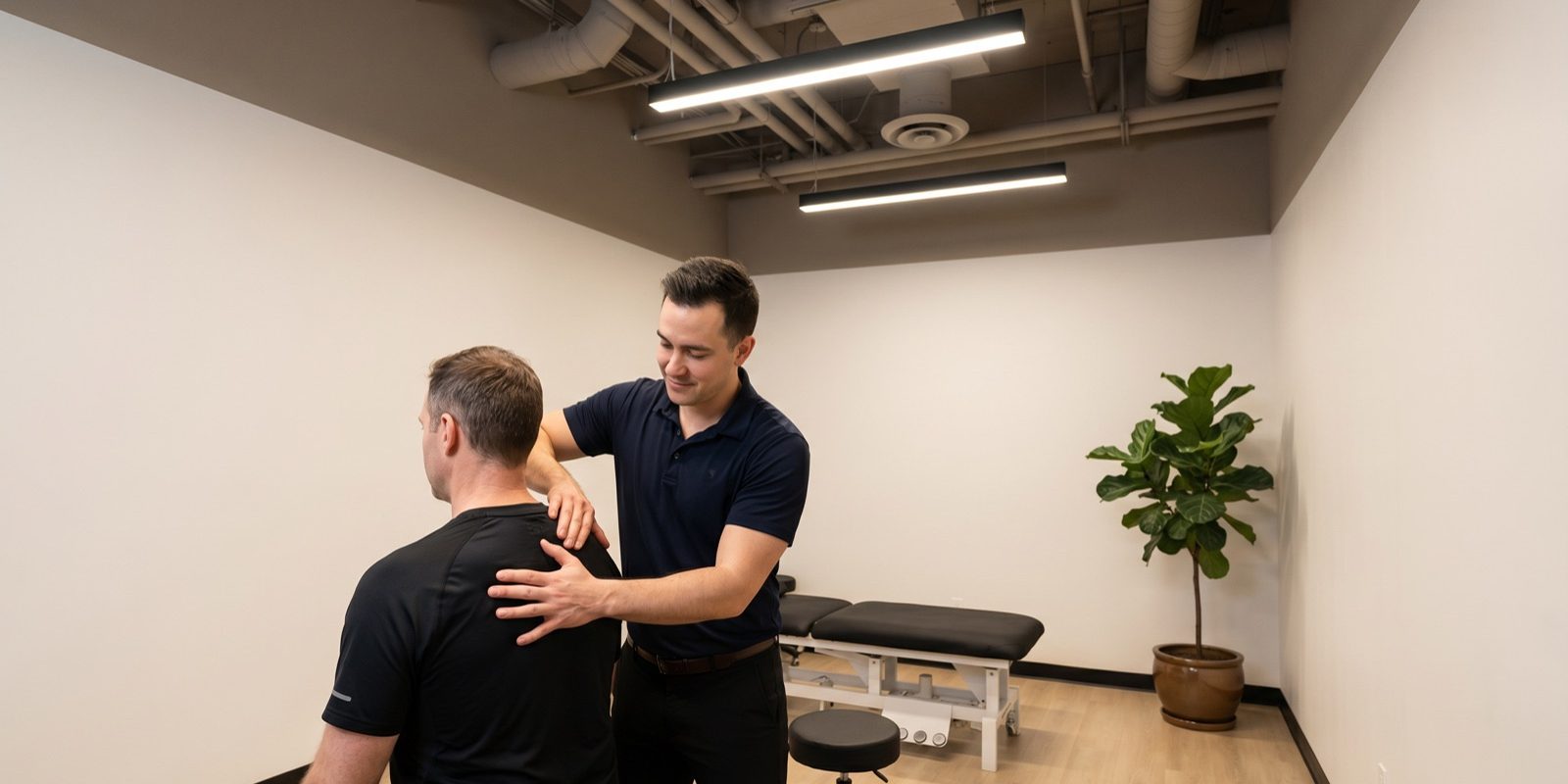
A first visit usually has three parts: a conversation about your symptoms, history and goals; a movement assessment to see which movements are limited or painful; and a plan in plain language, which may start right away with hands-on treatment and an exercise or two.
Step 1: The conversation
Expect questions about how the problem started, what makes it better or worse, how it affects daily life, your health history and your goals.
Step 2: The movement assessment
Your physiotherapist checks range of motion, strength and balance and asks you to try movements that bother you, such as climbing a step or reaching overhead. Some tests may briefly bring on your familiar pain, which helps show what is involved (NHS Tayside). Say if anything is too much.
Step 3: Your plan (hands-on treatment, exercise and education)
In the words of his profile, Colin’s approach is “centered around understanding the factors contributing to each individual’s symptoms and developing an individualized treatment plan.” He combines hands-on treatment, exercise and education, aims to explain your injury in a simple, approachable way, and works with you toward the activities that matter to you (profile).
After your visit: soreness, home exercises and how often to come back
Some soreness can happen after a first visit, especially after movement tests or new exercises, and it often eases in a day or two. Do your home exercises as shown and tell your physiotherapist how you felt. There is no fixed number of visits: your progress is reassessed as you go, and the plan changes with it. Individual results vary.
Sore or tired muscles after exercises are common (Kingston and Richmond NHS). If pain is sharp, keeps getting worse or does not settle, call the clinic; for the warning signs below, see a doctor.
When to see a doctor first
Some symptoms need a doctor or emergency care before physiotherapy. Get medical help first after a serious fall or crash, or if you have numbness in the groin or saddle area, bladder or bowel changes, worsening weakness, a fever with your pain, or you cannot bear weight.
- Call 9-1-1 if, after a serious fall or crash, you have severe neck or back pain, cannot move part of your body, or have weakness, tingling or numbness in your arms or legs; also for back pain with chest pain (HealthLinkBC).
- Get immediate medical care for numbness in the groin or saddle area, or new bladder or bowel problems (HealthLinkBC).
- Call your doctor now for new or worsening leg weakness or numbness, or back pain with a fever (HealthLinkBC).
- See a doctor or walk-in clinic, or call 8-1-1, if you cannot bear weight on an injured ankle, even after rest, or it feels very unstable (Emergency Care BC).
Booking, hours, parking and getting here
Book online at artemis.janeapp.com or call 604-242-2233. Artemis Wellness Clinic is at 5911 No. 3 Rd #130, Richmond, BC V6X 0K9, near Brighouse SkyTrain station on the Canada Line. The clinic is open 7 days a week, 8 am – 8 pm, and Colin’s available times are shown on Jane.
- Walk-ins are accepted; booking ahead on Jane is the easiest way to get a time with Colin.
- Parking: free parking stalls 47 and 48 behind the unit (enter from Ackroyd Road or Firbridge Way; the parkade is closed on Saturdays and Sundays), paid street parking on the side street, and free 3-hour parking at the PriceSmart plaza across the street on Ackroyd Road. Details: contact page.
- Language: our team serves patients in English, and Colin also speaks Chinese. Family members or friends are welcome to come along to help.
Frequently Asked Questions
Do I need a doctor’s referral for my first physiotherapy appointment in BC?
No. In BC you can book a physiotherapist directly. Some extended health plans still ask for a referral before they reimburse, so check your plan.
How long is a first physiotherapy appointment at Artemis: 30, 45 or 60 minutes?
You choose: 30 minutes ($110), 45 minutes ($145) or 60 minutes ($170) on Jane, as of October 2026. Each can be a first visit or a follow-up.
What should I wear to physiotherapy?
Shorts for knee, hip or ankle problems, loose athletic wear for back pain, and a tank top or sports bra for neck or shoulder pain.
Does physiotherapy hurt, and is it normal to be sore afterwards?
Some tests may briefly bring on your familiar pain, and you can say if anything is too much. Soreness afterwards can happen and often eases in a day or two; tell your physiotherapist how you felt.
How many physiotherapy sessions will I need, and how often?
There is no fixed number. Your progress is reassessed as you go, and how often you come back depends on your goals and how your body responds. Individual results vary.
Can I bring a family member or friend to my appointment?
Yes, a family member or friend is welcome to come along to help. Our team serves patients in English, and Colin also speaks Chinese.
Can I use my extended health plan or ICBC claim for physiotherapy?
We can bill many insurers directly; you pay only the part your plan does not cover (co-pay, deductible or amounts above your plan maximum). We bill ICBC directly for your pre-approved treatments. If part of a fee is not covered by ICBC (a user fee), we tell you before your treatment.
Sources
- ICBC: Treatment in your first 12 weeks
- ICBC: Medical care and treatment
- CLHIA news release, April 2024
- Physiotherapy Association of BC: briefing note, February 2026
- HealthLinkBC: Low back pain
- HealthLinkBC: Cauda equina syndrome
- Emergency Care BC: Ankle sprain
- NHS Tayside: First physiotherapy appointment
- Kingston and Richmond NHS: Physio, after your appointment
- CHCPBC public registry
- ICBC: Physiotherapy program guide (CL492, effective September 27, 2026)