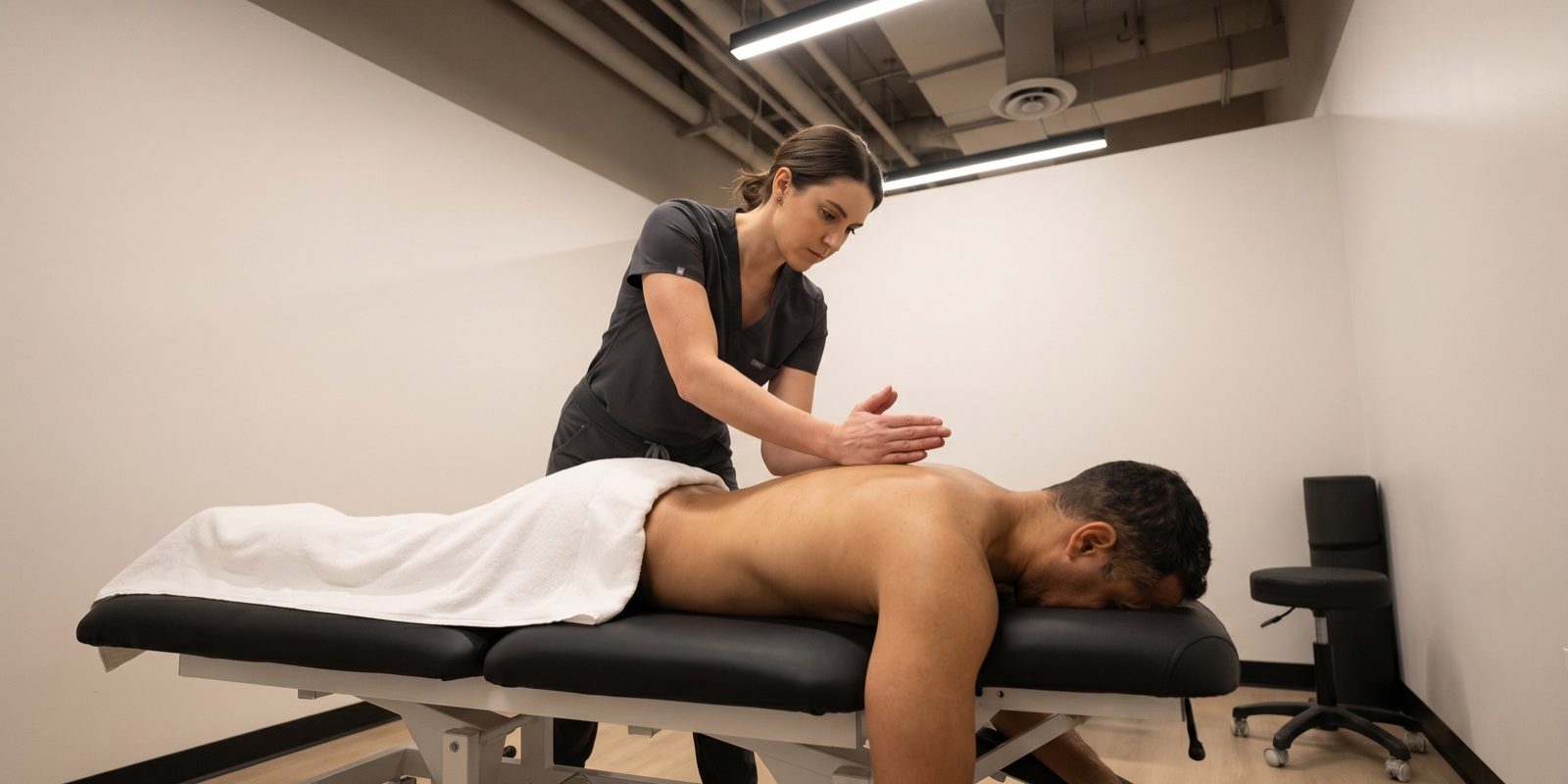
Lower back pain is one of the most common reasons people walk into our clinic at 5911 No. 3 Road #130. Whether your back pain came on suddenly when you bent to pick up a box, gradually after months at a desk, or following a car accident, the right treatment plan starts with a proper assessment — not a generic stretching handout. Artemis Wellness Clinic offers physiotherapy, registered massage therapy, chiropractic, acupuncture, and kinesiology under one roof, two minutes from Brighouse SkyTrain Station, and your first visit includes a full musculoskeletal assessment to help identify what is driving your pain. Book at Jane App or call 604-242-2233.
What Causes Lower Back Pain?
The lower back is a small region with high mechanical demand. It carries body weight, transfers force between hips and trunk, and absorbs shock from walking, sitting, and lifting. When pain develops, it is usually one of a few patterns:
Mechanical low-back pain (the majority of cases). The pain is reproduced by specific movements — bending forward, sitting too long, twisting — and eased by other positions. Causes include facet joint irritation, muscular guarding, sacroiliac joint dysfunction, or general deconditioning. Many cases improve gradually over four to eight weeks of structured treatment; individual results vary.
Disc-related pain. A bulging or herniated disc can produce localized back pain or pain that radiates into the buttock, thigh, or below the knee. When pain refers below the knee, sciatica is often involved.
Inflammatory back pain. Less common, but characterized by morning stiffness lasting more than 30 minutes, improvement with movement, and onset before age 40. Conditions like ankylosing spondylitis fall in this category and require medical co-management.
Pain following a motor vehicle accident. Whiplash-type injuries often produce low-back pain alongside neck symptoms. An approved ICBC claim can cover your pre-approved treatments.
Post-surgical back pain. After spinal surgery, structured rehabilitation can help patients safely regain strength and movement.
When to See a Professional Versus Wait It Out
Most short-lived low-back pain (a few days, no leg symptoms, no progressive weakness) can be managed at home with light activity, walking, and avoiding bedrest. Book a professional assessment if any of the following apply:
- Pain has not improved in two weeks
- Pain radiates into one or both legs
- You feel weakness, pins and needles, or numbness in a leg
- The pain woke you from sleep
- It is recurring (this is your third or fourth episode)
- You have a history of cancer, recent unexplained weight loss, or fever with the back pain
- You were in a car accident, even if the pain was mild at first
The earlier you start structured treatment, the shorter the recovery window tends to be — particularly important if you have an active job, young children at home, or an upcoming season of sport.
Our Approach to Lower Back Pain at Artemis
Lower back pain rarely has a single cause and rarely responds to a single treatment. Our model is multidisciplinary — meaning the assessment determines which combination of disciplines suits your specific pattern, and we deliver them under one shared treatment plan.
Step 1 — Detailed assessment (45–60 minutes). Your physiotherapist or chiropractor performs a movement assessment, neurological screen, and orthopaedic testing. The goal is to identify the structures driving your pain and the movement patterns reinforcing it.
Step 2 — Pain control (first 1–2 weeks). Manual therapy, soft-tissue work, acupuncture, and movement modification to bring acute pain down into a manageable range.
Step 3 — Movement restoration (weeks 2–4). Targeted mobility and motor-control exercises, plus continued manual therapy.
Step 4 — Strength and conditioning (weeks 4–8). Progressive loading of the trunk, hips, and posterior chain — the cornerstone of preventing recurrence. This phase often shifts to kinesiology-led sessions.
Step 5 — Return to activity. Sport, lifting, or work-specific drills depending on what you need to return to.
Evidence-Based Modalities We Use
Physiotherapy. Manual therapy, joint mobilization, and exercise prescription. Our physiotherapy services page covers the full scope of how we use physiotherapy for low-back patients.
Registered Massage Therapy. Deep-tissue and trigger-point work for muscular components — paraspinals, glutes, quadratus lumborum, hip rotators. RMT can help ease the secondary muscle guarding that develops alongside primary back pathology. See our RMT services page for details.
Chiropractic care. Spinal mobilization and, where appropriate, gentle manipulation for facet joint dysfunction and movement asymmetries. Our chiropractic service page explains how we integrate chiropractic with physiotherapy and RMT.
Acupuncture. Acupuncture has been studied for chronic low-back pain. It is sometimes combined with electroacupuncture.
Kinesiology. Progressive loading and movement re-education — a key discipline for preventing recurrence after pain has resolved.
Insurance and ICBC Direct Billing
Lower back treatment at Artemis can be claimed through:
- ICBC for accident-related back pain (no-fault benefits)
- Pacific Blue Cross, Sun Life, Manulife, Green Shield Canada, Canada Life — extended health plans, direct billing where supported
- WorkSafeBC for work-related back injuries: with an accepted claim we bill WorkSafeBC directly for registered massage therapy (a doctor’s referral is needed) and acupuncture, and approved services are not charged to you
With direct billing, you pay only the part your plan does not cover (co-pay, deductible or amounts above your plan maximum). Where direct billing is not available, we provide insurance-ready receipts.
Realistic Recovery Timelines
A common question — how long until I am better? Honest answer: it depends on the cause and how soon you start.
- Acute mechanical back pain (no leg symptoms): typically 4–8 sessions over 4–6 weeks
- Disc-related pain with mild leg symptoms: 8–14 sessions over 8–12 weeks
- Recurrent or chronic back pain: 12–20 sessions over 3–4 months, with a clear maintenance phase
- Post-MVA back pain: Variable — typically aligned with the ICBC 12-week pre-approved window
We give you a realistic estimate at your first visit and adjust as we see your progress. Individual results vary.
Frequently Asked Questions
Should I see a physiotherapist, RMT, or chiropractor for back pain?
For most cases, the right answer is “all three in some combination, sequenced appropriately.” That is why we run as a multidisciplinary clinic. Your first assessment determines the right starting discipline and the right addition over time.
Do I need a doctor’s referral?
No. Physiotherapy, RMT, chiropractic, acupuncture, and kinesiology are all direct-access in BC. You can book without a physician referral.
Is back pain after a car accident covered by ICBC?
Yes. ICBC’s no-fault benefits can cover physiotherapy, RMT, chiropractic, acupuncture, and kinesiology for accident-related back pain. We bill ICBC directly for your pre-approved treatments. If part of a fee is not covered by ICBC (a user fee), we tell you before your treatment.
How many sessions until I notice a difference?
Some patients notice improvement within 2 to 4 sessions; mechanical back pain typically takes 4 to 8 sessions over 4–6 weeks. Individual results vary.
Will I get a home exercise program?
Yes. Every treatment plan includes between-session work — typically 5 to 15 minutes per day. Compliance with the home program is one of the biggest predictors of speed of recovery.
Do you offer same-day or weekend appointments?
Often yes. Live availability is on our Jane App booking page.
Should I get an MRI before starting treatment?
For most cases of back pain, no. Imaging is indicated for specific red flags (radiating leg weakness, suspected fracture, history of cancer). Otherwise, conservative treatment is the appropriate first step and imaging only adds value if the response to treatment is not what we expect.
What should I wear?
Loose-fitting clothing that allows the therapist to see and move the lumbar spine. Shorts work well; gym attire is fine. Gowns are available.
Book Your Lower Back Pain Assessment in Richmond
Artemis Wellness Clinic
5911 No. 3 Road #130, Richmond, BC V6X 0K9
Phone: 604-242-2233
Online booking: artemis.janeapp.com
Two minutes from Brighouse SkyTrain Station, directly across from Richmond Centre. Multidisciplinary back pain treatment under one roof. Direct billing for ICBC, WorkSafeBC, and many extended health plans. Evening and weekend appointments available.