
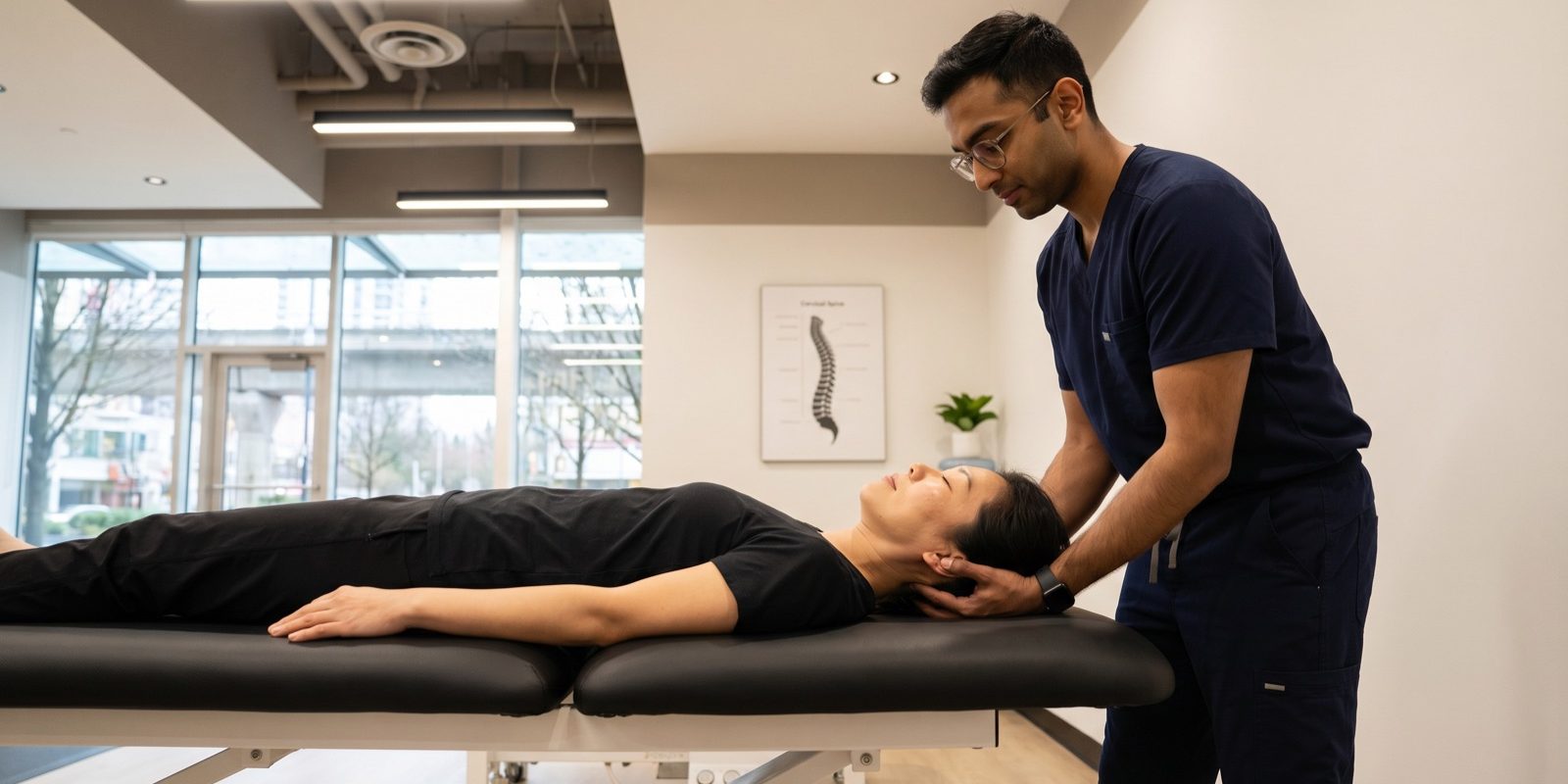
Neck pain is the second most common musculoskeletal complaint we see at Artemis Wellness Clinic — second only to low-back pain. Office workers, drivers, students, side sleepers, parents carrying small children, and people recovering from car accidents all walk through our doors with similar symptoms but very different underlying causes. Located at 5911 No. 3 Road #130 in central Richmond — two minutes from Brighouse SkyTrain Station — our multidisciplinary team identifies the specific drivers of your neck pain and builds a treatment plan around them. Book online at Jane App or call 604-242-2233.
What Causes Neck Pain?
The cervical spine is small but does a great deal of work — it supports the weight of the head (about 5 kg), allows wide ranges of movement in every direction, and houses critical nerves and blood vessels. Neck pain typically falls into one of these patterns:
Postural and screen-related neck pain. The most common pattern in office workers and students. The forward-head posture maintained for hours at a screen overloads the upper trapezius, levator scapulae, and suboccipital muscles. Over time, this produces persistent stiffness, occasional sharp pain on movement, and frequent headaches that start at the base of the skull.
Mechanical neck pain. Joint-driven pain that responds well to specific positions and is reproduced by particular movements. Often involves the upper cervical (C1–C2) or cervico-thoracic junction (C7–T1).
Whiplash-related neck pain. The classic post-collision pattern. Pain typically peaks 24 to 72 hours after the accident, includes generalized neck stiffness, headache, and sometimes shoulder or upper-back pain. See our whiplash and car accident injury treatment page for the dedicated guide.
Cervical radiculopathy (pinched nerve). When a nerve root is irritated — typically by disc bulge or facet joint irritation — pain can refer down the arm into the shoulder, elbow, or hand, often with pins and needles or weakness.
Tension headache and migraine triggers. Many headaches and migraines are driven by neck dysfunction, particularly suboccipital tension and upper cervical joint stiffness. Treating the neck often reduces headache frequency. See our headache and migraine treatment page.
Sleep-related neck pain. Side sleepers with poor pillow support, stomach sleepers (which forces the neck into prolonged rotation), and people who fall asleep on the couch frequently report wake-up neck stiffness.
When Neck Pain Needs a Professional Assessment
Most acute neck pain settles within a week with light movement and over-the-counter analgesics. Book an assessment if:
- Pain has lasted more than 7–10 days without improvement
- Pain refers into the shoulder, arm, or hand
- You have pins and needles, numbness, or weakness in an arm
- Headaches are becoming more frequent
- The pain is recurring (third or fourth episode)
- You were in a car accident
- The pain is preventing sleep
Severe red flags — sudden onset of “worst headache of your life,” fainting, vision changes, or severe trauma — require ER assessment, not clinic care.
Our Multidisciplinary Approach to Neck Pain
Like the low back, the neck rarely responds to one treatment in isolation. Our standard approach combines disciplines based on what your assessment reveals.
Phase 1 — Pain settle (week 1–2). Manual therapy, soft-tissue work, ergonomic adjustment for desk-based patients, and gentle range-of-motion drills.
Phase 2 — Mobility restoration (week 2–4). Joint mobilization, targeted stretching, and motor-control re-training for the deep neck flexors.
Phase 3 — Strengthening (week 4–8). Loading the deep cervical stabilizers, upper traps, and scapular stabilizers. This phase reduces recurrence dramatically.
Phase 4 — Maintenance and ergonomic durability. For desk-bound patients, this often includes workstation review and a permanent home program.
Treatment Modalities We Use
Physiotherapy. Cervical joint mobilization, soft-tissue release, exercise prescription, IMS for trigger points. Our physiotherapy services page covers the full physio approach.
Registered Massage Therapy. RMT is highly effective for the muscular component of neck pain — particularly the upper trapezius, levator scapulae, and suboccipital muscles. RMT pairs well with physiotherapy in alternating sessions. Read more about our RMT services.
Chiropractic care. Cervical mobilization and, where appropriate, gentle manipulation for joint dysfunction.
Acupuncture. Effective for chronic neck pain, headaches, and stress-driven neck tension. Often combined with cupping for upper trapezius tightness.
Dry needling / IMS. A specific, evidence-based technique for trigger points in the upper traps and scalenes.
Special Case: Neck Pain After a Car Accident
Whiplash deserves its own treatment pathway because the symptoms can be delayed and the ICBC coverage is specifically designed for accident-related care. If you were rear-ended, T-boned, or in a head-on collision and your neck started hurting hours or days later, ICBC covers your treatment — see our whiplash and car accident injury treatment guide for the full ICBC pathway.
We bill ICBC directly so you pay nothing for approved no-fault treatment.
Insurance and Direct Billing
Direct billing for neck pain treatment is available with:
- ICBC (no-fault benefits)
- Pacific Blue Cross
- Sun Life
- Manulife
- Green Shield Canada
- Canada Life
- WorkSafeBC
Where direct billing is not available, we provide receipts that meet insurance submission standards.
Realistic Recovery Timelines
- Postural neck pain (first episode, no nerve symptoms): 4–8 sessions over 4–6 weeks
- Recurring or chronic neck pain: 8–16 sessions over 8–12 weeks, with ongoing maintenance
- Whiplash without nerve symptoms: 8–12 sessions over 6–10 weeks (typically within ICBC’s 12-week pre-approval window)
- Cervical radiculopathy: 12–20 sessions over 3–4 months, sometimes with co-management by a physician for medication or imaging
Your practitioner provides a realistic estimate at your first visit and adjusts based on response.
Self-Care That Actually Helps Between Sessions
- Sleep on your side with a pillow that keeps your neck level (not too high, not too flat). Stomach sleeping is the worst position for the neck.
- For desk workers: every 30 minutes, stand up, look up at the ceiling for 5 seconds, and roll your shoulders back. Set a timer.
- Avoid prolonged static positions — small frequent movement beats a long stretch session at the end of the day.
- For acute flare-ups, use heat or ice (whichever feels better) for 15 minutes.
- The home program your practitioner prescribes is the single biggest factor in speed of recovery — do it.
Frequently Asked Questions
Should I see a physiotherapist, chiropractor, or RMT first for neck pain?
For most cases, a physiotherapy or chiropractic assessment is the right first visit because the assessment defines the treatment pathway. RMT often follows once the diagnostic picture is clear.
Do I need a doctor’s referral?
No. Physiotherapy, RMT, chiropractic, and acupuncture are all direct-access in BC. Some extended-health plans require referrals for reimbursement — check your plan.
Is neck pain after a car accident covered by ICBC?
Yes. ICBC’s no-fault benefits cover physiotherapy, RMT, chiropractic, acupuncture, and kinesiology for accident-related neck pain. We bill ICBC directly.
How many sessions until I feel better?
Most patients notice meaningful improvement within 2 to 4 sessions. Full resolution of postural neck pain typically takes 4 to 8 sessions over 4–6 weeks.
Can my headaches be coming from my neck?
Yes — frequently. Cervicogenic headaches (originating in the neck) are common, and many migraines have a strong cervical component. Our headache and migraine treatment page covers this in detail.
Do you offer evening or weekend appointments?
Yes. Live availability across all disciplines is visible in real time on our Jane App booking page.
Should I get an MRI before starting treatment?
For most cases of neck pain, no. Imaging is indicated for specific red flags (radiating arm weakness, suspected fracture, history of cancer). Conservative treatment is the right first step.
What should I wear?
A tank top or t-shirt works well for neck and shoulder treatment. Loose, comfortable clothing is fine.
Book Your Neck Pain Treatment in Richmond
Artemis Wellness Clinic
5911 No. 3 Road #130, Richmond, BC V6X 0K9
Phone: 604-242-2233
Online booking: artemis.janeapp.com
Two minutes from Brighouse SkyTrain Station, across from Richmond Centre. Multidisciplinary neck pain treatment — physiotherapy, RMT, chiropractic, acupuncture, and kinesiology under one roof. Direct billing for ICBC and most extended health plans. Evening and weekend appointments available.