Patients in my Richmond practice keep asking: “Is there anything I can do at home between visits?” There is, it costs nothing, and the basics take an afternoon to learn. This acupressure guide for beginners — by Mandy Tam, R.Ac, registered acupuncturist at Artemis Wellness Clinic — covers what acupressure is, how it might work (honestly), how to press, who should be careful, and the three points I teach first: LI4, ST36 and KD1. It anchors a five-part series; the linked guides go deeper on headaches, sleep, neck and shoulders, and digestion.
What is acupressure — and what is it not?
Acupressure means pressing specific points on the body with your fingers instead of needles — the same point map an acupuncturist uses, worked by hand — and it is a self-care habit, not a treatment plan. Your only tool is your thumb, so it is free, safe for the majority of people when basic rules are followed, and learnable in minutes.
Be equally clear about what it is not: acupressure cannot diagnose why your head aches or stomach churns, and it never substitutes for assessment or medical care. It sits alongside proper care the way stretching sits alongside physiotherapy — useful homework, honest scale.
Red flags — stop self-treating and get medical care if a symptom is severe, sudden, or new and unexplained; if pain wakes you from sleep or comes with numbness, weakness, fever or unintended weight loss; or for the worst headache of your life — call 911. Acupressure is general self-care, not diagnosis or treatment; this article is not medical advice. Unsure? Call HealthLink BC at 811.
How might acupressure work?
Two explanations sit side by side — the traditional channel framework of Chinese medicine, and proposed modern mechanisms — and neither is settled science yet. In the TCM framework — the lens acupuncturists train in — points lie along channels, and stimulating them is understood to influence the flow of qi and support balance; that tradition mapped the point names and locations used here.
Modern research proposes different explanations: acupressure points tend to sit over muscle- and nerve-rich sites, and sustained pressure there may influence local blood flow and pain signalling. Two hypotheses recur — gate control, where a non-painful sensation competes with pain signals travelling to the brain, and the relaxation response, where slow pressure plus slow breathing shifts the nervous system toward rest. All of it is proposed, with research ongoing.
The evidence deserves equal honesty: if you are wondering “do pressure points work,” the trials are mostly small and the results mixed. One application stands apart: PC6, on the inner wrist, studied for surgery-, chemotherapy- and pregnancy-related nausea with encouraging, though not unanimous, results. Treat everything else in this series as a low-risk comfort practice, not a proven therapy.
How do you press an acupressure point correctly?
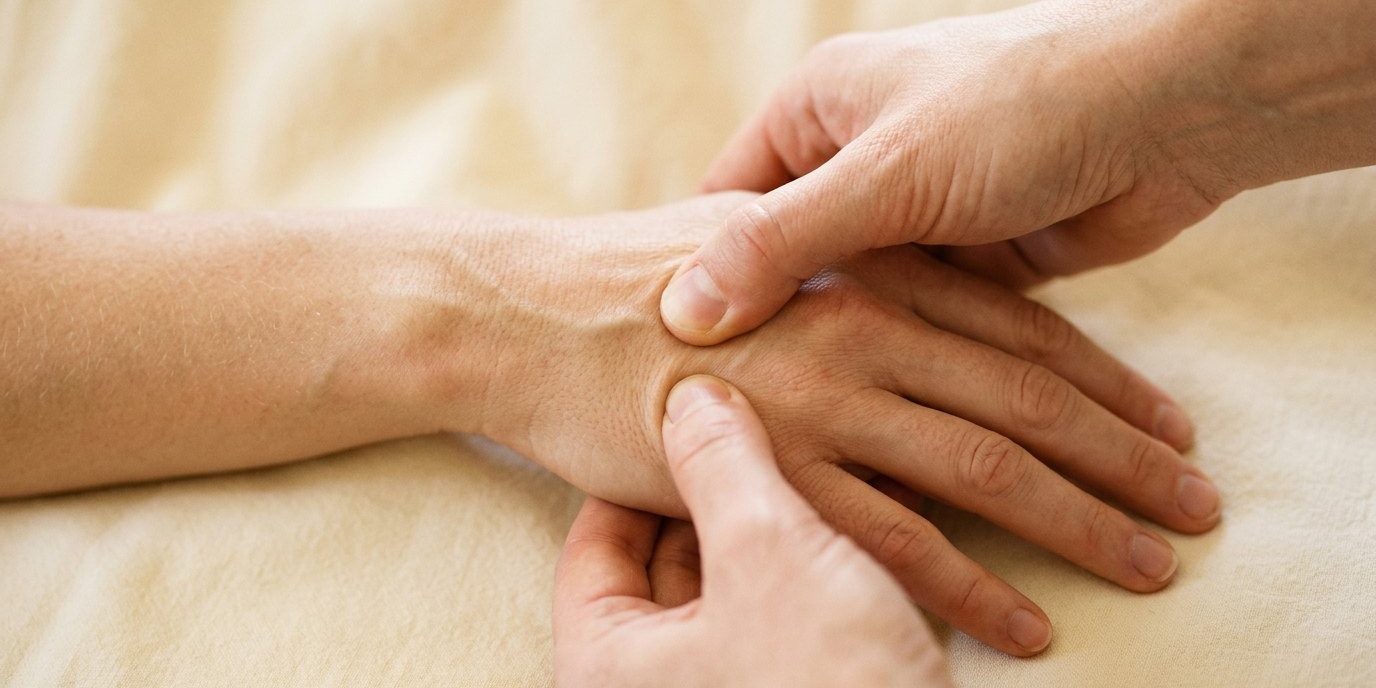
Press with a fingertip or thumb, firmly enough to feel a mild, pleasant ache — never sharp pain — and hold for 30 to 60 seconds while breathing slowly. That sentence is the core of doing acupressure at home; the rest is refinement.
- Pressure — firm but comfortable. A dull, spreading ache is right; sharp, electric or burning sensations mean move or ease off.
- Time — 30 to 60 seconds per point, held steadily or circled slowly.
- Breathing — slow nose-breathing with the exhale longer than the inhale; the breathing likely carries much of the calming effect.
- Frequency — one to three times a day, or as needed. Consistency beats intensity.
- Stop rule — anything that hurts, bruises or tingles is your signal to stop.
Who should be careful with acupressure?
The majority of people can use acupressure safely, but the situations in this table call for lighter pressure, skipped points or professional advice first — these safety rules and contraindications are the heart of this page — read them before you press anything.
| Situation | What to do |
|---|---|
| Pregnancy | Avoid LI4 (Hegu) and strong stimulation of GB21 (Jianjing), skip abdominal points, and check with your maternity provider before starting any self-care routine. |
| Broken, irritated or infected skin, rashes, wounds, recent surgical sites | Skip those areas completely until fully healed. |
| Varicose veins, lumps, moles, swollen or hot joints | Never press directly on them — choose another point or skip the session. |
| Blood thinners or bleeding disorders | Light pressure only; easy bruising is your sign to stop. |
| Front or side of the neck (near the carotid arteries) | Do not use pressure points there. The neck-area points in this series sit at the back of the skull, where pressing is safe. |
| New, severe or persistent symptoms | Acupressure cannot diagnose anything — see your doctor first. |
Which three points should you learn first?
Start with LI4 for everyday tension, ST36 for daily maintenance and KD1 for winding down — easy to find, broadly useful, and good teachers of what correct pressure feels like.
LI4 — Hegu (合谷)
Where: on the back of the hand, on the mound of muscle between the thumb and index finger — anatomically, the radial (thumb) side of the second metacarpal at its midpoint. Squeeze thumb and finger together, note the peak of the bulge, then relax and press there with the opposite thumb.
Used for: general tension and headaches.
Pregnancy caution: skip LI4 entirely during pregnancy — it is traditionally contraindicated.
ST36 — Zusanli (足三里)
Where: four finger-widths below the lower edge of the kneecap, one finger-width lateral to the shinbone — toward the outside of the leg, in the muscle beside the bone.
Used for: the classic “daily maintenance” point in the TCM tradition, associated with digestion and energy.
KD1 — Yongquan (涌泉)
Where: on the sole of the foot, in the hollow that appears at the junction of the front third and back two-thirds of the sole when you curl your toes — the depression behind the ball of the foot.
Used for: grounding and winding down at day’s end.
Which guide should you read next?
The one that matches your goal — each applies this page’s technique and safety rules to one everyday complaint.
- Headaches — Acupressure points for headaches: hand, temple and neck-base points for tension-type headaches, plus the red flags that need a doctor.
- Sleep — Acupressure points for sleep: calming points in a simple evening wind-down routine.
- Neck and shoulders — Acupressure for neck and shoulder tension: desk-worker points, including the safe back-of-skull area.
- Digestion and nausea — Acupressure points for digestion and nausea: including PC6, the point with the research record noted above.
When should you book a professional instead?
When a symptom is new, severe, worsening, or not improving after two or three weeks of sensible self-care — then an assessment does more than pressing harder.
A registered acupuncturist starts with exactly that assessment and can offer needle acupuncture, which fingertip pressure does not replicate. Framed honestly, the research on needle acupuncture is reasonably supportive for chronic musculoskeletal pain — low back, neck, knee — and for reducing the frequency of some recurring headaches; several clinical guidelines list it as an option. That is moderate evidence, not a promise — the standard I hold my own work to.
Dave Tam, RMT, our registered massage therapist, puts it plainly: thumbs tire within a minute, and you cannot reach your own mid-back or work a whole shoulder girdle at depth. Registered massage therapy provides the sustained, hands-on work self-pressure cannot replicate; the two habits complement each other.
For problems that sit between disciplines — joint restriction alongside longstanding muscle tension — Ethan Choi, R.Ac, R.TCMP, DOMP offers combined osteopathy and acupuncture care in a single plan.
And some symptoms should go straight to a physician: sudden or severe headache, chest pain, weakness or numbness, fever with a stiff neck, unexplained weight loss — any new, severe or persistent symptom. Doctor first; comfort practices after.
What do beginners ask most often?
Mostly whether it works, how hard to press, and who should be careful — short, honest answers below.
Does acupressure actually work?
It depends on the claim. PC6 for nausea carries real, if imperfect, trial evidence; slow pressure plus slow breathing may help some people feel calmer within minutes; for everything else, trials are small and mixed — a low-risk comfort practice, not a proven treatment.
Is acupressure the same as acupuncture?
Same point map, different tool. Acupuncture uses fine needles placed by a registered practitioner after an assessment; its research base does not automatically transfer to finger pressure.
How hard should I press?
Firm enough for a mild, pleasant ache, and no harder. Sharp, electric or burning sensations mean move or ease off; pressure that leaves bruises is too much.
How often can I do acupressure?
One to three times a day, and daily consistency matters more than force. If a point stays sore between sessions, give it a rest day.
How long before I notice anything?
Relaxation effects, when they come, arrive within minutes. For anything else, give a point two to three weeks of consistent use, then judge honestly — if nothing changed, stopping is reasonable.
Is acupressure safe during pregnancy?
Only with cautions: avoid LI4 and strong stimulation of GB21 (Jianjing), skip abdominal points, and clear any self-care routine with your maternity provider first.
Do I need to believe in qi for acupressure to help?
No. The traditional framework and the proposed modern mechanisms describe the same practice in different languages, and the comfort of steady pressure and slow breathing requires neither.
Will my extended health plan cover acupuncture if I book?
Many BC extended health plans include acupuncture and massage therapy categories, but plans differ and reimbursement is never guaranteed — check your policy or ask our front desk to verify before you book.
Ready to learn your points hands-on?
If you would rather have someone find LI4, ST36 and KD1 on you and calibrate that “pleasant ache” in person, that is a normal part of an acupuncture visit. Artemis Wellness Clinic is at 5911 No. 3 Road #130, Richmond BC V6X 0K9, a three-minute walk from Brighouse SkyTrain station. Book online at artemis.janeapp.com or call 604-242-2233 — bring your questions; these guides will be waiting when you get home.