I’m Mandy Tam, R.Ac, a Registered Acupuncturist at Artemis Wellness Clinic in Richmond, and stress and sleep sit at the centre of my practice. One question comes up week after week: “Is there anything I can do at home?” This guide — part of our acupressure series — is my answer: four acupressure points for sleep, arranged into a five-to-seven-minute bedtime sequence you do in bed, in order, finishing with your eyes closed. I’ll show you where each point lives, how to press it, and what the research honestly does and doesn’t say.
Can acupressure points really help you fall asleep?
Maybe — the honest answer is that the evidence for acupressure and sleep is limited and mixed. Some small trials suggest acupressure may help people fall asleep sooner or feel more rested, but studies are often small, hard to blind and uneven in quality, so I won’t oversell them. What I can say with more confidence is why this routine often feels helpful: a predictable wind-down ritual, warm touch and slowed breathing all shift the nervous system away from “alert and scanning” toward “safe enough to rest.” Whether individual points add specific effects — the working hypothesis involves nerve signalling from these spots — is still an open question.
In clinic I frame it this way: a free, safe wind-down tool, and even if nothing dramatic happens, you’ve ended the day with slow breathing and a pleasant hand-and-foot massage. It is not a treatment for insomnia disorder — if sleep trouble is entrenched, the doctor section below matters more than any pressure point.
What is the five-to-seven-minute bedtime acupressure routine?
It’s six small steps done in bed, in order: two to settle the body, then four points, ending at your feet. Use fingertip or thumb pressure that feels pleasant — comfortable, perhaps faintly tender, never painful.
Step 1: Lights low, screens away
Dim the room, set your phone face-down out of reach and get into bed — thirty seconds, and the cue itself is the point: you’re teaching your brain these signals mean the day is over.
Step 2: One minute of slow breathing
Try 4-7-8 breathing — in through the nose for four, hold for seven, out slowly for eight — for about four rounds. If the holds feel strained, switch to slow diaphragmatic breathing: belly rises on the inhale, each exhale longer than the inhale.
Step 3: Yintang (印堂) — between the eyebrows, one minute
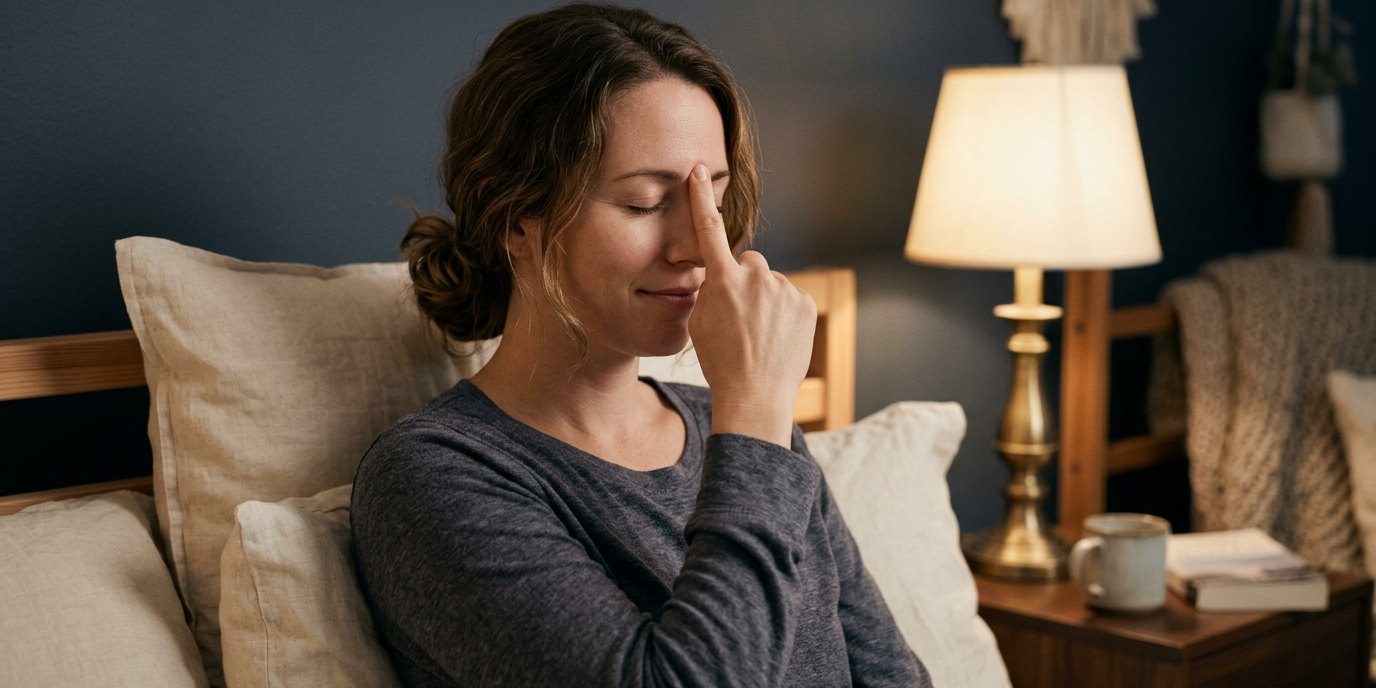
Yintang sits on the midline, between the inner ends of your eyebrows. With your eyes closed, make light fingertip circles there — barely more than skin contact — for about a minute. Many people feel the forehead and jaw soften.
Step 4: HT7 — Shenmen (神门) — 30 to 60 seconds each wrist
HT7 is on the palm side of the wrist crease, on the little-finger (ulnar) side. Trace from the base of your little finger down to the wrist crease, then press the small hollow there, just to the thumb-side of the tendon that runs to the pea-shaped pisiform bone (the flexor carpi ulnaris). Shenmen translates roughly as “spirit gate,” a classic point in Traditional Chinese Medicine for a busy, unsettled mind. Hold or circle gently for 30 to 60 seconds, then switch wrists.
Step 5: PC6 — Neiguan (内关) — 30 to 60 seconds each arm
The Neiguan PC6 point sits on the inner forearm, three finger-widths (about 2 cun) above the wrist crease, in the groove between the two central tendons — make a fist and you’ll see them pop up. Traditionally it’s used for a racing or unsettled feeling in the chest and for nausea, which is why I include it on nights when your chest still feels wired. Press gently into the groove for 30 to 60 seconds per arm.
Step 6: KD1 — Yongquan (涌泉) — one minute each foot, lying down
Curl your toes and a hollow appears on the sole, at the junction of the front third and the back two-thirds of the foot — that hollow is KD1, a grounding point. Lying on your back, bend one knee and rest that ankle across the opposite shin so the sole faces you, then make slow thumb circles in the hollow for about a minute per foot. Afterwards, rest your arms, keep the breath long and quiet, and let the night take it from there — no grading yourself.
How firmly — and how often — should you press?
Gently: every point in this routine should feel pleasant, and pressing harder will not press you deeper into sleep. What matters is consistency over intensity — the same short sequence at roughly the same time each night, until it becomes a sleep cue in itself. Give it two or three weeks before judging, restart without guilt if you miss a night, and skip any spot where the skin is broken or irritated.
When is poor sleep a reason to see a doctor?
See your family doctor if sleeplessness is chronic — trouble falling or staying asleep three or more nights a week, for three months or longer — if it drags down your daytime energy, mood or concentration, or if you snore loudly, gasp or seem to stop breathing at night — possible sleep apnea. Acupressure for insomnia has real limits: chronic insomnia deserves proper assessment, and the first-line treatment is cognitive behavioural therapy for insomnia (CBT-I), a structured, well-researched program your doctor can help you access. Nothing in this article replaces it.
Red flags — see a doctor promptly if you snore loudly, gasp, choke or seem to stop breathing during sleep; if chest discomfort or breathlessness wakes you; if you act out your dreams or your legs crawl and jerk at night; or if sleeplessness persists three months or more despite good habits. In crisis tonight, call or text 9-8-8. This article is general information, not medical advice — unsure, call HealthLink BC at 811.
If worry or low mood is what keeps you awake, please treat that as the main story, not a footnote — your family doctor or a registered mental-health professional can help. And if you’re in crisis tonight, call or text 9-8-8, Canada’s Suicide Crisis Helpline: free, confidential and answered around the clock.
One seasonal note: hazy late-summer evenings can stir up anxiety and unsettle sleep together, so we’ve written a separate guide to anxiety and sleep support during smoke season.
How does our Richmond clinic team support better sleep?
From several angles, because poor sleep rarely travels alone. In my own acupuncture sessions for stress, anxiety and insomnia, I take a longer history than any article can — when you wake, what your evenings hold, where stress lands in your body — and choose points for your pattern rather than a generic list. Many patients find the sessions calming; some doze off on the table. The same honesty applies: research on acupuncture for insomnia is promising but mixed, and I never promise results — what I offer is unhurried, individualized care.
Dave Tam, RMT, our clinic director, watches the same story from the massage table: “By evening, people are carrying the whole day in their jaw and shoulders. It’s hard to hand a clenched body over to sleep.” Relaxation-focused registered massage therapy may make that hand-off easier, and Dave suggests a one-minute self-release before the points: let your teeth part slightly, make slow fingertip circles over the jaw muscles in front of your ears for thirty seconds, then knead the top of each shoulder with the opposite hand for fifteen seconds a side.
When body tension and poor sleep arrive together, my colleague Ethan Choi, R.Ac, R.TCMP, DOMP offers combined gentle manual therapy and acupuncture in a single care plan.
What do patients ask me about acupressure for sleep?
Usually some version of “where exactly is it?” and “will it actually work?” — here are the short answers I give in clinic.
Where is the HT7 sleep point?
The HT7 Shenmen point is on the palm side of the wrist crease, on the little-finger side: trace down from the base of your little finger to the crease and press the small hollow just to the thumb-side of the tendon that runs to the pisiform bone.
How long does acupressure take to work for sleep?
Judge it after two or three weeks of nightly use, not one night. Any benefit seems to build with repetition — and if nothing shifts, that’s useful information to bring to your doctor or acupuncturist.
Can I use these pressure points to fall asleep again at 3 a.m.?
Yes. Keep the lights off, restart the slow breathing, then work HT7 and PC6. If you’re still wide awake after twenty or thirty minutes, get up briefly and do something dull in dim light, then try again.
Do I need to find each point exactly?
No — with fingertips, close is good enough. Use the landmarks, then let a pleasant, slightly tender feeling confirm the spot; precision matters more with needles than thumbs.
Is bedtime acupressure safe during pregnancy?
Gentle pressure at these points is generally considered low-risk — PC6 is even studied for pregnancy-related nausea — but if you’re pregnant, please clear any new routine with your doctor or midwife first.
Is acupressure the same as acupuncture?
No — same map, different tools. Acupressure uses fingertip pressure you apply yourself, while acupuncture at our Richmond clinic uses fine, single-use sterile needles placed by a registered practitioner.
Is this routine a treatment for insomnia disorder?
No, and I won’t pretend otherwise. Chronic insomnia deserves proper assessment, and CBT-I remains the first-line treatment; think of this sequence as a supportive wind-down habit, not a substitute for care.
Would a little in-person support help?
It might — especially if short nights have started to feel normal. You can book an acupuncture visit with me online at artemis.janeapp.com or by calling 604-242-2233; we’re about a three-minute walk from Brighouse SkyTrain, an easy stop on the way home.
Artemis Wellness Clinic · 5911 No. 3 Road #130, Richmond BC V6X 0K9 · 604-242-2233 · artemis.janeapp.com