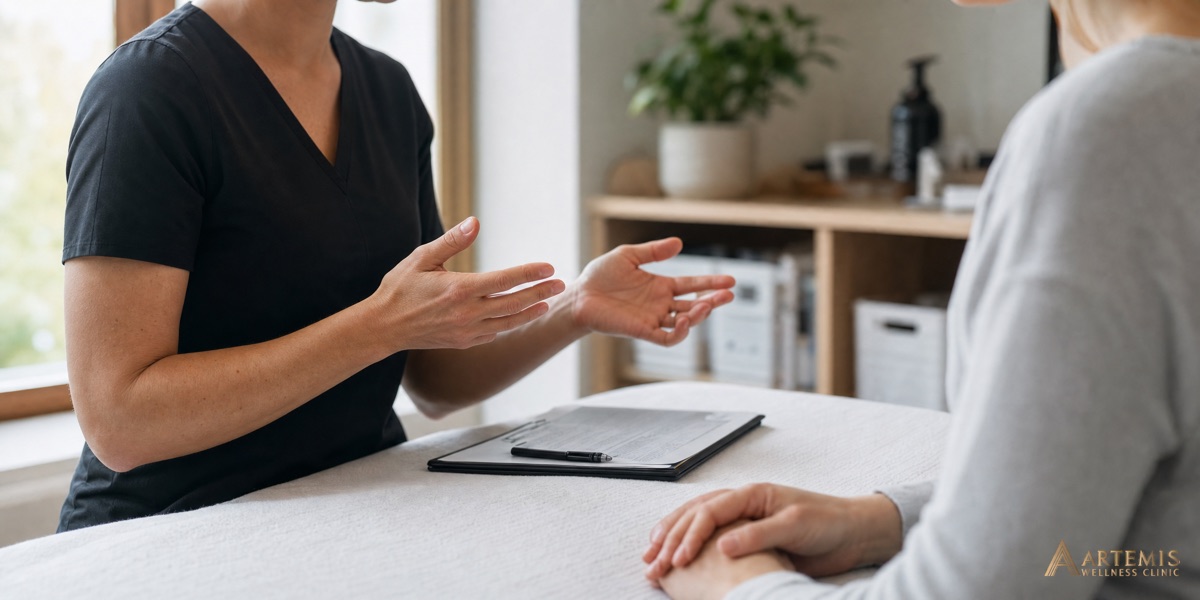
Pain rarely arrives with a label that tells you who to book. Is that aching low back a job for massage, physiotherapy, chiropractic, or acupuncture? Should a stubborn headache go to an osteopathic manual practitioner or a registered massage therapist? At Artemis Wellness Clinic in Richmond, you don’t have to guess. We are one multidisciplinary clinic with six disciplines under a single roof — RMT massage, Acupuncture & TCM, Physiotherapy, Chiropractic, Kinesiology, and Osteopathy — and your first job is simply to describe what hurts. We match the care to the condition from there.
This page is a map. Find the body region or symptom that fits, follow the link to read about how we approach it, and book when you’re ready. If you’re not sure where you fit, that’s normal — keep reading for a quick “which discipline” guide and a red-flag note on when to see a doctor first.
One clinic, matched to your condition
Most pain involves more than one tissue and often benefits from more than one approach. A frozen shoulder might need hands-on mobilization plus a home exercise plan; sciatica might combine manual therapy with acupuncture for symptom relief and kinesiology for the long game. Because all six disciplines work in the same building, we can blend them without sending you across town.
The first assessment determines the mix. Your initial visit is mostly listening and testing — history, movement screening, and hands-on examination — so the practitioner can understand the driver of your pain, not just where you feel it. From there we recommend a starting discipline and, where it helps, a combination. Plans are reviewed as you progress, so the mix can change as you improve. Nothing here is a guaranteed outcome; the goal is care that may help you move and feel better, grounded in what the evidence supports.
Neck, back & spine
The spine is the most common reason people walk through our door. Start here if your pain sits anywhere from your neck to your tailbone.
- Lower back pain — aching, stiffness, or spasm in the low back, with or without leg symptoms.
- Neck pain — tension, reduced range of motion, or pain from posture and desk work.
- Combined neck & back pain — when discomfort spans the whole spine and needs a coordinated plan.
- Sciatica — nerve-type pain that travels from the low back into the buttock or leg.
- Whiplash & car-accident injury — neck and upper-back strain after a collision; commonly covered by ICBC.
- Chronic pain management — for pain that has lingered beyond three months and needs a longer-term approach.
Shoulder, arm & hand
Reaching, gripping, lifting, and typing all live here. Choose this group for pain from the shoulder down to the fingertips.
- Frozen shoulder — progressive stiffness and loss of shoulder range, often without a clear injury.
- Rotator cuff injury — shoulder pain with overhead movement or weakness after a strain.
- Tennis elbow — pain on the outer elbow from repetitive gripping and wrist use.
- Tennis vs. golfer’s elbow — not sure which side of the elbow hurts? This explains the difference.
- Carpal tunnel syndrome — numbness, tingling, or weakness in the hand from nerve compression at the wrist.
Hip, leg & foot
Weight-bearing aches and overuse injuries that affect how you stand and walk belong here.
- Plantar fasciitis — heel and arch pain, often sharpest on the first steps of the morning.
- Sprains & strains — ankle, knee, or muscle injuries from a twist, fall, or overload.
- Arthritis pain relief — joint stiffness and ache that we aim to ease so you can stay active.
Head, jaw & balance
Symptoms above the shoulders — and the dizziness that can come with them — may respond to targeted, gentle care.
- Headache & migraine — tension-type, cervicogenic, and migraine patterns we may help manage.
- TMJ disorder — jaw clicking, tightness, or pain that affects chewing and opening.
- TMJ & jaw pain — a closer look at jaw-pain causes and hands-on options.
- Vertigo & BPPV — positional dizziness that may respond to specific repositioning techniques.
Gentle osteopathic options
Osteopathy uses light, whole-body manual techniques — an option to consider if you prefer a gentler hands-on approach.
- Osteopathy for lower back pain — gentle manual treatment for persistent or recurring low-back discomfort.
- Osteopathy for headaches & migraines — a soft-tissue and structural approach to head and neck tension.
Which discipline should I see?
You don’t need to decide alone — the first assessment will guide you — but here’s how the six disciplines compare at a glance:
- RMT massage — hands-on soft-tissue work for muscle tension, stiffness, and stress; may help ease pain and support recovery.
- Acupuncture & TCM — fine-needle and traditional techniques that may help with pain, headaches, and tension. (Our registered acupuncturist Mandy Tam, R.Ac, provides acupuncture; she does not prescribe herbal medicine.)
- Physiotherapy — assessment-led rehab for injuries and movement problems, combining manual therapy with exercise.
- Chiropractic — joint-focused assessment and adjustment for spinal and joint complaints.
- Kinesiology — exercise-based rehab and movement coaching to rebuild strength and help prevent recurrence.
- Osteopathy — gentle, whole-body manual therapy; our practitioner Ethan Choi holds R.Ac, R.TCMP, and DOMP credentials.
A simple rule of thumb: choose hands-on relief (RMT, acupuncture, osteopathy) when you mainly want to ease pain and tension; choose movement-based care (physiotherapy, chiropractic, kinesiology) when you want to address a mechanical problem and rebuild capacity. Most plans use a bit of both.
When to see a doctor first — red flags
Some symptoms need medical assessment before hands-on therapy. Please see a physician or go to urgent care first if you have any of the following:
- Severe pain after major trauma (a serious fall, a high-speed crash).
- Numbness in the saddle/groin area, or new loss of bladder or bowel control.
- Sudden, unexplained weakness in a limb, or a “worst-ever” headache that came on like a thunderclap.
- Fever, unexplained weight loss, or night pain that wakes you, alongside your symptoms.
- Chest pain, shortness of breath, or signs of stroke (face droop, slurred speech) — call 911.
When in doubt, check first. HealthLink BC (call 8-1-1) offers free nurse advice any time, and resources at healthlinkbc.ca can help you decide. We’re happy to coordinate with your family doctor once you’ve been cleared.
Coverage: ICBC, WorkSafeBC & extended health
Artemis offers direct billing, so you don’t have to pay the full fee and wait to be reimbursed. We direct bill ICBC (for car-accident injuries) and WorkSafeBC (for work-related injuries), as well as Pacific Blue Cross, Sun Life, Manulife, Canada Life, Green Shield, and 20+ plans through TELUS Health. With extended health, you pay only the part your plan does not cover (co-pay, deductible or amounts above your plan maximum); for ICBC, if part of a fee is not covered by ICBC (a user fee), we tell you before your treatment. See our direct billing & insurance hub for the full list and how to set up a claim.
Frequently asked questions
Do I need a referral to be seen at Artemis? For most disciplines, no — you can book directly. ICBC and WorkSafeBC claims have their own intake steps, and our front desk can walk you through them. A doctor’s referral is needed for massage therapy under a WorkSafeBC claim and for certain extended-health plans.
I don’t know which discipline I need. What should I book? Book a first assessment with the discipline that feels closest, or call us at 604-242-2233 and we’ll point you to a sensible starting point. The assessment itself confirms the right mix, so you won’t be locked in by your first choice.
Can I see more than one type of practitioner? Yes. Many plans combine, for example, massage with physiotherapy or acupuncture with kinesiology. Because all six disciplines share one clinic, coordinating care is straightforward.
My pain started after a car accident — is that covered? Car-accident injuries are generally handled through ICBC, and we bill ICBC directly for your pre-approved treatments; if part of a fee is not covered by ICBC (a user fee), we tell you before your treatment. Bring your claim number and BC PHN if you have them; if not, we can help you get started. For workplace injuries, with an accepted WorkSafeBC claim we bill WorkSafeBC directly.
How soon will I feel better? It depends on the condition, how long you’ve had it, and how your body responds. Some people notice change within the first few visits; individual results vary, and we focus on honest, steady progress rather than promises. Your plan is reviewed as you go.
Is acupuncture or chiropractic safe for my condition? Each discipline has its own indications and cautions, which your practitioner reviews at the assessment. If your symptoms include any of the red flags above, we’ll ask you to see a doctor first.
Where are you located? We’re at 5911 No. 3 Road #130, Richmond BC V6X 0K9 — about 3 minutes from Brighouse SkyTrain station. Free parking behind the clinic (stalls 47–48, weekdays) and 3-hour free parking at the PriceSmart plaza on Ackroyd Road.
Ready to find the right care?
Tell us what hurts, and we’ll match you to the discipline — or combination — that fits. Book online at artemis.janeapp.com or call 604-242-2233. Artemis Wellness Clinic · 5911 No. 3 Road #130, Richmond BC V6X 0K9 · 3 minutes from Brighouse SkyTrain.
Combined manual + TCM care: for persistent back or neck pain, headaches and jaw tension, osteopathic manual therapy and acupuncture can be combined in a single plan with Ethan Choi, R.Ac, R.TCMP, DOMP.