A sprain or strain is one of the most common reasons people walk into a physiotherapy clinic — and one of the most commonly mishandled at home. Most people use the words interchangeably, ice the area for two days, then push back into normal activity hoping it has healed. Many of those injuries linger for weeks or months because the healing process was never properly supported. At Artemis Wellness Clinic at 5911 No. 3 Road #130 in Richmond, our physiotherapy and registered massage therapy team treats sprains and strains across the whole body — ankles, knees, shoulders, elbows, wrists, hips, and the spine — using a stage-based protocol that protects the injury early, restores movement systematically, and rebuilds strength to pre-injury level. We are two minutes from Brighouse SkyTrain Station, with direct billing for ICBC, WorkSafeBC, and most major extended health plans. Book at Jane App or call 604-242-2233.
Sprain Versus Strain: What’s the Difference?
These two terms refer to different tissues:
Sprain — an injury to a ligament, the connective tissue that connects bone to bone and stabilizes a joint. The most common sprains are ankle (lateral ligaments rolled outward), knee (medial collateral ligament from sideways force, or ACL from rotational force), wrist (catching yourself in a fall), and acromioclavicular (the bump on top of the shoulder, from contact sports).
Strain — an injury to a muscle or tendon, the contractile tissue that moves a joint. The most common strains are hamstring (sprinting or kicking), calf (sudden push-off), lower back (lifting awkwardly), neck (whiplash from a car accident), groin (changing direction in sport), and rotator cuff (overhead reaching or lifting).
Both are graded 1 to 3:
– Grade 1 (mild): stretched but not torn. Mild swelling, full range of motion, normal strength. Recovery 1–3 weeks with proper care.
– Grade 2 (moderate): partial tear. More swelling, painful limited motion, weakness. Recovery 3–8 weeks.
– Grade 3 (severe): complete rupture. Significant swelling, severe pain, instability or inability to use the joint. Recovery 8 weeks to several months; may require imaging and specialist consultation.
A clinical assessment in the first week determines the grade and shapes the recovery plan.
When to Get Professional Help (And When Self-Care Is Enough)
Many grade 1 sprains and strains do recover with relative rest, gentle movement, and a few weeks of patience. Book an assessment if any of the following apply:
- You cannot bear weight on a lower-limb injury (suspected fracture or grade 3 sprain)
- The joint feels unstable, “gives way,” or locks
- Significant swelling or bruising appears within the first hour
- Pain has not noticeably improved after 7–10 days of self-care
- The injury keeps returning every time you go back to the activity that caused it
- The injury occurred in a motor vehicle accident or workplace incident (ICBC/WorkSafeBC documentation matters)
- You need to return to a sport, work activity, or training schedule with confidence
- This is the same area as a previous injury
Early professional assessment in moderate-to-severe cases significantly shortens overall recovery time and reduces the risk of chronic instability and re-injury.
The Modern Approach: Beyond R.I.C.E.
The classic “Rest, Ice, Compression, Elevation” advice is now considered incomplete. Current evidence-based protocols (PEACE & LOVE, summarized below) emphasize early protected movement rather than prolonged immobilization, because soft tissue heals stronger when loaded appropriately during the repair phase.
In the first 24–72 hours (PEACE):
– Protect — avoid further injury, but do not fully immobilize unless instructed
– Elevate — raise the limb above heart level to reduce swelling
– Avoid anti-inflammatories — early in the process they can interfere with healing (paracetamol/Tylenol for pain is fine)
– Compression — light wrap to manage swelling
– Education — understand the realistic recovery timeline
In the subsequent days and weeks (LOVE):
– Load — progressive return to activity within tolerance
– Optimism — recovery is expected; outcomes correlate with attitude
– Vascularization — gentle aerobic exercise (walking, stationary bike) maintains circulation
– Exercise — restore range of motion, then strength, then sport-specific control
A physiotherapist’s role is to calibrate “within tolerance” precisely — too little movement causes stiffness and weakness, too much causes re-injury and prolonged inflammation.
Our Stage-Based Recovery Protocol
Every sprain and strain at Artemis is treated through four stages, with the timeline scaled to the grade and tissue involved.
Stage 1 — Protect and Settle (typically week 1)
Goals: control pain and swelling, protect the injured tissue, maintain general fitness.
- Education on activity modification specific to your injury and lifestyle
- Manual lymphatic-style techniques to manage swelling
- Gentle pain-free joint mobilization to maintain range
- Taping or bracing if joint stability is compromised
- Cardiovascular maintenance via uninvolved areas (e.g., upper body cycling for ankle sprain)
Stage 2 — Restore Range and Loading (typically weeks 2–4)
Goals: regain full pain-free range of motion, begin progressive loading.
- Manual therapy (joint mobilization, soft-tissue release) for restrictions
- Range-of-motion exercises tailored to your stage of healing
- Isometric loading (gentle static contractions) to begin tendon and muscle reconditioning
- For lower-limb injuries: bodyweight exercises in safe ranges
- Coordination with our registered massage therapy team when soft-tissue restriction is contributing to recovery
Stage 3 — Strength and Control (typically weeks 4–8)
Goals: rebuild full strength, restore proprioception (joint position sense), prepare for higher demands.
- Progressive resistance training with bands, dumbbells, or cables
- Single-leg balance and stability work for lower-limb injuries
- Plyometric introduction (hopping, bounding) for sport-bound patients
- Movement-pattern correction to address any compensations that developed
Stage 4 — Return to Activity (typically weeks 6–12+, depending on goal)
Goals: bridge from clinic exercises to actual sport, work, or daily activity demands.
- Sport-specific drills: cutting, sprinting, jumping, throwing
- Work-task simulation for physical occupations
- Return-to-play or return-to-work clearance criteria (strength, endurance, hop testing for lower limb)
- Discharge with a maintenance program to prevent re-injury
The stages overlap; you do not need to “finish” one before beginning the next. They describe emphasis rather than rigid sequence.
Common Sprain and Strain Presentations We Treat
Ankle sprain (lateral inversion). The most common sprain. We assess for syndesmosis (high ankle) involvement, possible fracture screen using the Ottawa Ankle Rules, and recurrence risk. Balance retraining is essential — without it, the re-injury rate is substantial.
Knee sprain (MCL, ACL, meniscus). MCL grade 1–2 sprains usually respond well to conservative management. Suspected ACL tears or meniscal damage are referred for imaging.
Hamstring strain. A common athletic injury where rushed return to sprint or jump activity drives re-injury. Eccentric loading (Nordic hamstring exercise progression) is a key feature of evidence-based recovery.
Calf strain (gastrocnemius or soleus). Especially common in tennis, running, hiking. Heel-raise progressions and progressive loading return you to full activity.
Lower-back muscular strain. Often happens with lifting, twisting, or after prolonged sitting. See our lower back pain treatment guide for the full approach.
Neck strain (including whiplash from MVA). A common ICBC presentation. Combined physiotherapy + RMT + active rehab. See our neck pain treatment guide.
Rotator cuff strain. Pain on overhead reach, lifting, or sleeping on the shoulder. Often combined with bursitis or impingement.
Wrist sprain (TFCC, scapholunate). From falls onto outstretched hands. Distinguishing simple sprain from significant ligament injury is essential — early imaging in suspected cases.
Groin/adductor strain. Common in soccer, hockey, change-of-direction sports.
Hip flexor strain. Often in runners and kicking-sport athletes.
For motor-vehicle-accident patients, see our ICBC physiotherapy guide for how the no-fault benefits system covers your treatment.
Insurance and Direct Billing
Sprain and strain treatment at Artemis is delivered by our physiotherapy and registered massage therapy teams, with direct billing available to:
- ICBC — covered for motor vehicle accident injuries under your no-fault claim. We bill directly with no out-of-pocket cost for pre-approved sessions.
- WorkSafeBC — covered for workplace injuries with an open claim and approved treatment plan.
- Pacific Blue Cross, Sun Life, Manulife, Green Shield Canada, Canada Life — direct billed when your plan supports physiotherapy or RMT.
- Self-pay — current rates visible at the time of booking in the Jane App system.
What to Expect at Your First Appointment
- Arrive 10 minutes early for paperwork (or pre-fill in Jane App).
- History (10 minutes). When did the injury happen, mechanism, what makes it better or worse, your goals for recovery.
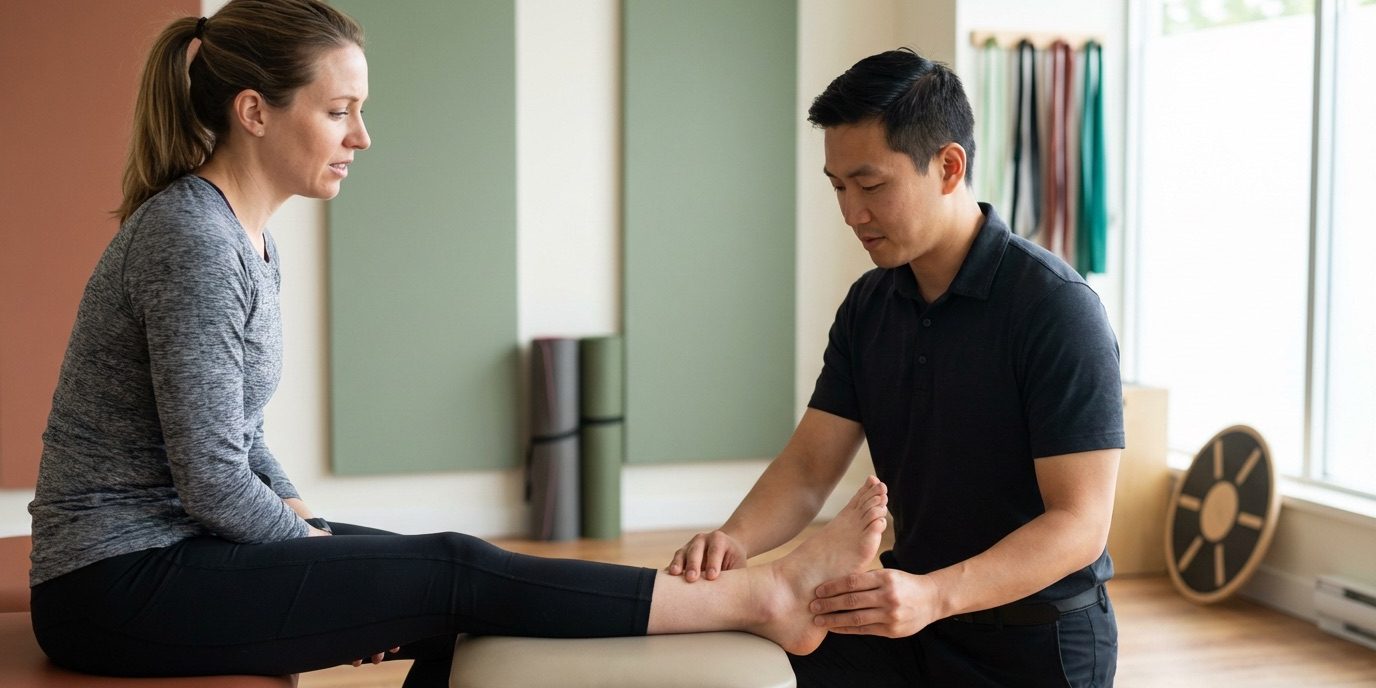
- Physical assessment (15 minutes). Visual inspection, swelling check, range-of-motion testing, special tests for the involved structure, strength testing where safe.
- Diagnosis and grading discussion (5–10 minutes). What we found, how serious it is, expected recovery timeline.
- First-stage treatment (15 minutes). Manual therapy, taping if needed, education on what to do today and over the next 48 hours.
- Home program and follow-up booking (5 minutes). Specific exercises and activity modifications, plus your next appointment timing.
Frequently Asked Questions
How long until I can return to my sport or work?
Highly variable by grade and tissue. Mild grade 1 strains may resolve in 1–2 weeks. Grade 2 sprains typically need 4–8 weeks. Grade 3 injuries can take 3 months or more. Your physiotherapist will give you a specific timeline at your first visit.
Should I ice or heat?
Ice is most useful in the first 48–72 hours for pain control. After that, heat can help with mobility and is generally preferred. Either way, the bigger lever is appropriate movement, not temperature application.
Do I need imaging (X-ray, MRI)?
Not for most sprains and strains. We use clinical decision rules (Ottawa Ankle Rules, Pittsburgh Knee Rules, etc.) to determine if imaging is necessary. Most injuries are diagnosed clinically.
Should I take ibuprofen?
For acute injuries, current evidence suggests minimizing NSAIDs in the first few days because they can interfere with the early healing response. Acetaminophen (Tylenol) for pain is generally fine. We adjust this advice if you have a chronic condition or are on regular medications.
Do I need a doctor’s referral?
No. Physiotherapy and RMT in BC are direct-access. ICBC and WorkSafeBC patients should have an open claim number.
Do you direct bill ICBC and extended health?
Yes. ICBC and WorkSafeBC billed directly under your claim. Pacific Blue Cross, Sun Life, Manulife, Green Shield, and Canada Life direct-billed when your plan supports physio/RMT.
Can I keep training while I recover?
Almost always yes — but the activity is modified. We will give you a clear “yes / no / modify” list specific to your injury and goals. Maintaining cardiovascular fitness through unaffected areas is important.
How do I prevent the same injury from coming back?
Re-injury risk is highest in the first 12 weeks after return to activity, and remains elevated for the first season. We address this with sport-specific reconditioning, proprioceptive training, and a progressive return-to-play protocol — not just “wait until it stops hurting.”
Do you have evening or weekend appointments?
Yes. See real-time availability at artemis.janeapp.com.
Book a Sprain or Strain Assessment in Richmond
Artemis Wellness Clinic
5911 No. 3 Road #130, Richmond, BC V6X 0K9
Two minutes from Brighouse SkyTrain Station, directly across from Richmond Centre
Phone: 604-242-2233
Online booking: artemis.janeapp.com
Multidisciplinary team — physiotherapy, registered massage therapy, acupuncture, chiropractic, kinesiology — under one roof. ICBC, WorkSafeBC, Pacific Blue Cross, Sun Life, Manulife, Green Shield Canada, and Canada Life direct billing. Evening and weekend appointments available.