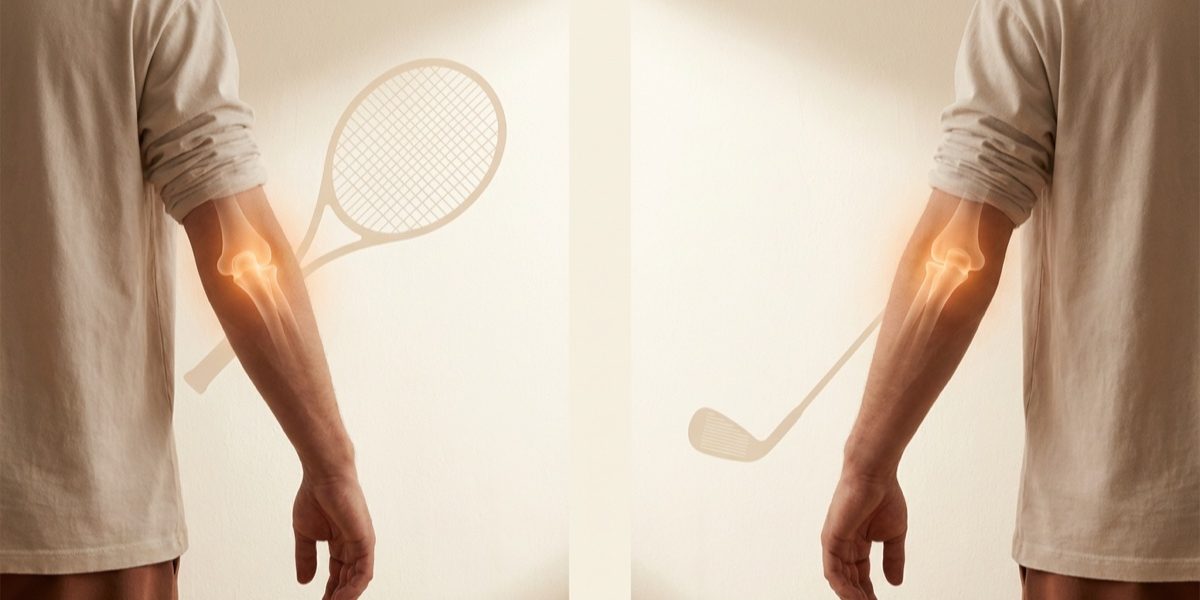
Both conditions hurt at the elbow. Both are tendon overload injuries. Both happen to people who don’t play tennis or golf. And the wrong treatment for the wrong one can drag a 6-week recovery into a 6-month one. At Artemis Wellness Clinic at 5911 No. 3 Rd #130, Richmond, BC — two minutes from Brighouse SkyTrain — our team treats elbow tendinopathy daily, with diagnostic clarity at visit one and a structured loading program run out of our on-site rehab gym. Book at artemis.janeapp.com or call 604-242-2233.
This guide is a side-by-side comparison: how to tell them apart, who actually gets each one, what treatment looks like, and what timelines to expect. For a deeper symptom-focused breakdown of tennis elbow alone see our Tennis Elbow Treatment in Richmond BC article — this piece is for the patient who is not yet sure which condition they have.
The Anatomy in 30 Seconds
Two tendon attachments at the elbow do most of the work for forearm and wrist movement.
- The lateral epicondyle (outside of the elbow) is where the wrist extensors attach. Overload here = tennis elbow (lateral epicondylitis or, more accurately, lateral elbow tendinopathy).
- The medial epicondyle (inside of the elbow) is where the wrist flexors and pronators attach. Overload here = golfer’s elbow (medial epicondylitis or medial elbow tendinopathy).
Press your thumb on the bony bump on the outside of your elbow. Painful with even moderate pressure? Likely tennis elbow. Now press the bony bump on the inside. Painful? Golfer’s elbow. Both painful? You’d be the third or fourth case this month — combined patterns are not rare in our clinic.
Side-by-Side Comparison
| Feature | Tennis Elbow (Lateral) | Golfer’s Elbow (Medial) |
|---|---|---|
| Pain location | Outside of elbow | Inside of elbow |
| Worst movement | Extending wrist against resistance, gripping | Flexing wrist, twisting palm down to up |
| Common everyday triggers | Mouse and trackpad use, lifting kettles, painting walls, holding child seat | Lifting weights with palms up, hammering, throwing, golf swing |
| Common sport triggers | Tennis backhand, badminton clears, climbing, weightlifting | Golf, baseball/softball pitching, racquet topspin, kettlebell |
| Often misdiagnosed as | Cervical referred pain, radial tunnel | Ulnar nerve, cubital tunnel, cervical referred pain |
| Frequency in our clinic | More common | Less common but rising with strength-training trend |
| Typical treatment duration | 6–12 weeks | 8–14 weeks (slightly slower on average) |
Who Actually Gets Each One
After tracking elbow cases through our clinic, the breakdown looks nothing like the names suggest:
Tennis elbow patients — the overwhelming majority do not play tennis. Top occupations and activities we see:
– Office workers and developers (mouse and keyboard)
– Trades (painters, electricians, finish carpenters)
– New parents (lifting child seats, strollers)
– Climbers (Squamish summer, indoor gyms in winter)
– Strength athletes (heavy curls and pull-ups with palms-down grip)
– Actual tennis and badminton players (a small minority)
Golfer’s elbow patients — same pattern:
– Strength athletes (deadlifts with mixed grip, kettlebell swings)
– Trades involving repetitive grip and twist (mechanics, plumbers)
– Throwers (softball, baseball, ultimate frisbee)
– Pickleball and racquet players hitting heavy topspin
– Actual golfers (also a minority)
The condition is named after the sport that historically presented to clinics first, not after the population that gets it most.
When to Come In
Come in this week if any of these apply:
- Pain is sharp at the bony bump, not just diffuse forearm soreness
- Grip strength has dropped (you fumble a coffee cup, can’t twist a jar lid)
- Pain is present at rest or wakes you up
- You’ve been “icing it and resting” for more than 3 weeks with no improvement
- Pain has spread up into the upper arm or down into the wrist
The reason for early treatment is simple: elbow tendinopathy has a much shorter and easier rehab when caught at week 2 than at week 12. With early intervention (focused tissue work, eccentric loading and load modification), many cases may settle within 4–6 weeks. Chronic cases that have been brushed off for months can take 4–6 months and respond to fewer treatment options.
How We Diagnose at Visit One
Your physiotherapist will run a short series of orthopaedic tests:
- Cozen’s test (resisted wrist extension) — positive in tennis elbow
- Mill’s test (passive wrist flexion with elbow extended) — positive in tennis elbow
- Reverse Mill’s / passive wrist extension — positive in golfer’s elbow
- Resisted wrist flexion and pronation — positive in golfer’s elbow
- Cervical screen (rule out neck-referred pain that mimics elbow tendinopathy)
- Ulnar nerve provocation (rule out cubital tunnel syndrome, which often coexists with golfer’s elbow)
- Grip strength dynamometer — establishes objective baseline you’ll re-test in 4 weeks
If imaging is needed (rare — most elbow tendinopathies are diagnosed clinically) we send a referral letter for ultrasound, which is the gold standard for tendon imaging.
Our Multidisciplinary Treatment Plan
Elbow tendinopathy is one of the conditions where a coordinated multidisciplinary approach can be helpful. Our standard plan blends:
- Physiotherapy — diagnostic confirmation, manual therapy, mobilization, taping or counterforce bracing if needed, and the loading program. Progressive loading has strong research support for chronic elbow tendinopathy.
- Registered Massage Therapy (RMT) — focused work on the forearm extensors (tennis elbow) or flexors (golfer’s elbow), plus the upstream chain: triceps, biceps, deltoid, and trapezius, which often tighten when the elbow is guarded.
- TCM-based acupuncture — local and distal needling around the affected tendon (LI10, LI11 for lateral; PC3, HT3 for medial). Research suggests acupuncture may help with pain in both conditions; some patients notice relief after a few sessions.
- Chiropractic — many elbow cases have an upstream cervical or thoracic component. Improving upper-quadrant joint mobility may address one of the perpetuating factors.
- Kinesiology / on-site rehab gym — supervised eccentric loading on a graduated resistance progression, plus grip strength rebuilding.
The On-Site Rehab Gym for Elbow Loading
The cornerstone of evidence-based elbow tendinopathy treatment is progressive eccentric loading — controlled lengthening of the tendon under increasing resistance. This is best done with proper equipment under supervision, not with a soup can in your kitchen.
Our on-site rehab gym (built out as part of the new 2025 facility) gives your kinesiologist:
- Adjustable dumbbells from 1 lb up — for graded eccentric wrist extensions and flexions
- Cable column with low-friction pulleys — for controlled rotational and pronation loading
- TheraBand FlexBar (the “Tyler Twist” device) — a home exercise tool with research support for both conditions, started in clinic with proper form
- Grip dynamometer — for objective progress tracking
- Suspension trainer for closed-chain upper body re-loading once symptoms are controlled
A typical loading week might be: 3 supervised sessions in clinic, 3 home maintenance sessions on the FlexBar we send you home with. Progress is measured and adjusted weekly.
Insurance and ICBC
Coverage works the same as for any musculoskeletal condition we treat:
- Extended health plans cover RMT, physio, acupuncture, and chiropractic. We can bill many insurers directly at the front desk, including Pacific Blue Cross, Sun Life, Manulife, Green Shield and Canada Life; you pay only the part your plan does not cover (co-pay, deductible or amounts above your plan maximum).
- ICBC — applies if elbow pain followed a car accident (e.g., bracing on the steering wheel during impact, holding the wheel during whiplash). Within the first 12 weeks after the crash, no doctor’s referral or ICBC approval is needed (bring your claim number and BC PHN); ICBC pre-approves up to 12 RMT, 12 acupuncture, 25 physiotherapy, 25 chiropractic and 12 kinesiology treatments. We bill ICBC directly for your pre-approved treatments. If part of a fee is not covered by ICBC (a user fee), we tell you before your treatment.
- WorkSafeBC — if the elbow injury is work-related (very common in trades, manufacturing, food service, and any repetitive-grip occupation): with an accepted claim we bill WorkSafeBC directly, and approved services (physio, RMT, active rehab) are not charged to you. Massage therapy needs a doctor’s referral.
Realistic Recovery Timelines
- Acute tennis elbow (under 6 weeks of symptoms) — 4–8 weeks of treatment, return to activity often without modification
- Chronic tennis elbow (over 12 weeks of symptoms) — 8–16 weeks, return to activity with load modification
- Acute golfer’s elbow — 6–10 weeks of treatment, slightly slower than tennis elbow on average
- Chronic golfer’s elbow — 10–16 weeks, with attention to ulnar nerve symptoms if present
- Combined lateral + medial pattern — 10–14 weeks, working both sides simultaneously
Research generally favours adding a structured loading program over passive treatment alone (RMT, acupuncture) without loading. Individual results vary.
Frequently Asked Questions
I haven’t played tennis (or golf) in years — can I really have this?
Yes. The vast majority of “tennis elbow” patients have never picked up a racquet, and most “golfer’s elbow” patients have never set foot on a course. The names refer to the original presenting populations, not the only causes.
Should I rest it completely?
Almost never. Complete rest leads to deconditioning of the tendon and a longer recovery. The right approach is load modification — keep the affected arm working, but reduce the volume of the trigger activity, and add structured loading.
Do I need a doctor’s referral?
No. You can self-refer to RMT, physio, acupuncture, chiropractic, and kinesiology in BC. For a WorkSafeBC claim, massage therapy needs a doctor’s referral.
Do you direct bill ICBC and extended health?
Yes for ICBC and for most major insurers. Bring your insurance card and we’ll confirm coverage at check-in.
Is cortisone injection a good idea?
Short-term: cortisone often gives 2–6 weeks of pain relief. Long-term: studies consistently show worse outcomes at 6 and 12 months compared to physiotherapy alone. We recommend trying conservative care first; if you go ahead with an injection, we coordinate the rehab on the back end.
Can acupuncture help?
Research suggests acupuncture may help as an adjunct for both conditions, and some patients notice less pain after a few sessions; it’s not a substitute for loading work but easing pain can make it easier to start loading. Individual results vary.
I climb at the Hive in Vancouver — is climbing causing this?
Climbing is a top-five cause of both lateral and medial elbow tendinopathy in our clinic. Crimping and overhanging gym climbing especially load the flexor tendons. We routinely treat climbers and have specific load-modification protocols (deload weeks, jug-only sessions) that aim to let you keep climbing during recovery.
Do you have evening or weekend appointments?
Yes — open seven days a week, 8 am – 8 pm. Availability varies by practitioner; check live times at artemis.janeapp.com.
Book Your Elbow Assessment
If your elbow has been hurting for more than 2 weeks, book online at artemis.janeapp.com or call 604-242-2233. We’re at 5911 No. 3 Rd #130, Richmond, BC, two minutes from Brighouse SkyTrain, with on-site rehab gym, multidisciplinary team, and direct billing for ICBC, Pacific Blue Cross, Sun Life, Manulife, Green Shield, Canada Life, and WorkSafeBC.
For related guidance see our dedicated Tennis Elbow Treatment in Richmond BC, Carpal Tunnel Syndrome Treatment, Sports Injury Treatment in Richmond BC, and Sports Massage Therapy in Richmond.