If you’re 35 or older and still putting in tournament weekends, marathon training blocks, full-throttle ski days, masters-league tennis, or 5-times-a-week strength training, you’ve probably noticed that the body responds differently than it did a decade ago. Recovery takes longer. Niggles linger. The injury that “would have been nothing” in your 20s now means a week off and a follow-up visit. At Artemis Wellness Clinic at 5911 No. 3 Rd #130, Richmond, BC — two minutes from Brighouse SkyTrain — our team cares for masters athletes and weekend warriors through coordinated RMT, physiotherapy, acupuncture, chiropractic, and kinesiology, with longevity-focused programming in our on-site rehab gym. Book at artemis.janeapp.com or call 604-242-2233.
This guide covers what changes after 35 (and again after 50), the most common injury patterns we see in masters athletes, how an integrated approach can support a longer training life, and how to keep training durable rather than fragile.
What Actually Changes After 35
The narrative that “the body falls apart at 40” is wrong. Most of the changes that matter are gradual, predictable, and largely modifiable with the right training and recovery support. The big ones:
- Tendons stiffen and respond more slowly to load. This is the single most important change for sport-injury risk. Tendinopathies that would have resolved in 2 weeks at 25 may take 8–12 weeks at 45.
- Sarcopenia begins (slowly) in the 30s and accelerates after 50. Without specific resistance training, you lose 1–2% of muscle mass per year after 30. The fix is straightforward — strength training preserves and rebuilds it — but it has to be intentional.
- Recovery time after hard sessions lengthens. Where a 25-year-old can train hard 5 days a week, a 50-year-old usually needs 2–3 quality sessions plus active recovery.
- VO2 max and anaerobic capacity decline. This is much less than most people assume — masters athletes who keep training stay remarkably aerobically capable into their 60s and 70s.
- Joint surfaces change — small amounts of cartilage loss, occasional spurs, mild degenerative changes on imaging. Important: degenerative changes on imaging do not equal pain. Many asymptomatic 50-year-olds have “abnormal” imaging.
- Sleep quality matters more. A bad night’s sleep used to be one workout off; now it can be a week. Sleep is the underrated recovery driver.
The masters athletes who keep performing into their 60s and 70s are not the ones with magical genetics. They’re the ones who train smarter, recover deliberately, treat issues before they compound, and maintain strength training as a non-negotiable.
The Most Common Injuries We See in Masters Athletes
After tracking masters athlete cases through our clinic, the patterns cluster:
- Tendinopathies — Achilles, patellar, lateral epicondylitis (tennis elbow), gluteal, rotator cuff. These are the dominant injury category after 40.
- Rotator cuff strain and partial tears — common in tennis, swimming, throwing sports, and overhead lifting after 45.
- Hamstring strains — recurrence rate is high in masters runners and team-sport athletes who don’t do specific posterior chain strengthening.
- Low back pain episodes — often acute “I bent down to tie my shoe and my back went” episodes overlaid on chronic deconditioning.
- Adductor (groin) strains — common in masters soccer, hockey, and tennis players.
- Plantar fasciitis — a hallmark masters runner and hiker complaint.
- Frozen shoulder (adhesive capsulitis) — peaks in the 40–60 age range, often appears insidiously without obvious trauma.
- Knee osteoarthritis flares — not a contraindication to sport; managed well, masters athletes with OA can keep training and competing.
What we don’t see: most of these patients are not injured because they’re “too old to do this.” They’re injured because their training plan, recovery, and strength base haven’t adapted to their current age. Both can be adjusted.
When to Come In
A masters athlete who comes in early can often recover sooner than one who waits. Come in if any of these apply:
- A new pain pattern that hasn’t resolved within 7–10 days
- A “tweak” you can train through but feel during and after
- Recurring same-spot pain that returns every training block
- A nagging injury you’ve had for “years” — these can often still improve; chronic doesn’t always mean permanent
- Sudden loss of strength or range of motion
- Sleep disrupted by pain
- A new acute injury from a single incident — come in this week
How to Get Here
We’re at 5911 No. 3 Rd #130, Richmond, BC, two minutes from Brighouse SkyTrain. Free parking behind the clinic (stalls 47–48, weekdays) and 3-hour free parking at the PriceSmart plaza on Ackroyd Road. The Canada Line makes us easily accessible from downtown Vancouver, the airport, and most of South Vancouver.
Open seven days a week, 8 am – 8 pm.
Our Multidisciplinary Approach to Masters Athlete Care
A masters athlete injury is rarely just one tissue — it’s an interaction between tissue capacity, training load, recovery, sleep, and the cumulative micro-damage of decades of activity. Treating only one component leaves the rest to drive the next flare. Our team integrates:
- Physiotherapy — orthopaedic assessment, screening for the structural changes that matter (and identifying the imaging findings that don’t), manual therapy, and the loading program. Our physios are experienced with masters athletes and tailor return-to-sport timelines to your competitive calendar.
- Registered Massage Therapy (RMT) — for masters athletes, RMT can be a regular part of recovery. Many of our masters athletes book monthly or bi-weekly RMT during heavy training blocks. Our Sports Massage Therapy in Richmond protocol is built for this population.
- Acupuncture — a supportive option for the chronic tendinopathies that dominate masters athlete injury patterns. Some patients notice a difference within a few sessions for chronic Achilles, patellar, and rotator cuff issues; individual results vary.
- Chiropractic — assessment and treatment of spinal mobility limits that can build up over decades of training and life.
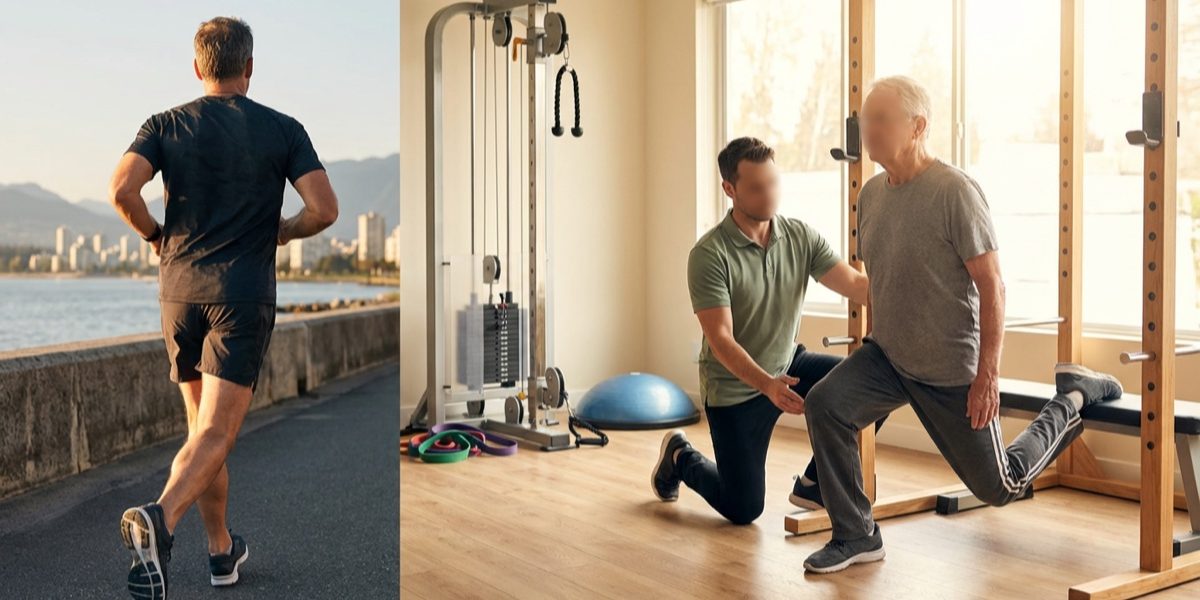
- Kinesiology / on-site rehab gym — supervised strength work, sport-specific patterning, and longevity-focused programming that aims to help masters athletes keep training and competing into their 60s and 70s.
The integrated approach is what compounds — it works on the symptom of the week and on the underlying capacity deficits together.
Longevity-Focused Strength Work in the On-Site Rehab Gym
This is a very high-leverage intervention for masters athletes. Strength training helps preserve muscle mass, maintains tendon stiffness in the right range, supports bone density, and can help reduce injury risk.
Our on-site rehabilitation gym — built out as part of the new 2025 facility — gives your kinesiologist:
- Squat rack and Olympic barbell — for the foundational compound lifts that drive total-body strength and bone density
- Cable column for graded resistance work in any plane
- Adjustable dumbbells from 1 lb up — for unilateral work, eccentric loading, and progressive tendon loading
- Slide board, BOSU, balance trainers — for the proprioception work that helps reduce the risk of falls and rolled ankles
- Plyometric boxes — for graduated impact and jump training (yes, masters athletes should still jump, properly loaded)
- Open floor for Turkish get-ups, carries, and the multi-plane work that sport-specific patterning depends on
A typical longevity-focused program for a 50-year-old runner might be: 2 supervised gym sessions per week (one strength-focused, one mobility/balance-focused) plus your usual run training. After 8–12 weeks many runners notice a stronger base and better-feeling runs; individual results vary.
Insurance and Coverage
- Extended health plans often include RMT, physio, acupuncture, and chiropractic. We can bill many insurers directly, including Pacific Blue Cross, Sun Life, Manulife, Green Shield and Canada Life; you pay only the part your plan does not cover (co-pay, deductible or amounts above your plan maximum).
- ICBC — applies if a current injury followed a motor vehicle accident. ICBC pre-approves up to 12 RMT, 12 acupuncture, 25 physiotherapy, 25 chiropractic and 12 kinesiology treatments, and within the first 12 weeks after the crash no doctor’s referral or ICBC approval is needed (bring your claim number and BC PHN). We bill ICBC directly for your pre-approved treatments. If part of a fee is not covered by ICBC (a user fee), we tell you before your treatment.
- WorkSafeBC — if the injury was work-related: with an accepted claim we bill WorkSafeBC directly, and approved services are not charged to you (massage therapy needs a doctor’s referral).
Apart from massage therapy under a WorkSafeBC claim, you do not need a doctor’s referral to book with us; some extended health plans ask for one before they reimburse, so check your plan.
Realistic Recovery Timelines (Masters-Adjusted)
These are based on what we see in the 35–65 population in our clinic; individual results vary. Younger ranges generally apply to 35–45; older ranges to 50–65:
- Acute hamstring strain (Grade 1) — 3–6 weeks
- Acute hamstring strain (Grade 2) — 6–12 weeks
- Achilles tendinopathy — 8–16 weeks of structured eccentric loading
- Plantar fasciitis — 8–16 weeks
- Lateral epicondylitis (tennis elbow) — 8–14 weeks
- Rotator cuff strain (no tear on imaging) — 6–12 weeks
- Rotator cuff partial tear — 8–16 weeks of conservative care; surgical referral if function doesn’t return
- Frozen shoulder — 6–18 months from onset; treatment aims to ease symptoms and support recovery
- Acute low back episode — 2–6 weeks; rebuilding strength can help lower the risk of recurrence
- Knee OA flare — 2–6 weeks for the flare; ongoing strength and load management for the long term
Across all of these, structured strength rebuilding is often part of recovery and can help lower the risk of the next injury.
Frequently Asked Questions
Am I too old to start lifting weights?
No. Research consistently shows that structured resistance training can be safe and beneficial for healthy adults at any age, including into the 80s and 90s. We start with appropriate progressions for your current capacity. There is no age at which it becomes too late.
Will my old injuries always come back?
Often no. Many “old injuries” we see are not really chronic — they’re just untreated. After a structured 8–16 week treatment program, many patients report a clear improvement in their symptoms, although individual results vary.
Do I need imaging before I come in?
Usually no. Most masters athlete injuries are diagnosed clinically. If imaging is needed (MRI for suspected significant tendon tear, X-ray for suspected fracture), we send the referral letter. Important caveat: imaging in older athletes often shows degenerative findings that aren’t the actual cause of pain. We interpret imaging in context of what the assessment shows.
Do you direct bill ICBC and extended health?
Yes for ICBC and most major insurers — Pacific Blue Cross, Sun Life, Manulife, Green Shield, Canada Life. Bring your insurance card.
Should I keep training while I’m being treated?
Almost always yes, with adjusted volume and intensity. Total rest is rarely the answer — it leads to deconditioning that delays recovery further. We give you specific weekly limits.
Can acupuncture really help chronic tendinopathies?
It may help. Acupuncture is often used as a supportive treatment for tendinopathies (Achilles, patellar, lateral epicondylitis) and myofascial pain. Many masters athletes notice a difference after a few sessions, and it can be particularly useful for chronic cases that have not responded to passive care alone. Individual results vary.
I’m a Vancouver masters runner training for the BMO Marathon — when should I come in?
Two to three sports massage sessions in the 6–8 weeks before the race may help reduce injury risk. One session within a week of race day for full-body recovery. Any nagging issue from the build should be assessed at least 6 weeks out so we have time to address it without affecting the race.
Do you have evening or weekend appointments?
Yes — open seven days a week, 8 am – 8 pm. Availability varies by practitioner; booking ahead online at artemis.janeapp.com secures your preferred time, and walk-ins are also welcome.
What’s the single best thing a masters athlete can do for longevity?
Two answers, equally important. First: build and maintain a strength base — twice-weekly resistance training is the highest-leverage intervention. Second: treat issues early. The masters athletes who stay healthy aren’t the ones with no problems; they’re the ones who address problems at week 2 instead of week 12.
Book Your Masters Athlete Assessment
Book online at artemis.janeapp.com or call 604-242-2233. We’re at 5911 No. 3 Rd #130, Richmond, BC, two minutes from Brighouse SkyTrain, with on-site rehab gym, multidisciplinary team, evening hours, and direct billing for ICBC, Pacific Blue Cross, Sun Life, Manulife, Green Shield, Canada Life, and WorkSafeBC.
For related guidance see our Sports Injury Treatment in Richmond BC, Sports Massage Therapy in Richmond, Kinesiology and Active Rehabilitation guide, and Senior Health and Rehabilitation in Richmond BC.