
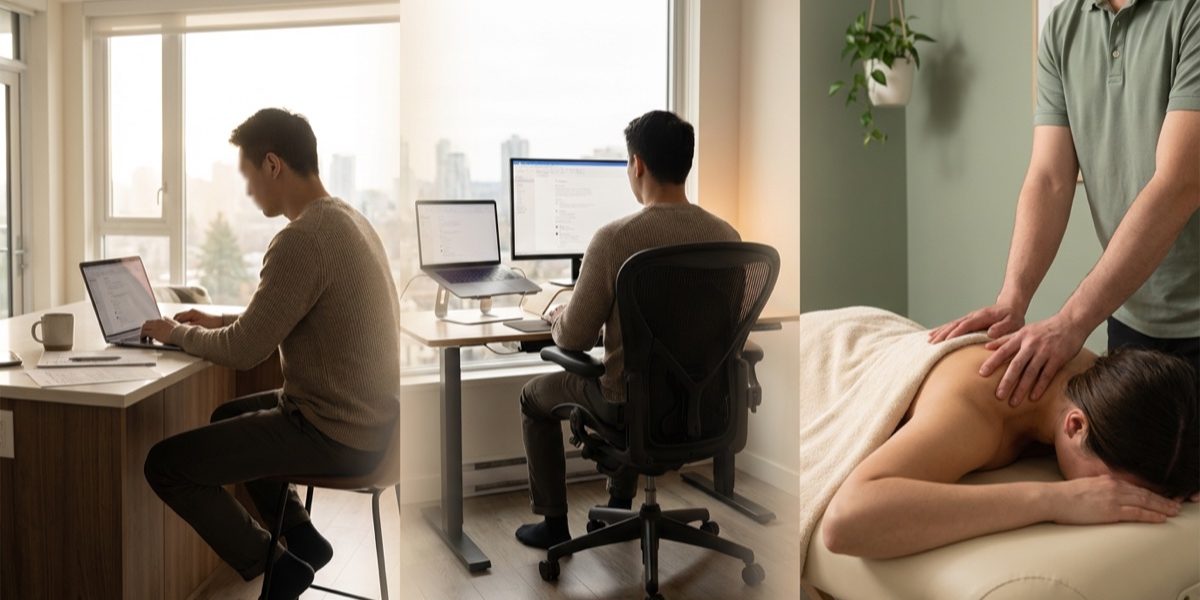
The hybrid work era has changed how musculoskeletal injuries show up in our Richmond clinic. The classic “office worker” pattern — pain caused by 8 hours at one good ergonomic desk — has been overtaken by the hybrid pattern: three days a week at a properly set up office workstation, two days a week hunched over a laptop on the kitchen table or sofa. Two completely different postures, neither one quite right, ten or twelve hours a day in each, and a body that never gets to consolidate one pattern before flipping to the other. At Artemis Wellness Clinic at 5911 No. 3 Rd #130, Richmond, BC — two minutes from Brighouse SkyTrain — our team treats hybrid-worker pain through coordinated RMT, physiotherapy, acupuncture, chiropractic, and kinesiology, with strength rebuild work in our on-site rehab gym. Book at artemis.janeapp.com or call 604-242-2233.
This guide covers the patterns we see in hybrid workers across Vancouver and Richmond, when to come in, what an integrated treatment plan looks like, and how to set yourself up so this doesn’t keep recurring. For a pure office-focused breakdown see our companion Office Worker Desk Pain Treatment in Richmond BC article.
Why Hybrid Workers Get Different Injuries
Pure office workers and pure work-from-home workers each settle into a single posture — for better or worse. Hybrid workers don’t. The constant switching between two different setups produces a distinct injury profile:
- Mid-back (thoracic) tension — the hallmark hybrid pattern. Days at the office in a forward-leaning position, days at home in a slightly different forward-leaning position. The thoracic spine never sets into one pattern long enough for compensation to stabilize, but it also never gets the full recovery of consistent good posture. Result: chronic low-grade tension.
- Cervical pain with headaches — laptop days are particularly bad for the neck. A laptop screen sits 30+ centimetres lower than an external monitor, which means the neck flexes more, the upper trapezius takes more load, and headaches become a daily background.
- Right-shoulder elevation pattern — mousing on a laptop pushes the right shoulder forward and up. Two days a week of this is enough to set up a chronic right-side trap and levator pattern.
- Wrist and forearm tendinopathy — laptop trackpads encourage thumb-and-index finger overuse. We’ve seen a sharp uptick in De Quervain’s tenosynovitis, lateral epicondylitis (tennis elbow), and “mouse arm” complaints since hybrid became normalized.
- Low back pain (sofa workers especially) — working from a sofa or low-back chair compresses the lumbar spine into sustained flexion. Even one day a week of this can cause chronic low back pain in someone whose other days are fine.
- Hip flexor tightness and glute deactivation — long sedentary blocks (whether at office or home) shorten the hip flexors and shut down glute firing. This shows up as hip pain, low back pain, and reduced exercise tolerance on weekends.
The shape of the problem matters: most hybrid workers attribute their pain to one of the two settings (“it must be my home setup”) when the actual driver is the switching itself — the fact that the body never settles into either pattern fully.
When to Come In
Most hybrid workers wait too long. The pain becomes background, manageable with ibuprofen, and treatment gets postponed until something acute happens. By the time we see the patient, the pattern has been compounding for months or years.
Come in if any of these apply:
- Daily background neck or upper back tension that’s been present for 4+ weeks
- Headaches more than once or twice a week, especially in the late afternoon
- Pain that wakes you up or is present first thing in the morning
- Pain that limits exercise — you’ve stopped going to the gym because your back “isn’t right”
- Numbness or tingling in the hands or fingers (especially morning or end-of-day)
- Wrist or forearm pain after laptop days
- A new acute episode (sharp pain, sudden range-of-motion loss) — come in this week
You don’t need a doctor’s referral to see an RMT, physiotherapist, acupuncturist, chiropractor, or kinesiologist in BC.
How to Get Here
We’re at 5911 No. 3 Rd #130, Richmond, BC, two minutes from Brighouse SkyTrain. The Canada Line drops you across the street, which makes us easy to reach from downtown Vancouver offices. Many of our hybrid-worker patients book lunchtime or end-of-day appointments and Canada Line both ways.
Open seven days a week, 8 am – 8 pm.
Our Multidisciplinary Approach to Hybrid-Worker Pain
A hybrid-worker pain pattern is rarely a single tissue. It’s a layered combination of:
- Sustained postural tension in the upper trapezius, levator scapulae, suboccipitals, rhomboids, and pec minor
- Hypomobile thoracic spine, especially T3–T7
- Hip flexor shortening and glute medius weakness
- Forearm extensor and flexor overuse from keyboard and mouse
- Postural strength deficits — middle trapezius, lower trapezius, and deep cervical flexors are usually weak
Treating only one of these (e.g., “just get a massage every two weeks”) often gives temporary relief that fades within days. The integrated approach can help with more durable change. Our team:
- Physiotherapy — postural assessment, joint mobility work (especially thoracic), nerve mobility screening, manual therapy, and the postural strengthening program. Your physio will also walk through your home setup with you (we have a checklist).
- Registered Massage Therapy (RMT) — the foundational tissue work for upper trap, levator, suboccipital, pec minor, and lateral neck. Many hybrid workers book RMT every 3–4 weeks during heavy-load periods.
- Acupuncture — may be helpful for tension headaches, chronic neck and shoulder tension, and the stress-related component of hybrid-work pain. Many patients find acupuncture deeply relaxing.
- Chiropractic — addresses the thoracic and cervical mobility deficits that maintain the postural pattern. Restoring T3–T7 mobility can be an important part of care for chronic upper back tension.
- Kinesiology / on-site rehab gym — supervised postural strength work: middle trap activation, scapular control, deep cervical flexor training, and the glute and hip flexor work that addresses the lower-body component.
A typical first month: physio assessment + RMT in week 1, RMT + acupuncture in week 2, chiropractic + kinesiology in week 3, RMT + kinesiology in week 4. Coordinated so each visit builds on the last.
Postural Strength Work in the On-Site Rehab Gym
This is the part that often gets skipped. Massage, acupuncture and chiropractic can all help reduce symptoms — but if the underlying postural strength deficit isn’t addressed, the pattern often returns within weeks of the last session.
Our on-site rehabilitation gym — built out as part of the new 2025 facility — gives your kinesiologist:
- Cable column with adjustable pulleys for face pulls, scapular retraction, and band-pull-aparts
- Resistance bands for deep cervical flexor activation (a cornerstone exercise for tech-neck recovery)
- Squat rack and barbell for posterior chain rebuilding
- Foam rollers and trigger-point tools for self-management between sessions
- Open floor for thoracic mobility work, banded pulls, and yoga-influenced postural drills
- Dumbbells from 1 lb up — for graded eccentric forearm and wrist work to address the laptop-day “mouse arm” pattern
A typical postural rebuild program runs 8–12 weeks, with 1–2 supervised sessions per week and a short home program in between. By the end, many patients notice a clear reduction in symptoms and have a maintenance routine they can run independently. Individual results vary.
Workstation Triage — The Five Highest-Impact Changes
Before any treatment will fully take hold, the workstation pattern has to change. Our physio team will walk through your specific setup — but for hybrid workers the highest-impact universal changes are:
- External monitor at home, even small. A $150 24-inch display at eye level transforms laptop days. The single best ergonomic investment a hybrid worker can make.
- Wireless keyboard and mouse for laptop days. With the laptop raised on a stand and a separate keyboard/mouse, your home setup approximates your office setup.
- Stand for half of every laptop block. A stack of books works fine. Standing for half of every laptop hour radically reduces the cumulative load.
- Chair height matched between settings. Different chair heights at office and home produce different shoulder and elbow loads, and your body doesn’t get to consolidate one pattern. Match them within an inch.
- No working on the sofa, ever. This is the one rule with no exceptions. Sofa work loads the lumbar spine in flexion in a way that nothing in the office or proper desk setup does.
Insurance and Coverage
- Extended health plans often include RMT, physio, acupuncture, and chiropractic. We can bill many insurers directly at the front desk, including Pacific Blue Cross, Sun Life, Manulife, Green Shield and Canada Life; you pay only the part your plan does not cover (co-pay, deductible or amounts above your plan maximum).
- WorkSafeBC — if your pain is determined to be work-related and your claim is accepted, we bill WorkSafeBC directly for physio, RMT, and active rehab. Your employer’s HR or your physiotherapist can help with the WSBC claim.
- ICBC — applies if your neck or back pain followed a motor vehicle accident; the rear-end-then-WFH-recovery pattern is one of the most common combined cases we see.
You don’t need a doctor’s referral to book with us; WorkSafeBC massage therapy claims do require one.
Realistic Recovery Timelines
- Acute hybrid-worker neck flare — 2–4 weeks of treatment to baseline; longer if postural strength rebuild is needed
- Chronic upper back tension (months or years of pattern) — 8–16 weeks of integrated treatment + strength rebuild
- Tension headaches — many patients see a reduction within 3–6 sessions; a full program usually runs 8–12 weeks
- Mouse arm / laptop wrist pain — 4–8 weeks of focused treatment plus equipment changes
- Sofa-related low back pain — 2–8 weeks; depends entirely on whether the sofa-working pattern stops
The single biggest predictor of recovery speed is whether the workstation triage actually happens. Patients who change their setup often improve faster; patients who don’t may find improvements hard to maintain. Individual results vary.
Frequently Asked Questions
I work three days at the office, two from home — is that the worst combination?
It’s the most common pattern we see, and yes, it tends to produce more upper back complaints than either pure office work or pure work-from-home. The switching itself is the issue, not either setting alone.
Do I need to bring photos of my home setup?
It helps. A wide shot of your home workstation taken from the side is the most useful single thing — it shows monitor height, chair posture, and arm position. Email it to us before your first visit if you’d like an ergonomics-focused first session.
Can I really change a years-old pain pattern?
Often, yes. Many patients who’ve had chronic upper back tension or headaches for 5+ years notice a clear reduction in symptoms within 8–12 weeks of integrated treatment plus strength rebuild plus workstation changes. Individual results vary.
Do you direct bill extended health, ICBC, and WorkSafeBC?
Yes for ICBC, WorkSafeBC (with an accepted claim), and many extended health plans (Pacific Blue Cross, Sun Life, Manulife, Green Shield, Canada Life); you pay only the part your plan does not cover. Bring your insurance card.
Can acupuncture really help tension headaches?
It can help — there is encouraging research on acupuncture for both episodic and chronic tension-type headaches. Many patients notice improvement within 3–6 sessions; individual results vary.
I’m getting hand numbness when I wake up — what is it?
Most often a combination of cervical nerve irritation and median nerve compression at the wrist. We screen at visit one and tailor treatment to whichever is the dominant driver. See our Carpal Tunnel Syndrome Treatment in Richmond BC for the pure wrist version.
Do you have evening or weekend appointments?
Yes — open seven days a week, 8 am – 8 pm. Lunchtime appointments are popular with downtown Vancouver hybrid workers because the Canada Line is so direct.
I don’t have time for the gym — can I just get massages?
You can, and they can help — for a while. The reason we built the on-site rehab gym is exactly this: most patients won’t do the strength work on their own at a separate facility, but they will do it during a clinic visit. Even one supervised session per week can make a meaningful difference.
Book Your Hybrid-Worker Assessment
Book online at artemis.janeapp.com or call 604-242-2233. We’re at 5911 No. 3 Rd #130, Richmond, BC, two minutes from Brighouse SkyTrain, with on-site rehab gym, multidisciplinary team, lunchtime and evening hours, and direct billing for ICBC, Pacific Blue Cross, Sun Life, Manulife, Green Shield, Canada Life, and WorkSafeBC.
For related guidance see our Office Worker Desk Pain Treatment in Richmond BC, Neck and Back Pain Treatment in Richmond BC, Carpal Tunnel Syndrome Treatment, and Sports Massage Therapy in Richmond.