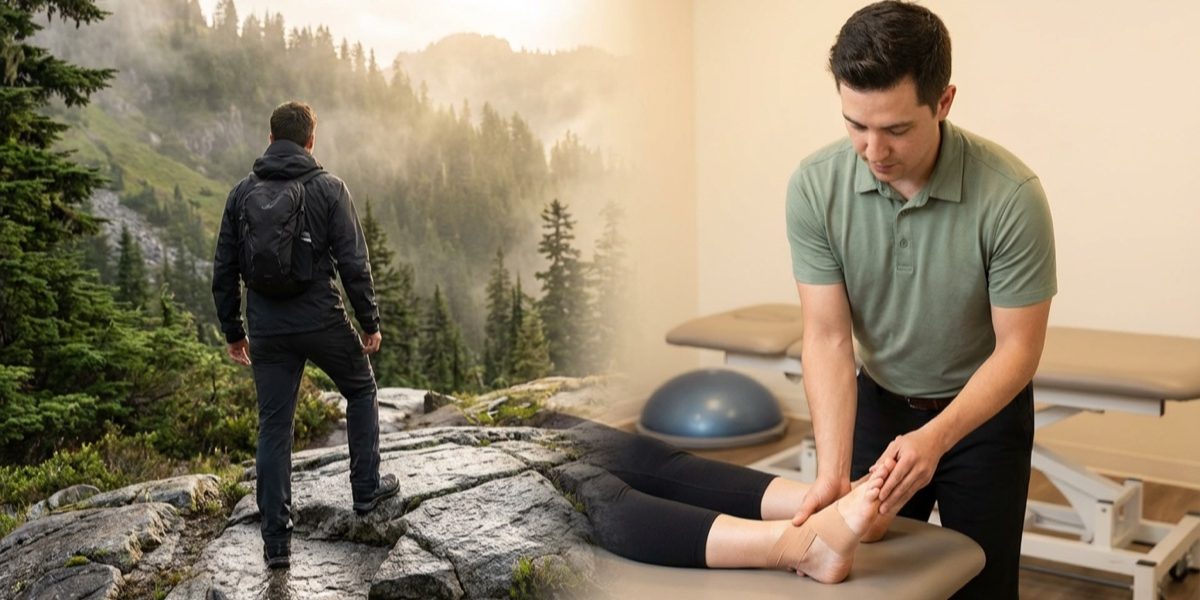
The Grouse Grind. The Chief. The BCMC. The Howe Sound Crest. Garibaldi Lake. Joffre. Lynn Peaks. The West Coast Trail. BC delivers some of the best hiking on the planet, and with the best hiking comes a predictable set of injuries: rolled ankles on root and rock, downhill knee pain, plantar fasciitis from heavy boots, IT band syndrome from sustained descents, and the universal hiker’s hip and lower back complaints from carrying a pack on uneven terrain. At Artemis Wellness Clinic at 5911 No. 3 Rd #130, Richmond, BC — two minutes from Brighouse SkyTrain — we treat hikers and trail runners every weekend through coordinated RMT, physiotherapy, acupuncture, chiropractic, and kinesiology, with structured return-to-trail programs in our on-site rehab gym. Book at artemis.janeapp.com or call 604-242-2233.
This guide covers the most common BC hiking injuries, when to come in, what an integrated treatment plan looks like, and how to keep your trail season on track.
What Hiking Injuries Look Like in BC
The terrain shapes the injuries. BC trails are typically rocky, root-laced, steep on both ascent and descent, often wet, and frequently exposed to weather changes mid-hike. The most common patterns we see:
- Lateral ankle sprains — the single most common hiking injury, almost always on a rolled ankle on a root or rock during descent. Severity ranges from mild ligament stretch (Grade 1) to a complete tear with major bruising and instability (Grade 3).
- Patellofemoral pain (“hiker’s knee”) — the dull ache behind the kneecap that arrives during long descents. The Grouse Grind down-trail (when it was open), the Chief descent, and any long alpine day produces this in deconditioned quads.
- IT band syndrome — sharp lateral knee pain that arrives at a predictable point in the descent. Common in hikers ramping volume too quickly.
- Plantar fasciitis — heel pain that’s worst on the first steps in the morning. Heavy boots, long days, and uneven loads accelerate this. See our Plantar Fasciitis Treatment in Richmond BC for the full protocol.
- Achilles tendinopathy — back-of-ankle stiffness, worst in the morning and at the start of a hike. Common in hikers who’ve recently increased boot weight or trail mileage.
- Hip and lower back pain — often pack-related; sometimes a result of a poorly fitting hip belt or asymmetric loading.
- Toe and toenail injuries — from boots that don’t fit properly, especially on long descents.
Trail runners add knee and Achilles overuse from harder, faster, more sustained efforts on the same terrain.
When to Come In
For acute injuries:
- Rolled ankle with immediate swelling, can’t bear weight → urgent care first to rule out fracture; come to us next for rehab.
- Rolled ankle with mild swelling, bearing weight is uncomfortable but possible → come to us within 72 hours. Early management may help shorten recovery.
- Sharp knee pain that started during a hike and has not resolved within 3 days → come in within a week.
- Plantar pain on first steps that hasn’t resolved within 2 weeks → come in.
- Concussion from a fall → physician first, then us for vestibular rehab and any musculoskeletal follow-up.
For overuse and post-hike soreness:
- Persistent pattern that returns at the same point in every hike → come in within 2 weeks.
- Chronic plantar fasciitis or Achilles pain through the season → come in now — these can worsen if ignored.
- General “everything is sore” after a big day → one or two RMT sessions plus a few stretches may help; not urgent.
How to Get Here from the Trailhead
We’re a straightforward drive from most North Shore trailheads. From Grouse, BCMC, Lynn Canyon, or Lynn Peaks, the simplest route is south on Highway 1 across Lions Gate, through downtown to the Cambie Bridge, then south through Vancouver to No. 3 Road. Most hikers do the route in under an hour. From Squamish (Stawamus Chief, Garibaldi area), it’s about 90 minutes via Highway 99 and the tunnel. From any North Shore trailhead, you can also drop your car and ride the Canada Line from Vancouver Waterfront to Brighouse SkyTrain — across the street from us at 5911 No. 3 Rd #130.
Open seven days a week, 8 am – 8 pm.
Our Multidisciplinary Approach to Hiking Injuries
A hiking injury is rarely just one tissue. A “simple” rolled ankle quickly becomes a kinetic-chain problem: the ankle is unstable, the knee compensates, the hip overworks, and within a few weeks you have low-back pain and an asymmetric gait. Treating only the ankle leaves the rest of the chain to flare. Our team integrates:
- Physiotherapy — orthopaedic assessment, ruling out fractures or ligament tears, manual therapy, taping, and the progressive loading and balance program. Our physios are experienced with BC hikers and will give you specific guidance on which trails you can attempt at each stage of recovery.
- Registered Massage Therapy (RMT) — focused work on the calf, soleus, peroneals, IT band, glutes, hip flexors, and quads. After a long hike or West Coast Trail, full-body deep-tissue work may help ease residual stiffness.
- Acupuncture — a supportive option for ankle sprains, plantar fasciitis, and Achilles tendinopathy. Some hikers notice some improvement the day after treatment; individual results vary.
- Chiropractic — addresses the lumbar and pelvic compensations that develop after prolonged limping or post-injury asymmetric gait.
- Kinesiology / on-site rehab gym — supervised balance and proprioception training, single-leg loading, and trail-specific functional progressions before you return to the BC alpine.
The On-Site Rehab Gym for Hikers and Trail Runners
A modern rolled-ankle rehab is not “ice it and rest.” Current best practice is early protected mobilization plus structured proprioception and progressive loading within the first two weeks. Research suggests this kind of structured training can lower the risk of chronic instability (which is what produces the second and third sprains).
Our on-site rehabilitation gym — built out as part of the new 2025 facility — gives your kinesiologist:
- BOSU and balance trainers for graded proprioception work
- Slide board for frontal-plane stability
- Cable column for controlled multi-plane loading
- Plyometric boxes for progressive impact loading toward return-to-trail
- Step-up platforms for downhill control simulation
- Open floor for agility ladder, lateral cutting, and uphill/downhill walk drills
A typical post-ankle-sprain return looks like: protected weight-bearing days 1–7 → balance and proprioception days 7–21 → progressive loading and short walk progression weeks 3–4 → flat trail return week 4–6 → uphill trail return week 6–8 → sustained downhill (the hardest test for ankles) week 8+. Your kinesiologist supervises in-clinic sessions and signs off on each progression.
Insurance and Coverage
- Extended health plans often cover RMT, physio, acupuncture, and chiropractic. We can bill many insurers directly, including Pacific Blue Cross, Sun Life, Manulife, Green Shield and Canada Life; you pay only the part your plan does not cover (co-pay, deductible or amounts above your plan maximum).
- ICBC — applies if your hiking injury followed a motor vehicle accident (e.g., you drove home from a hike and were rear-ended; the impact aggravated a tweaked ankle). Within the first 12 weeks after the crash, ICBC pre-approves up to 12 RMT, 12 acupuncture, 25 physiotherapy, 25 chiropractic and 12 kinesiology treatments. We bill ICBC directly for your pre-approved treatments. If part of a fee is not covered by ICBC (a user fee), we tell you before your treatment.
- WorkSafeBC — if hiking is part of your job (parks, search and rescue, conservation) and your claim is accepted, we bill WorkSafeBC directly, and approved physio, RMT and active rehab services are not charged to you.
For ICBC, no doctor’s referral or ICBC approval is needed within the first 12 weeks after the crash (bring your claim number and BC PHN). WorkSafeBC massage therapy needs a doctor’s referral; extended health plans vary, so check whether yours asks for one.
Realistic Recovery Timelines
- Grade 1 ankle sprain — 1–3 weeks; back to easy hiking in 2 weeks
- Grade 2 ankle sprain — 3–8 weeks; trail return in 6 weeks with bracing
- Grade 3 ankle sprain (full ligament tear) — 8–16 weeks; possible surgical referral
- Hiker’s knee (patellofemoral pain) — 3–6 weeks of treatment plus quad/glute strengthening
- IT band syndrome — 4–8 weeks of physio + RMT + load reduction
- Acute plantar fasciitis — 4–8 weeks of structured care
- Chronic plantar fasciitis — 8–16 weeks; usually slower than acute cases
- Acute Achilles tendinopathy — 6–12 weeks of eccentric loading
- Pack-related upper back pain — 1–4 weeks of treatment plus pack-fit adjustment
These are typical ranges; individual results vary.
Frequently Asked Questions
I rolled my ankle yesterday — should I rest it or come in?
Both. Use the first 24–48 hours for protected weight-bearing (ice, compression, elevation if very swollen, walking only as tolerated). Come in within 72 hours so we can assess severity, rule out fracture, and start early proprioception work. Early care may help reduce the risk of chronic instability.
Do I need an X-ray for a rolled ankle?
Not always. Your physiotherapist will use the Ottawa Ankle Rules to decide. If imaging is needed we’ll send a referral letter that day.
Do you direct bill ICBC and extended health?
Yes for ICBC and most major insurers — Pacific Blue Cross, Sun Life, Manulife, Green Shield, Canada Life.
Can I keep hiking while I’m being treated?
Often yes, with adjusted terrain and distance. We give you specific weekly limits — flat dyke walks before alpine ridges, for example.
I’m doing the West Coast Trail / Sunshine Coast Trail / Garibaldi traverse — when should I come in?
Two or three pre-trip sessions in the 6–8 weeks before to address any niggles, plus a return-to-trail screening. One session within a week of return for full-body recovery.
My plantar pain has been bothering me for months — is it too late?
No. Chronic plantar fasciitis can still be treated; it usually takes longer than acute cases. Many chronic cases improve over 8–16 weeks with a structured loading program; individual results vary.
Can acupuncture really help an acute ankle sprain?
It can be a supportive option. Some research suggests acupuncture may help reduce pain and swelling after acute soft-tissue injuries; individual results vary.
What about pack fit — do you do that?
We don’t sell or fit packs, but we identify pack-related injury patterns and refer to local outdoor retailers (MEC, Valhalla Pure) for proper pack fitting when needed.
Do you have evening or weekend appointments?
Yes — open seven days a week, 8 am – 8 pm. Availability varies by practitioner; check live times at artemis.janeapp.com.
Book Your Trail Recovery Assessment
Don’t let an injury cut your hiking season short. Book online at artemis.janeapp.com or call 604-242-2233. We’re at 5911 No. 3 Rd #130, Richmond, BC, two minutes from Brighouse SkyTrain, with on-site rehab gym, multidisciplinary team, and direct billing for ICBC, Pacific Blue Cross, Sun Life, Manulife, Green Shield, Canada Life, and WorkSafeBC.
For related guidance see our Sports Injury Treatment in Richmond BC, Plantar Fasciitis Treatment, Sports Massage Therapy in Richmond, and Kinesiology and Active Rehabilitation guide.