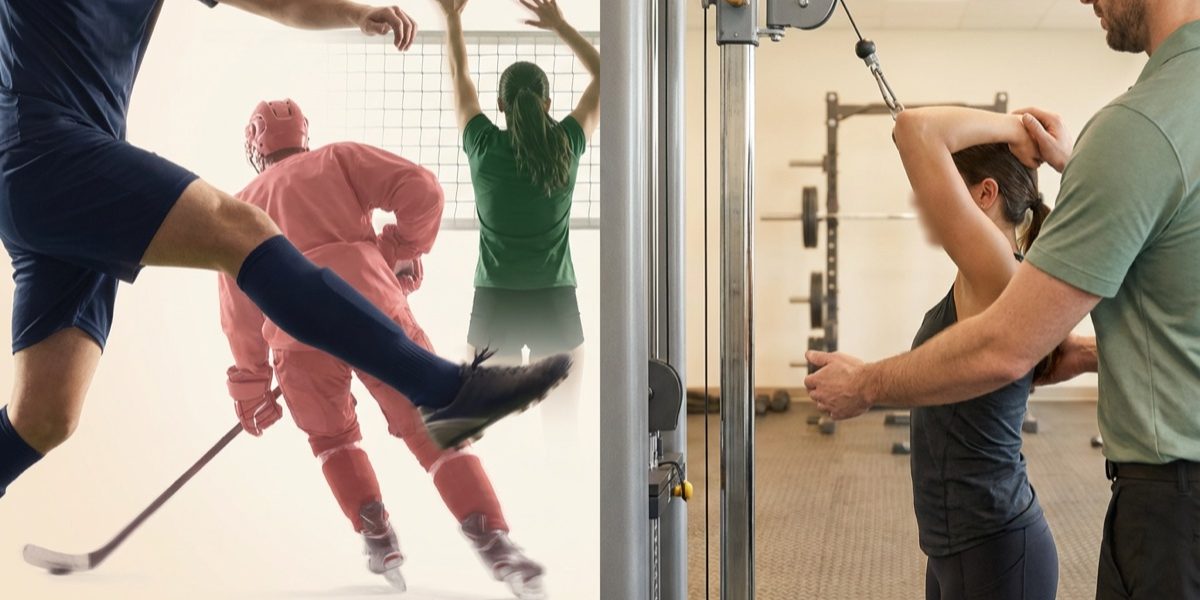
Adult recreation leagues are the lifeblood of Richmond and Vancouver fitness. Soccer at Minoru Park. Hockey at Richmond Ice Centre. Volleyball at Richmond Olympic Oval. Basketball, ultimate frisbee, rugby, pickleball, dragon boat — every season brings a new wave of “I rolled my ankle in a Tuesday-night league” patients to our door. At Artemis Wellness Clinic at 5911 No. 3 Rd #130, Richmond, BC — two minutes from Brighouse SkyTrain — our team treats team-sport injuries through coordinated RMT, physiotherapy, acupuncture, chiropractic, and kinesiology, with structured return-to-sport progressions in our on-site rehab gym. Book at artemis.janeapp.com or call 604-242-2233.
This guide covers the most common adult-league injuries we see across Richmond, when to come in, what an integrated treatment plan looks like, and how we get you back on the field, ice, or court for next season.
What Team Sport Injuries Look Like
Different sports produce different injury patterns. The most common we see at our clinic:
- Soccer / futsal — hamstring strains, groin (adductor) strains, ankle sprains, knee ligament injuries (ACL, MCL), calf strains, plantar fasciitis
- Ice hockey — groin strains, hip flexor strains, shoulder AC joint injuries, low back pain, concussion
- Basketball — ankle sprains (the most common single injury we see in adult leagues), knee tendinopathies (jumper’s knee), Achilles tendinopathy and ruptures, finger sprains
- Volleyball — shoulder rotator cuff strain (especially in spike-heavy positions), patellar tendinopathy, ankle sprains, lower back from constant flexion
- Ultimate frisbee — ACL tears (sudden cuts on cleated foot), hamstring strains, shoulder labral strain (long throws), ankle sprains
- Rugby — concussion, AC joint injuries, hamstring and quad strains, knee ligament injuries
- Pickleball — Achilles tendinopathy and ruptures, ankle sprains, lateral epicondylitis (tennis elbow), patellofemoral pain — these injuries have surged in our clinic over the last 24 months as the sport’s adult uptake has accelerated.
- Dragon boat — shoulder, lower back, and forearm tendinopathies from the repetitive paddle stroke
We also see plenty of contact injuries — collisions, contusions, bone bruising — and the universal post-tournament “I’m 35 and I just played four games in a weekend” pattern.
When to Come In
Standard sports rules:
- Any acute pop or snap, immediate inability to continue, immediate swelling → urgent care first to rule out fracture or major ligament tear; come to us next for rehab.
- Any concussion symptoms (headache, fogginess, balance changes) → physician or urgent care first; we provide vestibular rehab and progressive return-to-sport once cleared.
- A “tweak” you can play through but feel during and after → come in within 1 week. Catching it early can help keep a small injury from becoming a season-ending one.
- Lingering soreness 5+ days after a game → come in. Most adults dismiss this as “getting old”; usually it’s a treatable strain or tendinopathy.
- Repeated ankle sprains in the same ankle → come in for a structured proprioception and strength program. Chronic ankle instability is one of the most preventable repeat-injury patterns we see.
How to Get Here from Your Game
We’re directly accessible from most Richmond and South Vancouver venues:
- Minoru Park / Minoru Arenas — 4 minutes by car
- Richmond Olympic Oval — 7 minutes
- Richmond Ice Centre — 5 minutes
- South Arm Outdoor Pool / Steveston Park — 10 minutes
- UBC fields — 30 minutes via Bridgeport
- Vancouver Curling Club / Hillcrest — 25 minutes via Cambie
Our address is 5911 No. 3 Rd #130, Richmond, BC, with Brighouse SkyTrain two minutes away. There is free parking behind the clinic (stalls 47–48, weekdays) and 3-hour free parking at the PriceSmart plaza on Ackroyd Road. Open seven days a week, 8 am – 8 pm.
Our Multidisciplinary Approach to Team Sport Injuries
A team-sport injury is rarely just one tissue. A hamstring strain comes with low-back compensation. An ankle sprain produces hip and quad guarding within days. A concussion brings cervical and vestibular components. Treating only the obvious injury leaves the rest of the chain to flare into the second injury. Our team integrates:
- Physiotherapy — orthopaedic assessment, ruling out fractures or major ligament tears, manual therapy, taping, and the loading program. Our physios are experienced with adult-league athletes and tailor the return-to-sport timeline to your league schedule, not a generic textbook.
- Registered Massage Therapy (RMT) — focused work on the strained muscle and the upstream/downstream chain. After a heavy tournament weekend, full-body RMT may help ease the residual soreness.
- TCM-based acupuncture — may be used as a supportive option for muscle strains (hamstring, calf, adductor), tendinopathies (Achilles, patellar) and the acute phase of ankle sprains. Some athletes notice less pain and swelling after treatment; individual results vary.
- Chiropractic — addresses the spinal and pelvic compensations that develop with prolonged guarding and asymmetric movement.
- Kinesiology / on-site rehab gym — supervised return-to-sport progressions, sport-specific drills, and strength work that aims to lower the risk of a second injury.
For collision injuries (especially hockey and rugby), if there’s any concussion concern we screen at visit one and coordinate with your physician for clearance before progressing.
Return-to-Sport Through the On-Site Rehab Gym
Return-to-sport is an often-overlooked part of musculoskeletal recovery. “The pain is gone, you can go back” is not enough — re-injury rates are high when athletes return without restored strength symmetry, sport-specific movement competence, and progressive impact loading.
Our on-site rehabilitation gym — built out as part of the new 2025 facility — gives your kinesiologist:
- Squat rack and Olympic platform for posterior chain reloading (critical for hamstring and ACL recovery)
- Cable column for sport-specific resisted patterns (rotation, single-leg pulls, pushes)
- Slide board for frontal-plane stability (key for soccer, hockey, basketball cuts)
- BOSU and balance trainers for proprioception (critical for chronic ankle instability)
- Plyometric boxes for graduated impact and jump training (volleyball, basketball, ultimate)
- Open floor for agility ladder, lateral cut, and acceleration/deceleration drills
- Dummy bag and resistance bands for sport-specific contact simulation
A typical return-to-sport progression might be: pain-free walking → jogging → straight-line running → cutting and pivoting → controlled scrimmage → full game. Your kinesiologist supervises in-clinic sessions and signs off on each progression. The aim is to lower the risk of re-injury in the first weeks back.
Insurance and Coverage
- Extended health plans cover RMT, physio, acupuncture, and chiropractic. We can bill many insurers directly, including Pacific Blue Cross, Sun Life, Manulife, Green Shield and Canada Life; you pay only the part your plan does not cover (co-pay, deductible or amounts above your plan maximum).
- ICBC — applies if your sport injury followed a motor vehicle accident (e.g., the rear-end collision on the way home from the game aggravated a strain). Within the first 12 weeks after the crash, no doctor’s referral or ICBC approval is needed (bring your claim number and BC PHN); ICBC pre-approves up to 12 RMT, 12 acupuncture, 25 physiotherapy, 25 chiropractic and 12 kinesiology treatments. We bill ICBC directly for your pre-approved treatments. If part of a fee is not covered by ICBC (a user fee), we tell you before your treatment.
- WorkSafeBC — if the injury was work-related (e.g., physical job, security work, on-shift incident): with an accepted claim we bill WorkSafeBC directly, and approved services (physio, RMT, active rehab) are not charged to you. Massage therapy needs a doctor’s referral.
Many of our adult-league athletes also use a combination — initial visits on extended health, then ICBC if a separate accident is involved.
Realistic Recovery Timelines
These are typical approximate ranges for general information; every recovery is different:
- Grade 1 hamstring strain — 2–4 weeks to return-to-play
- Grade 2 hamstring strain — 4–8 weeks
- Grade 3 hamstring strain (full tear) — 12+ weeks; surgical referral if proximal avulsion
- Grade 1 ankle sprain — 1–3 weeks
- Grade 2 ankle sprain — 3–8 weeks with bracing
- Grade 3 ankle sprain — 8–16 weeks; possible surgical referral
- Adductor (groin) strain — 3–8 weeks; recurrence is common without proper rehab
- Patellar tendinopathy (“jumper’s knee”) — 6–12 weeks of structured eccentric loading
- Achilles tendinopathy — 8–16 weeks of eccentric loading
- Achilles rupture — surgical or conservative pathway, both 6–12 months to full return-to-sport
- AC joint sprain — 4–8 weeks for Grade 1, 8–12 weeks for Grade 2
- Concussion — 2–6 weeks for typical case; longer with persistent symptoms
Frequently Asked Questions
Do I need a doctor’s referral?
No. You can self-refer to RMT, physio, acupuncture, chiropractic, and kinesiology in BC. For ICBC, no doctor’s referral or ICBC approval is needed within the first 12 weeks after a crash; for WorkSafeBC, massage therapy needs a doctor’s referral; extended health plans vary, so check with your insurer.
Do you direct bill ICBC and extended health?
Yes for ICBC and most major insurers — Pacific Blue Cross, Sun Life, Manulife, Green Shield, Canada Life. Bring your insurance card and we’ll confirm coverage at check-in.
Can I keep playing while being treated?
It depends on injury severity. Mild strains and tendinopathies — often yes, with adjusted volume. Acute Grade 2+ sprains — usually no, you need to let the tissue heal first. Your physio will give you specific guidance based on your league schedule and the tissue involved.
My team has a tournament this weekend — should I cancel?
Come in this week for an assessment. We can give you a clear yes/no and a strapping/bracing plan if you can play. Pushing through a Grade 2 ligament injury for one tournament can cost you 6 weeks; we’d rather you sit out the weekend and play the rest of the season.
Can acupuncture help with muscle strains?
Acupuncture may be used as a supportive treatment for hamstring, calf and adductor strains. Some athletes notice improvement after a few sessions; individual results vary. It is usually combined with RMT and progressive loading.
I’ve sprained the same ankle three times this year — what’s wrong?
You have chronic ankle instability — extremely common in basketball, soccer, and volleyball players. A structured proprioception and strength program can help improve ankle stability. Research shows that structured balance and strength training helps lower the risk of another sprain.
Do you have evening or weekend appointments?
Yes — open seven days a week, 8 am – 8 pm. Sunday and Monday evenings book first (the highest-volume post-game day); book a week ahead.
What about pickleball injuries — are they really that common?
In our clinic the answer is unequivocally yes. Pickleball is now one of the top three sources of adult-league sports injuries we treat, especially Achilles tendinopathy/rupture, lateral epicondylitis (tennis elbow), and ankle sprains. The sport rewards bursts of acceleration, lateral cutting, and sustained reaction time — all in a population that often hasn’t done that pattern of movement in decades.
Can I see multiple practitioners in one day?
Yes — many of our patients book back-to-back sessions (e.g., physio assessment followed by RMT, or acupuncture followed by kinesiology). Coordinated same-day care is one of the main reasons we built the clinic this way.
Book Your Sport Injury Assessment
Is an injury affecting your season? Book online at artemis.janeapp.com or call 604-242-2233. We’re at 5911 No. 3 Rd #130, Richmond, BC, two minutes from Brighouse SkyTrain, with on-site rehab gym, multidisciplinary team, evening hours, and direct billing for ICBC, Pacific Blue Cross, Sun Life, Manulife, Green Shield, Canada Life, and WorkSafeBC.
For related guidance see our Sports Injury Treatment in Richmond BC, Sports Massage Therapy in Richmond, Kinesiology and Active Rehabilitation guide, and Whiplash and Car Accident Injury Treatment.