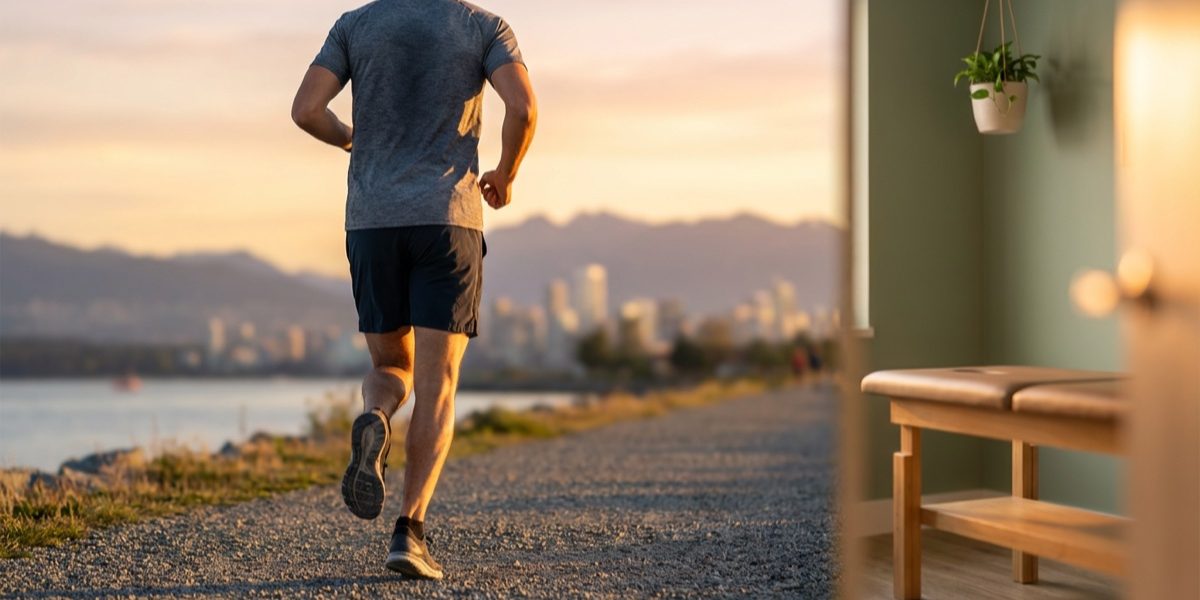
Running injuries follow Vancouver’s race calendar. We see the first wave of new patients in late January as Sun Run training kicks off, a second peak in March and April leading into the Vancouver Sun Run and BMO Vancouver Marathon, and a third wave in August/September during fall marathon training. At Artemis Wellness Clinic at 5911 No. 3 Rd #130, Richmond, BC — two minutes from Brighouse SkyTrain — our team treats a wide range of running injuries through coordinated RMT, physiotherapy, acupuncture, chiropractic, and kinesiology, with progressive return-to-running plans run out of our on-site rehab gym. Book at artemis.janeapp.com or call 604-242-2233.
This guide covers the most common Richmond and Vancouver running injuries, when to come in versus push through, what an integrated treatment plan looks like, and how we plan treatment around your race timeline.
The Five Running Injuries We See Most Often
Eighty percent of running clinic visits in our experience fall into five categories. Recognizing which one you’re dealing with helps you decide whether to back off this week or come in immediately.
- Patellofemoral pain (“runner’s knee”) — pain at or behind the kneecap, worse going downstairs and on long downhill segments. This is the single most common diagnosis we see in Richmond runners. It’s almost always a load-management plus glute/quad strength issue, not a structural one.
- IT band syndrome — sharp lateral knee pain that arrives at a predictable distance into your run (often around 30–40 minutes). Cyclists also get this; for runners it’s mileage-related and is often managed with RMT release plus hip strengthening.
- Shin splints (medial tibial stress syndrome) — diffuse aching along the inner shin. New runners and runners ramping mileage too fast are at highest risk. We rule out stress fracture first; if it’s true shin splints, a typical plan aims to have you running again in 2–4 weeks.
- Plantar fasciitis — heel pain on the first steps in the morning that warms up but returns. Common in marathoners ramping long-run distance. See our dedicated Plantar Fasciitis Treatment in Richmond BC guide for the full protocol.
- Achilles tendinopathy — stiffness and pain at the back of the ankle, worst first thing in the morning and during the first kilometre of a run. Acute cases often settle sooner; chronic cases usually need progressive eccentric loading in our rehab gym.
We also routinely treat hamstring strains, calf strains, hip flexor tendinopathy, sacroiliac joint pain, and stress reactions in tibia and metatarsals.
When to Come In, When to Adjust on Your Own
Run through the following filter:
- Pain that is sharp, localized to one spot, and present at rest → come in this week.
- Pain that worsens during a run rather than warming up → come in this week.
- A limp during the run, or 24+ hours after → come in this week.
- Diffuse soreness that warms up, doesn’t worsen, and resolves within 24 hours → likely manageable with a rest day, ice after the next run, and a session of Sports Massage within the next two weeks.
- Any acute pop, snap, or sudden inability to bear weight → urgent care or ER first, then us for rehab.
For Sun Run trainees in March or marathoners in their last 6 weeks of build, we lower the threshold: come in earlier, even for “minor” issues. Dealing with a small issue early is usually simpler than dealing with a bigger one later.
How to Get Here from Your Run
We’re a 7-minute walk from the Brighouse SkyTrain terminus, the southern endpoint of the Canada Line. Most Vancouver runners can be at our front door 25 minutes after stepping off the seawall at Cambie Bridge. From the Richmond dyke loop (West Dyke or Middle Arm) we’re a short ride south on No. 3 Road. If you drove from a long run start at Garry Point Park, Iona Beach, or the Pitt Meadows–Coquitlam dykes, there are two free parking stalls (47 and 48) behind the unit — enter from Ackroyd Road or Firbridge Way; the parkade is closed on Saturdays and Sundays. There is also paid street parking on the side street, and free 3-hour parking at the PriceSmart plaza across the street on Ackroyd Road.
Open seven days a week, 8 am – 8 pm.
Our Multidisciplinary Approach to Running Injuries
A running injury is rarely one tissue. It’s a load-versus-capacity mismatch that shows up at the weakest point — usually the knee, foot, or shin — but the cause is upstream in the hip, the gait, or the training plan. That’s why we look at the hip, the gait and the training plan, not only at the painful spot.
Our team integrates:
- Physiotherapy — gait assessment, orthopaedic special tests, ruling out stress fractures or structural issues, hands-on manual therapy, and the progressive loading program.
- Registered Massage Therapy (RMT) — focused work on the calf, soleus, IT band, glute medius, and TFL — the muscles that often tighten around running injuries. Some runners book sports massage every 2–3 weeks during heavy training as part of their injury-prevention routine.
- Acupuncture — needling around the painful area (Achilles, plantar fascia, lateral knee) plus distal points, which may help with pain management alongside the loading program. Some runners report feeling less pain after a session; individual results vary.
- Chiropractic — assesses and treats pelvic and lumbar joint restrictions that may contribute to uneven gait. A 1cm functional leg-length difference can be enough to cause persistent unilateral runner’s knee.
- Kinesiology / on-site rehab gym — supervised return-to-running progressions, hip and core strength work, single-leg loading, and sport-specific drills.
Your team shares one chart and talks to each other. The physiotherapist who diagnosed your IT band syndrome can directly hand off to the RMT for tissue work and the kinesiologist for hip strength work — same building, same week.
Return-to-Running Through the On-Site Rehab Gym
Our on-site rehabilitation gym — built out as part of our new 2025 facility — runs supervised return-to-running programs with:
- Treadmill for gait re-education and walk/run progressions
- Squat rack for posterior chain loading
- Cable column for single-leg pulley work
- Slide board, BOSU, and balance trainers for proprioception
- Plyometric boxes for graduated impact loading
- Open floor space for agility and stride drills
A typical post-injury return looks like: walk-only week 1 → walk/jog intervals on the treadmill week 2–3 → outdoor easy runs week 3–4 → tempo and hill re-introduction week 5–6 → race-pace work week 6+. Your kinesiologist supervises the in-clinic sessions and signs off on each step before you progress.
Insurance — How Treatment Is Covered
Many patients claim treatment through one of:
- Extended health plans — many plans (Pacific Blue Cross, Sun Life, Manulife, Green Shield, Canada Life and others) include RMT, physio, acupuncture and chiropractic, up to your plan’s limits. We can bill many insurers directly; you pay only the part your plan does not cover (co-pay, deductible or amounts above your plan maximum).
- ICBC — applies if a running injury followed a car accident (e.g., you were rear-ended, then your training ramp produced a knee issue). Within the first 12 weeks after a crash, no doctor’s referral or ICBC approval is needed (bring your claim number and BC PHN); ICBC pre-approves up to 12 RMT, 12 acupuncture, 25 physiotherapy, 25 chiropractic and 12 kinesiology treatments. We bill ICBC directly for your pre-approved treatments. If part of a fee is not covered by ICBC (a user fee), we tell you before your treatment.
- WorkSafeBC — if your job involves running (security, courier, on-foot trades) and the injury is work-related, with an accepted claim we bill WorkSafeBC directly, and approved services are not charged to you.
You do not need a doctor’s referral to book; for a WorkSafeBC claim, massage therapy needs a doctor’s referral.
Realistic Recovery Timelines
General timelines (individual results vary):
- Mild patellofemoral pain — 2–4 weeks
- Moderate IT band syndrome — 3–6 weeks, often back to easy runs in week 2 with adjusted training
- Shin splints — 2–4 weeks of reduced volume + strengthening
- Acute Achilles tendinopathy — 4–8 weeks, eccentric loading is the cornerstone
- Chronic Achilles or plantar fasciitis — 8–16 weeks of structured loading, aimed at reducing the risk of recurrence
- Stress reactions (not full fracture) — 4–8 weeks of relative rest plus cross-training, then graded return-to-run
- Stress fracture confirmed by imaging — 6–12 weeks no running, then graded return; we coordinate with your physician for clearance
Frequently Asked Questions
Can I keep running while I’m being treated?
Often yes, with adjusted volume and sometimes a temporary surface or pace change. Total rest is rarely needed and often counterproductive. Your physio or kinesiologist will give you specific weekly limits.
Do I need a doctor’s referral?
No. In BC you can self-refer to RMT, physio, acupuncture, chiropractic, and kinesiology (for a WorkSafeBC claim, massage therapy needs a doctor’s referral). If we suspect a stress fracture or another condition that needs imaging, we’ll send a referral letter.
Do you direct bill ICBC and extended health?
Yes. We bill ICBC directly for your pre-approved treatments; if part of a fee is not covered by ICBC (a user fee), we tell you before your treatment. We can also bill many extended health insurers directly (Pacific Blue Cross, Sun Life, Manulife, Green Shield, Canada Life); you pay only the part your plan does not cover (co-pay, deductible or amounts above your plan maximum).
I’m running the Sun Run / BMO Marathon — should I come in before or after?
Both can be useful. Some runners book two or three sports massage sessions in the 6 weeks before race day as part of their preparation, and one session in the week after race day to help with recovery. Pre-race we focus on tissue prep; post-race on flush and recovery.
Do you have evening or weekend appointments?
Yes — the clinic is open 7 days a week, 8 am – 8 pm. Availability varies by practitioner; live times are on artemis.janeapp.com.
Can acupuncture help with running injuries?
It may help some runners with pain. Research has looked at acupuncture for tendon pain (Achilles, plantar fascia, lateral knee) and for myofascial pain. Some of our runners report less pain within two or three sessions; individual results vary.
I’m dealing with shin pain that won’t quit — is it shin splints or a stress fracture?
The classic difference: shin splints are diffuse and warm up; a stress fracture is sharply localized to one spot, present at rest, and gets worse with running. We do the screening tests at visit one and refer for imaging if needed.
Does the rehab gym cost extra, or is it included?
Kinesiology sessions in the rehab gym are billed separately at standard kin rates; ICBC and many extended health plans include kinesiology, and we can bill many insurers directly. You don’t pay a “gym fee” — it’s part of your treatment session.
Book Your Running Assessment
If a niggle is affecting your training, book online at artemis.janeapp.com or call 604-242-2233. We’re at 5911 No. 3 Rd #130, Richmond, BC, two minutes from Brighouse SkyTrain. Open seven days a week (8 am – 8 pm), on-site rehab gym, multidisciplinary team, and direct billing for ICBC, Pacific Blue Cross, Sun Life, Manulife, Green Shield, Canada Life, and WorkSafeBC.
For related guidance see our Sports Injury Treatment in Richmond BC, Plantar Fasciitis Treatment, Sports Massage Therapy in Richmond, and Kinesiology and Active Rehabilitation guide.