Lower back pain has a way of working itself into everything: the careful way you swing your legs out of the car after the commute down No. 3 Road, the brace-and-lift before picking up a toddler, the 2 a.m. search for a sleeping position that doesn’t ache. It is one of the most common reasons adults seek care anywhere in Canada — and one of the most common reasons patients walk through our doors asking about osteopathy for lower back pain in Richmond.
Osteopathic manual therapy is a gentle, hands-on approach that looks at how your whole body — pelvis, hips, spine, breathing pattern, even old ankle injuries — contributes to the load on your lower back. At Artemis Wellness Clinic, osteopathy is provided by Ethan Choi, R.Ac, R.TCMP, DOMP, DO(Spain), an osteopathic manual practitioner who is also a Registered Acupuncturist and Registered TCM Practitioner, treating in English and Korean. Ethan is licensed with the College of Complementary Health Professionals of BC (CCHPBC) as an acupuncturist and TCM practitioner.
You’ll find us at 5911 No. 3 Road #130, Richmond, BC V6X 0K9 — about 3 minutes’ walk from Brighouse SkyTrain station.
📞 Call 604-242-2233 or book at artemis.janeapp.com — evening & weekend appointments available.
How osteopathy approaches lower back pain
Most lower back pain is mechanical — it comes from how joints, muscles, fascia and discs are being loaded day after day, rather than from a single dramatic injury. That’s why an osteopathic assessment rarely stops at the painful spot. Ethan examines how your pelvis sits, how your hips rotate, how your mid-back and ribs move, and how you stand, bend and walk — looking for the pattern that keeps feeding strain into the same few segments of your lumbar spine.
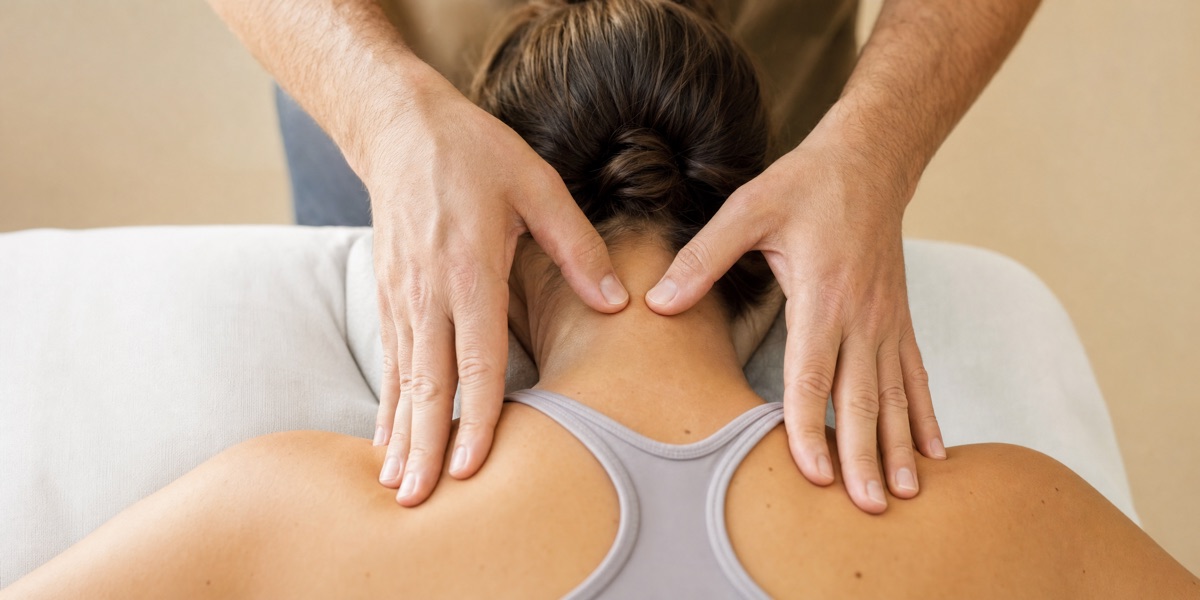
Treatment is gentle and hands-on: slow soft-tissue work through the lumbar and gluteal muscles, rhythmic joint mobilization of the lumbar spine, pelvis and hips, myofascial release along the lines of tension that connect the back to the legs and trunk, and quieter, very light craniosacral-style techniques that some patients find calming when firmer work isn’t comfortable. There is no aggressive forcing; many patients are surprised by how light the work feels.
A few patterns come up again and again in Richmond:
Sitting and driving. Long desk hours plus a daily drive — the tunnel queue, the bridge, the school run — keep the hips flexed and the lumbar spine slumped for hours at a stretch. Over time the hip flexors adapt and shorten, the gluteal muscles become underused, and the low back ends up doing stabilizing work it isn’t designed for. Treatment often focuses as much on the front of the hips as on the back itself, alongside practical changes to seat setup and sitting breaks.
Lifting. Whether it’s warehouse shifts near the airport, renovation work, or simply hauling groceries and car seats, the riskiest moment is usually a bend-and-twist with the load away from the body. Hands-on work can ease the irritated tissues, but Ethan will also look at why your hips and mid-back aren’t sharing the bend — because if the hips won’t hinge, the lumbar spine will.
Sleep positions. Stomach sleeping tends to hold the low back in extension all night; a sagging mattress lets it hang in flexion. Small adjustments — a pillow between the knees for side sleepers, or under the knees for back sleepers — often change how stiff the first ten minutes of the morning feel.
The pelvis–hip relationship. The lumbar spine sits on the pelvis the way a mast sits on a deck. If the pelvis is rotated or one sacroiliac region is stiff, or one hip has quietly lost internal rotation, the segments just above compensate with every step. Addressing the pelvis and hips is often an important part of care for persistent low back pain — and it’s a hallmark of the osteopathic whole-body approach.
A note on evidence, stated honestly: research on manual therapy for low back pain suggests modest benefits for many people, particularly when combined with staying active, and individual results differ. Osteopathy is not a quick fix or a cure — it is one reasonable, gentle option within a broader plan. If your back pain is part of a wider picture that also includes neck pain, headaches or jaw tension, our overview of osteopathy for back, neck, headaches and TMJ looks at how those regions connect; this page goes deeper on the low back alone.
What a session looks like
A first visit runs about 40 minutes: health history, movement assessment, hands-on treatment, and simple take-home advice on sitting, lifting and sleep set-up. You stay clothed in comfortable, loose layers, and nothing proceeds without your consent. For a step-by-step walkthrough — what to wear, what the techniques feel like, how you might feel afterwards — see our guide to what happens in an osteopathy session.
Who it may help — and when to see a doctor first
Osteopathic manual therapy may help with the everyday, mechanical varieties of lower back pain: stiffness after sitting or driving, recurring strain from lifting, postural ache late in the workday, pregnancy-related back discomfort, and the lingering tightness that follows an old strain. Some patients find relief over a series of sessions; a few notice change quickly, others more gradually, and results vary from person to person.
Some symptoms, however, need a doctor before any manual therapy. See your family doctor, call 811, or go to emergency first if your back pain comes with any of the following:
- Numbness or tingling spreading into one or both legs
- New problems with bowel or bladder control, or numbness in the saddle area
- Progressive weakness in a leg or foot (e.g., tripping, foot drag)
- Fever, chills, or feeling generally unwell alongside the pain
- Pain following significant trauma such as a fall or car accident
- Unexplained weight loss, a history of cancer, or pain that is constant and worsening at night
These can signal nerve compression or other conditions that need medical assessment and sometimes urgent care. HealthLink BC is a reliable resource, and 811 connects you with a nurse any time. If anything like this emerges during care at Artemis, Ethan will pause treatment and direct you to a physician — that is standard practice here, not an exception.
Osteopathy alongside RMT, physiotherapy and chiropractic
Lower back pain is often managed with a combination: hands-on treatment to ease symptoms, plus progressive strengthening to keep them from returning. Artemis houses six disciplines under one roof — RMT massage therapy, Acupuncture & TCM, Physiotherapy, Chiropractic, Kinesiology, and Osteopathy — so a plan can move between them without repeating your story at a new clinic. A common pairing for low back pain is osteopathy or RMT for symptom relief alongside physiotherapy or kinesiology for core and hip strengthening. If you’re weighing which discipline fits your situation first, our comparison of osteopathy vs RMT, physiotherapy and chiropractic breaks down how each approaches the same back.
Cost, insurance & direct billing
Many extended health plans include osteopathy under paramedical benefits — but plans genuinely vary, and some do not cover osteopathic manual therapy at all, so it’s worth checking before your first visit. Where your insurer supports it, we can bill directly through TELUS Health eClaims (Pacific Blue Cross, Sun Life, Manulife, Green Shield Canada and 20+ insurers; Canada Life and RWAM benefits cannot be claimed for osteopathy with Ethan Choi), so you don’t pay the covered portion upfront. Patients whose plans cover osteopathy and support direct billing often pay only their co-pay portion at the desk; amounts vary widely by plan, and a plan without osteopathy coverage means paying the full session fee and claiming nothing — verify with your insurer or our front desk before you book. We also direct bill ICBC and WorkSafeBC for approved claims. Details and a plan-checking checklist are in our direct billing and insurance guide.
Why Richmond patients choose Artemis
- Clear credentials. Ethan’s acupuncture and TCM designations (R.Ac, R.TCMP) are regulated by CCHPBC, and his osteopathic training includes a DOMP and a DO(Spain). (DO(Spain) is a European osteopathic qualification, not a medical degree.)
- Osteopathy close to home in central Richmond, rather than across a bridge.
- Six disciplines under one roof, so care can be coordinated rather than fragmented.
- Practical access: 3 minutes’ walk from Brighouse SkyTrain, with evening and weekend appointments. Ethan treats in English and Korean.
Frequently Asked Questions
Can osteopathy help with pain that runs from my lower back into my leg?
Sometimes leg-referred pain is muscular and may respond to manual therapy, but pain with numbness, tingling or weakness in the leg can indicate nerve involvement and should be assessed by a doctor first. Once serious causes are ruled out, gentle osteopathic treatment may be a reasonable part of your plan.
How many sessions will I need for lower back pain?
It varies with how long the problem has been building and what’s driving it. Many patients begin with 3–5 sessions spaced one to two weeks apart, then reassess. Ethan will give you an honest estimate after the first assessment — and will say so if osteopathy doesn’t seem like the right fit.
Is osteopathic treatment painful?
Generally no. Techniques are slow and gentle, and Ethan works within your comfort level. Some people feel mild, short-lived soreness for a day after treatment, similar to post-exercise stiffness.
Should I rest or stay active with lower back pain?
For most mechanical low back pain, gentle ongoing movement tends to support recovery better than bed rest. We’ll suggest specific, comfortable ways to keep moving between sessions; HealthLink BC offers similar general guidance.
Do I need a doctor’s referral to see an osteopathic practitioner?
No referral is needed to book. However, some insurance plans require a doctor’s referral for reimbursement, so check your plan’s terms — our front desk can help you confirm.
Is osteopathy covered by my extended health plan?
Many plans include it under paramedical benefits, but some don’t, and coverage levels differ. Where your insurer supports it we can direct bill so you don’t pay the covered portion upfront; verify your specific plan with your insurer or our front desk first.
What makes osteopathy different from massage for low back pain?
Massage therapy focuses primarily on muscle and soft tissue; osteopathic treatment combines soft-tissue work with joint mobilization and a whole-body assessment of the pelvis, hips and spine. Many patients use both — and at Artemis the two can be coordinated under one roof.
Book Osteopathy for Lower Back Pain in Richmond
If lower back pain is shaping your days, a gentle, whole-body assessment is a sensible place to start. Book with Ethan Choi, R.Ac, R.TCMP, DOMP, DO(Spain) at Artemis Wellness Clinic, 5911 No. 3 Road #130, Richmond, BC V6X 0K9 — 3 minutes’ walk from Brighouse SkyTrain.
📞 Call 604-242-2233 or book online at artemis.janeapp.com. Evening and weekend appointments available.
This article is for general educational purposes only and is not a substitute for personalized medical advice, diagnosis or treatment from a qualified health professional.