If you have typed “TCM clinic Richmond BC” into your phone and landed on a dozen near-identical websites, the most useful thing to learn first is not which clinic has the nicest photos. It is what the letters after a practitioner’s name mean. Traditional Chinese Medicine and acupuncture are regulated professions in British Columbia, and four separate registration titles exist — each permitting a different set of treatments. Most patients have never had them explained, so that is where this guide starts. It should be useful even if you book somewhere else.
What do R.Ac, R.TCM.H, R.TCM.P and Dr.TCM mean?
They are four distinct registration classes in BC, and they are not interchangeable — each one defines what a practitioner may legally do.
| Registration title | What it covers | Acupuncture | Chinese herbal medicine |
|---|---|---|---|
| R.Ac — Registered Acupuncturist | Acupuncture and related techniques within scope | Yes | No |
| R.TCM.H — Registered TCM Herbalist | Chinese herbal medicine | No | Yes |
| R.TCM.P — Registered TCM Practitioner | Acupuncture and Chinese herbal medicine | Yes | Yes |
| Dr.TCM — Doctor of Traditional Chinese Medicine | The broadest scope of the four; the only class permitted to use the “Dr.TCM” title | Yes | Yes |
The distinction people miss is the herbal one: a Registered Acupuncturist may needle you but may not prescribe Chinese herbal medicine, and a Registered TCM Herbalist is the reverse. The techniques that usually accompany acupuncture — electro-acupuncture, cupping, gua sha, moxibustion, tui na, acupressure — sit inside the acupuncture scope, which is why someone registered only as an R.Ac can still offer them. Individual registrations may also carry conditions or limits.
Who regulates TCM in BC, and how do I check a practitioner?
All four titles are granted and regulated by the College of Complementary Health Professionals of BC (CCHPBC), and anyone can look a practitioner up in the college’s public register in about a minute. Search by name; the register shows the registration class, whether it is current, and any conditions attached to it.
Three reasons to bother:
- Scope. It tells you what the person in front of you may legally do, not what a website implies.
- Accountability. Registrants answer to college standards, continuing education and a complaints process. Someone practising outside the college answers to none of it.
- Insurance. Most extended health plans that reimburse acupuncture require a registrant to have performed it. If a registration is not current, the claim can be refused.
The titles are protected: in BC, a person who is not registered may not call themselves a Registered Acupuncturist.
Here is the same check applied to our own two practitioners, as a worked example.
Mandy Tam — R.Ac. The clinic’s founder, registered with CCHPBC as a Registered Acupuncturist, working in English, Mandarin and Cantonese, with a focus on fertility, women’s health, pain, stress and sleep. R.Ac is her registration class: acupuncture and related techniques such as electro-acupuncture, cupping, gua sha and acupressure. It does not include Chinese herbal medicine, and she does not prescribe it.
Ethan Choi — R.Ac, R.TCMP, DOMP. Licensed with CCHPBC as a Registered TCM Practitioner; he provides acupuncture here. He is also an Osteopathic Manual Practitioner (DOMP) offering osteopathic manual therapy. He works in English and Korean.
What services does a TCM clinic offer?
A TCM appointment in BC is built around assessment plus acupuncture and its related manual techniques. The acupuncture and TCM service here covers:
- TCM assessment — history and questions about sleep, digestion, energy and pain patterns, pulse taken at both wrists, and observation of the tongue. This shapes everything that follows.
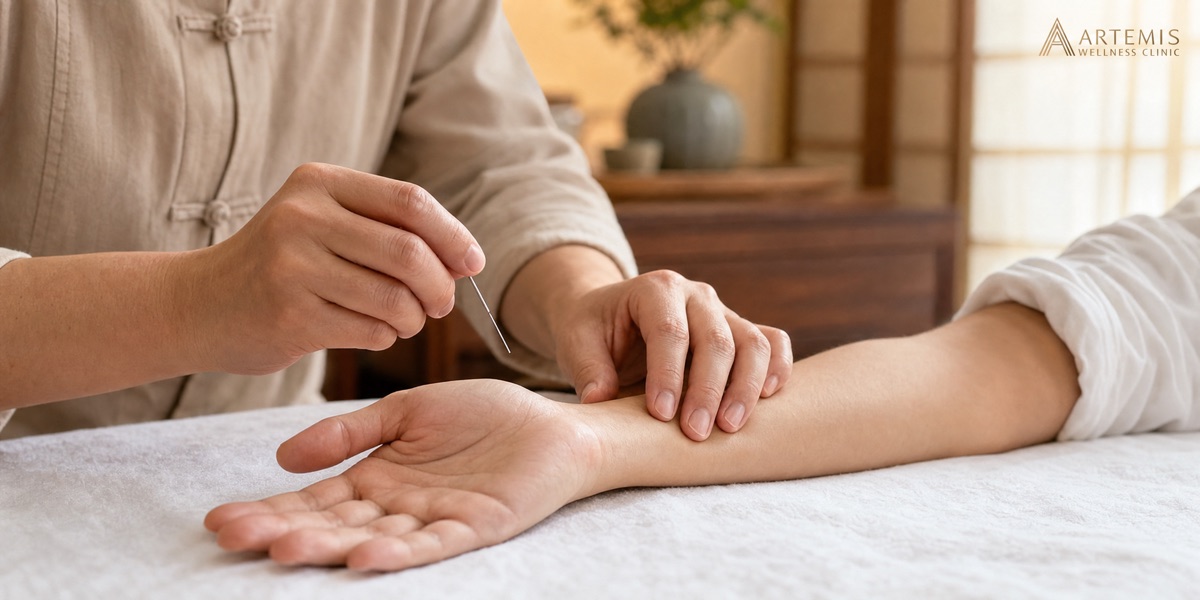
- Acupuncture — sterile, single-use disposable needles.
- Electro-acupuncture — a mild current applied to inserted needles.
- Cupping — suction cups, which leave circular marks that fade over several days.
- Gua sha — stroking the skin with a smooth-edged tool; also leaves temporary marks.
- Acupressure — the same points worked by hand, without needles.
- Lifestyle and dietary guidance — sleep, movement, load, food. General guidance, not a prescription.
Each of these is described in more detail on our techniques page.
On Chinese herbal medicine: herbal prescribing belongs to the R.TCM.H, R.TCM.P and Dr.TCM classes and is a separate scope of practice. It is not part of the TCM service offered at Artemis — the list above is what you can book here. If a herbal consultation is specifically what you want, ask any clinic you are considering whether it has a registrant with herbal scope who provides it. Do not assume that “TCM” on a sign means herbs are available.
What happens at a first TCM visit?
Expect about 50 to 65 minutes: paperwork and history, then assessment, then treatment. Bring a list of your medications and supplements, and mention blood thinners, bleeding disorders, a pacemaker or implanted device, or a possible pregnancy — each changes what is appropriate.
Acupuncture needles are far finer than injection needles. Most people feel a brief prick, then a dull, heavy or spreading sensation around the point. That sensation is expected; sharp or escalating pain is not, and you should say so immediately. Needles usually stay in for 15 to 30 minutes.
Afterwards, some people feel loose and sleepy, some feel energised, and a few feel tired or lightheaded for a day. Minor bruising happens. Cupping and gua sha marks are normal and temporary. Serious adverse events are uncommon, and single-use needles and clean-needle technique are college requirements.
You should leave with a plain-language plan: what the practitioner thinks is going on, what they propose, and when you will reassess it together.
What changes when TCM sits inside a multidisciplinary clinic?
The practical difference is coordination — the TCM practitioner is not working alone. Artemis runs six disciplines under one roof: registered massage therapy, acupuncture and TCM, physiotherapy, chiropractic, kinesiology and osteopathy. With your consent, practitioners can compare notes, so an acupuncture plan is not quietly working against an exercise plan, and treatment can be sequenced rather than stacked at random. If TCM is the wrong tool for your problem, the referral is down the hall. Administratively, it means one front desk, one intake and one direct-billing process, whichever discipline you see.
Two caveats, plainly: coordination only happens if you consent to it, and seeing one practitioner here does not oblige you to see another. If you ever feel you are being sold more services than your problem warrants, push back — here or anywhere.
One regulatory note, since it follows: massage therapy and chiropractic are regulated by the same college as TCM (CCHPBC), and physiotherapy by a separate BC college.
How does insurance work for acupuncture and TCM in BC?
Many extended health plans cover acupuncture when a registered acupuncturist performs it, which is precisely why the registration check matters.
- Extended health. We direct-bill Pacific Blue Cross, Sun Life, Manulife, Canada Life, Green Shield and 20+ insurers through TELUS Health. Direct billing means the clinic submits the claim and you pay the remainder — a convenience, not a promise. Plans differ on per-visit and annual maximums, on whether acupuncture shares a cap with other paramedical services, and on whether a physician’s referral is required. Some do not permit direct billing at all. No clinic can guarantee what an insurer will pay; verify your own coverage.
- ICBC. After a crash, ICBC’s Enhanced Care benefits pre-approve up to 12 acupuncture treatments within the first 12 weeks; for these you need no doctor’s referral or ICBC approval. Bring your claim number and BC PHN. We bill ICBC directly for your pre-approved treatments. If part of a fee is not covered by ICBC (a user fee), we tell you before your treatment. Beyond those treatments, further care needs ICBC’s approval.
- WorkSafeBC. If the injury happened at work and you have an accepted claim, treatment may be funded through WorkSafeBC, subject to its authorization. Bring the claim number so the front desk can confirm coverage before treatment starts.
- MSP. If you qualify for MSP Supplementary Benefits (premium assistance), MSP subsidises part of the fee for a limited number of visits per calendar year, shared across several therapies. Confirm eligibility with Health Insurance BC and ask whether we can bill it for your visit.
Our direct billing page lists the current insurers and what to bring.
What can TCM realistically do — and what can it not do?
The evidence is reasonably good for a narrow band of problems and thin for much of the rest. Systematic reviews most consistently support acupuncture for chronic musculoskeletal pain — low back, neck, knee osteoarthritis — for tension headache and migraine prevention, and for chemotherapy-induced nausea. Even there, average benefits are moderate rather than dramatic, and trials comparing real needling with sham needling generally show smaller differences than trials comparing acupuncture with no treatment at all. That is worth knowing before you spend money.
What TCM does not do: cure cancer, reverse structural disease, replace medication, or substitute for a diagnosis. Never stop a prescribed medication on a practitioner’s say-so — that decision belongs with your physician. And nobody can promise you an outcome.
A reasonable trial is a small number of sessions with an agreed point to reassess. I would rather tell someone at session four that this is not working than sell them a package of ten. The conditions we see most often are set out separately.
When should you see a physician first?
Some symptoms need medical assessment before any hands-on therapy, TCM included. Call 911 or go to emergency for chest pain or pressure, breathlessness, or pain spreading to the jaw or arm; sudden one-sided weakness or numbness, facial droop or slurred speech; the worst headache of your life; back pain with numbness around the groin or inner thighs, loss of bladder or bowel control, or progressive leg weakness; a significant head injury or suspected fracture; or sudden severe abdominal pain.
See a physician before an acupuncturist for unexplained weight loss; fever or night sweats alongside your pain; pain that is constant and worse at night regardless of position; new pain with a history of cancer; or any new or quickly worsening neurological symptom. If you are pregnant and have bleeding or severe pain, contact your maternity care provider.
None of this means TCM has nothing to offer afterwards. It means the diagnosis comes first.
How do I book, and where is the clinic?
Artemis Wellness Clinic is at 5911 No. 3 Road #130, Richmond BC V6X 0K9 — about a three-minute walk from Brighouse SkyTrain station on the Canada Line. Book online at artemis.janeapp.com or call 604-242-2233. If you are not sure acupuncture is the right starting point, say so when you call; it is a reasonable question, and sometimes the answer is no.
Frequently asked questions
What does R.Ac mean in BC?
R.Ac stands for Registered Acupuncturist, a registration class granted by the College of Complementary Health Professionals of BC (CCHPBC). An R.Ac may perform acupuncture and related techniques such as electro-acupuncture, cupping, gua sha and acupressure, but may not prescribe Chinese herbal medicine.
What is the difference between R.Ac and R.TCM.P?
An R.Ac is registered for acupuncture only. An R.TCM.P (Registered TCM Practitioner) is registered for both acupuncture and Chinese herbal medicine. R.TCM.H covers herbal medicine without acupuncture, and Dr.TCM is the broadest of the four classes.
How do I check whether an acupuncturist is registered in BC?
Search the practitioner’s name in the CCHPBC public register. It shows their registration class, whether the registration is current, and any conditions on it. If someone is not listed, they are not registered — and the titles themselves are protected in BC.
Does a registered acupuncturist prescribe Chinese herbal medicine?
No. Herbal prescribing sits with the R.TCM.H, R.TCM.P and Dr.TCM classes, not with R.Ac. Herbal medicine is not part of the TCM service offered at Artemis; ask any clinic directly whether it has a registrant with herbal scope who provides it.
Is acupuncture covered by insurance in BC?
Many extended health plans cover acupuncture when a registered acupuncturist performs it, but per-visit limits, annual caps and referral rules vary by plan, and some plans exclude it. ICBC and WorkSafeBC pathways exist for crash and workplace injuries. No clinic can guarantee reimbursement — verify with your insurer.
Do I need a doctor’s referral for acupuncture in Richmond?
No referral is needed to book. Some extended health plans, however, require a physician’s referral before they will reimburse, so check your plan wording. ICBC’s pre-approved sessions after a crash do not require one, and WorkSafeBC treatment runs through your claim.
Does acupuncture hurt?
Most people report a brief prick followed by a dull, heavy or spreading sensation, which is expected. Sharp or escalating pain is not — tell your practitioner immediately. Mild soreness, small bruises, and temporary cupping or gua sha marks are common and fade.