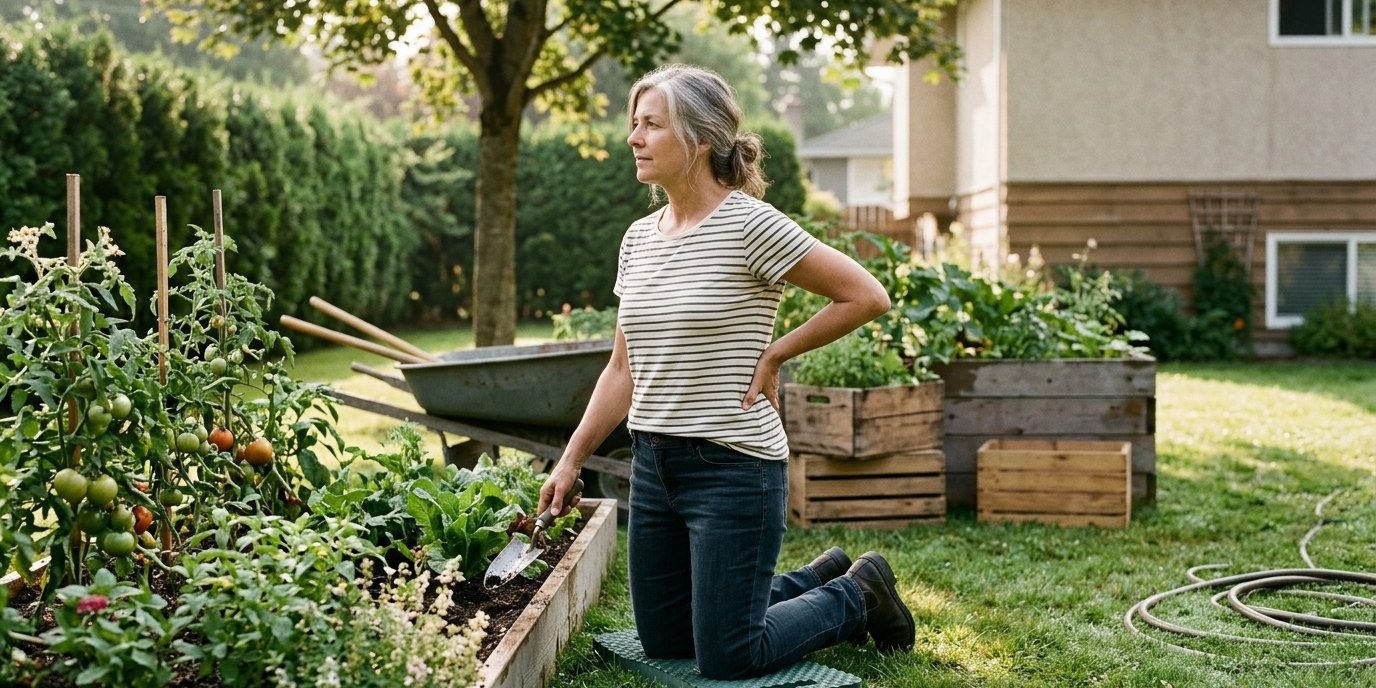
Peak yard-work season in BC follows a familiar pattern: a weekend of weeding, planting, and hauling mulch, then a stiff, sore lower back on Monday. Gardening back pain in Richmond spikes every summer, and most of these flare-ups are simple muscle strains that settle over days to weeks when the first steps are handled well. I’m Dave Tam, RMT, director of Artemis Wellness Clinic. Below is the recovery plan I walk gardeners through — with self-acupressure from Mandy Tam, R.Ac, movement help from Ethan Choi, R.Ac, R.TCMP, DOMP, and the thinking behind our lower back pain treatment in Richmond. First, though: check the red-flag list below — if anything on it applies, see a doctor first.
Why does gardening wreck your lower back?
Dave Tam, RMT (Director): Gardening combines four things the lower back tolerates poorly — long stretches of sustained forward bending, kneeling while reaching far ahead of you, twisting while carrying a load, and near-constant gripping that keeps the back and shoulders braced. None of these is harmful alone; the problem is dose. Hours of all four often land on a body that spent the cooler months at a desk. Muscles that are not conditioned for that workload fatigue, then strain, then tighten into protective guarding — which is why the real stiffness often arrives the next morning rather than mid-weeding.
How do you garden without hurting your back?
Dave Tam, RMT (Director): Warm up first, rotate tasks every 20 minutes, and set the work up so you bend and twist less. Six habits do the heavy lifting:
- Warm up before yard work. Five minutes of brisk walking plus ten slow squats and hip hinges is enough.
- Follow the 20-minute rule. Rotate so no position lasts more than about 20 minutes — weed, then prune standing, then water, then return.
- Kneel, don’t stoop. A kneeling pad with one knee down is easier on your spine than hanging in a bent-over stoop.
- Raise the work. Raised beds and long-handled tools cut how far and how often you bend.
- Hinge at your hips. Push your hips back with soft knees and a long spine when you lift, instead of rounding through the lower back.
- Carry loads close. Hug soil bags to your body, split heavy loads into two trips, and let a wheelbarrow do the carrying.
What should you do in the first 24–48 hours after a flare-up?
Dave Tam, RMT (Director): Keep moving — relative rest, not bed rest. Gentle walking, short and frequent, usually serves you better than lying still. After the first day, add heat: a warm shower or a heat pack for 15–20 minutes can help guarded muscles let go. Just as important, stop re-testing it — repeatedly bending to check whether it still hurts only re-irritates the strain. Give it a couple of days of normal-but-lighter activity before returning to the garden.
How can massage therapy support recovery?
Dave Tam, RMT (Director): In the recovery phase, massage therapy focuses on easing guarded, overworked muscles and restoring your tolerance for normal movement — it supports healing rather than shortcutting it. Honest timeline: most simple strains settle over days to weeks whether or not you book anything, and hands-on treatment may make that stretch more comfortable and restore confident movement sooner. Considering massage for lower back pain? Our registered massage therapy in Richmond page explains what a visit involves.
Which acupressure points can you try at home for a sore lower back?
Mandy Tam, R.Ac: Three points are worth learning for self-acupressure on the lower back — BL40 (Weizhong 委中) behind the knee, BL23 (Shenshu 肾俞) beside the spine, and LI4 (Hegu 合谷) on the hand. Use firm but comfortable pressure — a pleasant ache, never sharp pain — for 30 to 60 seconds per point while breathing slowly.
- BL40 — Weizhong 委中. Sit down, find the midpoint of the crease behind your knee, and press in gently with your thumb. A classical point for the lower back in TCM; work both legs.
- BL23 — Shenshu 肾俞. At waist level, measure two finger-widths out from the spine on each side. Press with your thumbs, or knead in small circles with loose fists.
- LI4 — Hegu 合谷. Squeeze the fleshy web between your thumb and index finger, pressing toward the index-finger bone — a general tension point. It is traditionally avoided during pregnancy, so skip it if you are pregnant.
Acupressure is a comfort tool, not a treatment plan. If muscular back pain keeps returning, acupuncture at our Richmond clinic may help — “may” is the honest word, and we will say so if it is not.
How do you rebuild movement once the acute pain settles?
Ethan Choi, R.Ac, R.TCMP, DOMP: Gradually — once the sharp edge fades, usually within a few days, the goal shifts from protecting your back to reintroducing bending and lifting in small, planned doses. In osteopathic manual therapy for lower back pain, I use gentle whole-body work — hips, mid-back, and breathing mechanics as well as the sore area — because a lower back that did all the weekend’s bending is often compensating for stiffness elsewhere. Between visits, a simple daily trio keeps things moving:
- Pelvic tilts. Lie on your back with knees bent; slowly flatten your lower back toward the floor, then release. Ten easy repetitions.
- Knee rocks. From the same position, draw your knees toward your chest and rock gently side to side for about a minute.
- Short walks. Ten to fifteen relaxed minutes, once or twice a day.
My training includes a DOMP diploma in osteopathic manual practice, and I am licensed with the College of Complementary Health Professionals of BC (CCHPBC) as a Registered Acupuncturist (R.Ac) and Registered TCM Practitioner (R.TCMP).
What if the pain lasts more than two weeks or keeps coming back?
That is the point where self-care hands off to a structured program. If back pain persists past roughly two weeks, flares up after every gardening weekend, or you want a structured strengthening plan, physiotherapy and kinesiology active rehab at the clinic can build the capacity that self-care alone does not.
When should you see a doctor first?
See a doctor first if any of the following applies — these need medical assessment before massage, acupressure, or exercise.
Red flags. Get medical care first if you notice any of these:
- Numbness, tingling, or weakness in a leg
- Numbness in the saddle area (groin, inner thighs, buttocks)
- Loss of bladder or bowel control (an emergency — go to a hospital emergency department now)
- Back pain that began after a fall or other impact
- Fever alongside back pain
- Night pain that does not ease when you change position
- A history of osteoporosis or cancer
This article is general information, not medical advice.
Still have questions about back pain after yard work?
Here are the short answers we give at the clinic all gardening season.
How long does back pain from gardening last?
Most simple muscle strains ease noticeably within a few days and settle over one to three weeks. A sore back after weeding that has not improved by the two-week mark deserves an in-person assessment.
Should I use ice or heat on a sore back?
Either is fine on the first day if it feels comforting. From the second day onward, heat tends to suit a strained, guarded back — 15 to 20 minutes at a time.
Should I stay in bed until it stops hurting?
No. Bed rest tends to slow recovery from simple strains; gentle walking and relative rest usually work better.
Can I keep gardening while my back is sore?
Light tasks in short stints are usually fine after the first couple of days. Hold off on digging, heavy lifting, and long bent-over sessions until you move comfortably again.
Do I need a doctor’s referral to see an RMT in BC?
No referral is needed to book massage therapy at our clinic. Some extended health plans require one before they reimburse, so check your plan’s rules first.
Can Artemis direct bill my insurance?
We direct bill more than 20 insurers through TELUS Health. Whether and how much is reimbursed depends on your plan, so we cannot guarantee coverage.
Where is the clinic located?
Artemis Wellness Clinic is at 5911 No. 3 Road #130, Richmond BC V6X 0K9, a three-minute walk from Brighouse SkyTrain station.
Where can you get help for gardening back pain in Richmond?
Artemis Wellness Clinic brings six disciplines under one roof in central Richmond — including registered massage therapy, acupuncture and TCM, osteopathic manual therapy, physiotherapy, and kinesiology — so recovery can start with one visit and expand only if needed. Find us at 5911 No. 3 Road #130, Richmond BC V6X 0K9, a three-minute walk from Brighouse SkyTrain. Book online at artemis.janeapp.com or call 604-242-2233, and get back to your garden with a plan behind you.