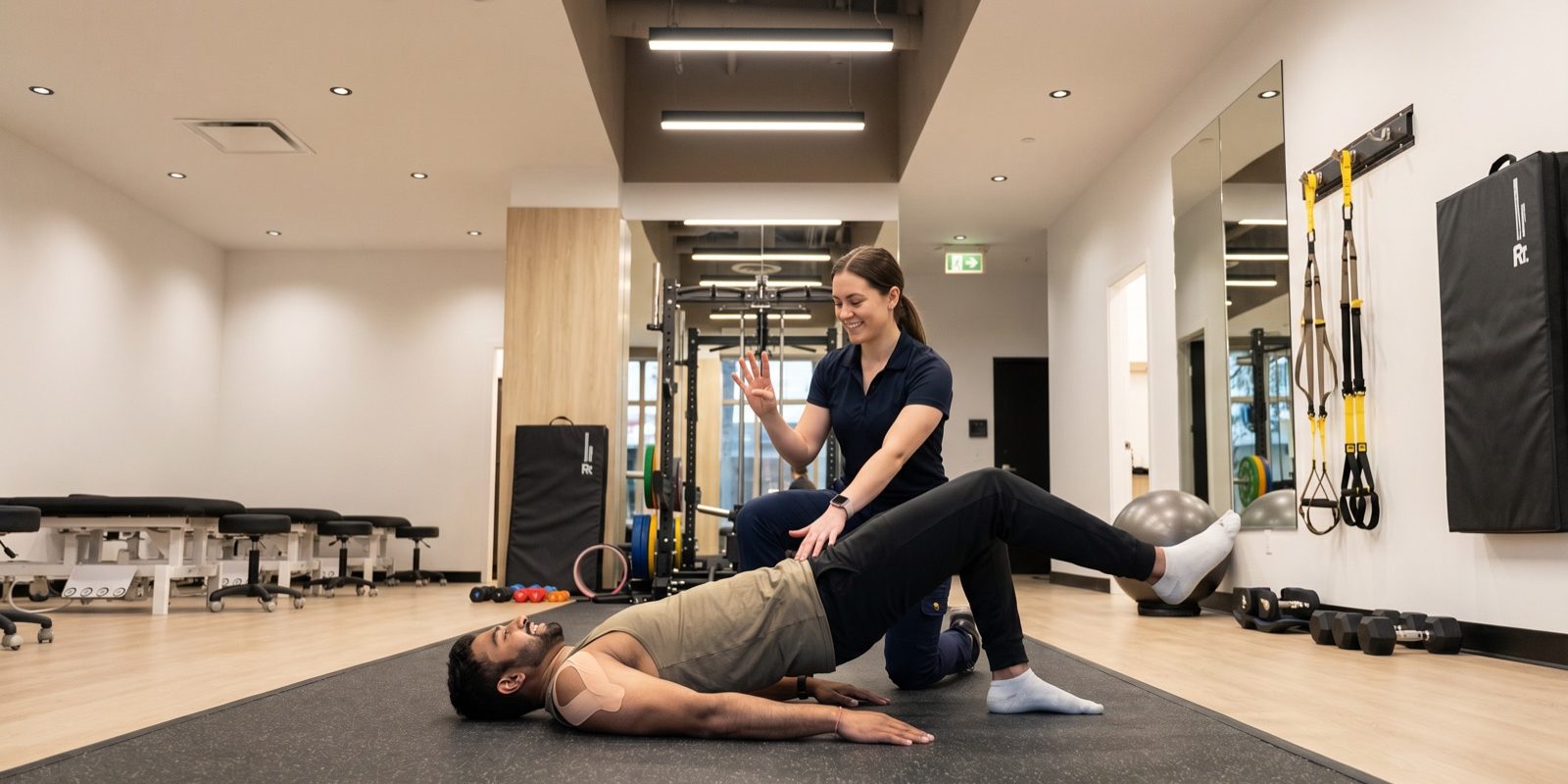
After a motor vehicle collision, the goal is not just to get out of pain — it is to fully recover the strength, mobility, and confidence to return to your normal life. Active rehabilitation is the discipline that bridges the gap between “the pain is mostly gone” and “I can carry my groceries, lift my kids, and go back to my regular workouts.” At Artemis Wellness Clinic, ICBC active rehab is delivered by registered kinesiologists and physiotherapists working together, and it is fully covered under your ICBC no-fault benefits. Located at 5911 No. 3 Road #130 — two minutes from Brighouse SkyTrain Station, across from Richmond Centre. Book on Jane App or call 604-242-2233.
What Is ICBC Active Rehab?
Active rehabilitation is a structured exercise-based program designed to restore the function lost after a motor vehicle collision. Unlike “passive” treatments — manual therapy, massage, modalities — where the practitioner works on you, active rehab puts you in the driver’s seat: progressive loading, movement re-training, and conditioning specific to the activities you need to return to.
Under BC’s Enhanced Care system, ICBC pre-approves kinesiology-led active rehab for accident-injury patients. Our team builds a structured 6-to-12-week program that:
- Restores the range of motion and strength lost after the collision
- Re-trains coordinated, pain-free movement patterns
- Progressively loads the body to your pre-accident capacity (or higher)
- Prepares you for return to work, sport, or specific activities of daily living
Who Qualifies for ICBC Active Rehab?
You qualify for ICBC active rehab if:
- You have an open ICBC claim from a motor vehicle collision
- You have completed (or are close to completing) the initial pain-control phase with physiotherapy, RMT, chiropractic, or acupuncture
- Your injuries are stable enough to begin progressive loading
In practice, most ICBC patients transition into active rehab somewhere between week 4 and week 8 after their collision. Some patients with mild injuries can start active rehab in week 2 or 3. We assess this during your initial physiotherapy or kinesiology consultation.
Phase-by-Phase Active Rehab Protocol at Artemis
Our active rehab program follows a consistent four-phase structure, adapted to your specific injury pattern.
Phase 1 — Foundation (week 1–2 of active rehab)
Goal: re-introduce structured movement at low intensity.
- Body-weight movement screens to identify movement deficits
- Mobility work for restricted joints (typically neck, mid-back, hips, shoulders)
- Activation exercises for under-firing muscle groups (deep core, glutes, scapular stabilizers, deep neck flexors)
- Aerobic conditioning at light intensity (10–15 minutes)
Sessions in this phase are 45–60 minutes, supervised one-on-one by a registered kinesiologist.
Phase 2 — Strength rebuilding (week 2–5 of active rehab)
Goal: progressively load the muscle groups deconditioned by the injury and the rest period that followed.
- Resistance training using body weight, dumbbells, cables, and bands
- Compound movements (squats, hinges, presses, pulls, carries) progressed by load and complexity
- Continued mobility work as needed
- Aerobic conditioning progressing toward 25–30 minutes
Phase 3 — Functional integration (week 5–8 of active rehab)
Goal: re-train the specific movements and demands of your daily life and work.
- Lifting mechanics for parents and trades workers
- Sustained postural endurance for office workers
- Repetitive motion drills for occupations involving overhead work, twisting, or carrying
- Coordination and balance work
Phase 4 — Return to sport or maximal function (week 8–12 of active rehab)
Goal: restore performance to pre-accident levels (or beyond — many patients leave active rehab fitter than they were before the collision because they finally have a structured program).
- Sport-specific drills (running, cutting, jumping for athletes)
- Return-to-work simulation for physical jobs
- Discharge planning and an independent maintenance program
Not every patient progresses through every phase — your starting point and end goals shape the plan.
Coordination with Other ICBC Providers
Active rehab does not happen in isolation. Throughout your active rehab program, our kinesiologists coordinate with:
- Your physiotherapist at our clinic for hands-on work on stubborn restrictions — see our ICBC physiotherapy guide
- Your RMT for soft-tissue work between active rehab sessions
- Your chiropractor if joint dysfunction is part of your picture
- Your acupuncturist for ongoing pain management
This is where the multidisciplinary clinic model matters most. When your kinesiologist notices that your mid-back is restricting your overhead lifting on Tuesday, the physiotherapist can address it in your Wednesday session, and you continue progressing in active rehab on Friday — all in the same building, all under one shared treatment plan, all billed directly to ICBC.
You can read about our broader ICBC-approved clinic services in Richmond for the full picture of how the disciplines coordinate.
For details on the kinesiology discipline itself — including how it differs from personal training — see our kinesiology service page.
What to Expect at Your First Active Rehab Session
- Intake and goal-setting (15 minutes). Review of your accident, current symptoms, what activities you need to return to, and the timeline. Bring your ICBC claim number.
- Movement assessment (20 minutes). Functional movement screen, range-of-motion measurement, baseline strength testing where appropriate.
- First training session (20–25 minutes). Tailored to your assessment findings — typically a combination of mobility work, activation exercises, and a light conditioning component.
- Plan and home program. A clear program for between-session work and a booking cadence (typically 1–2 supervised sessions per week, with home sessions in between).
How Many Active Rehab Sessions Will ICBC Cover?
ICBC’s pre-approved kinesiology session count is renewed periodically as your case progresses. For details on coverage windows and how additional sessions are approved, see our guide to how long ICBC covers treatment.
In practice, most active rehab programs at our clinic run 8 to 16 supervised sessions over 6 to 12 weeks. Patients with more significant injuries or longer pain windows may need more sessions, which we coordinate with your ICBC adjuster through our progress reporting.
Insurance and Direct Billing
For ICBC active rehab, we bill ICBC directly — you pay nothing at the clinic. We also direct-bill the following extended-health plans for kinesiology where your plan supports it:
- Pacific Blue Cross
- Sun Life
- Manulife
- Green Shield Canada
- Canada Life
- WorkSafeBC (for work-related accidents)
Frequently Asked Questions
Is active rehab the same as personal training?
No. Active rehab is delivered by registered kinesiologists with health-science training and clinical experience treating injury populations. The programming is rehabilitation-led, not fitness-led, and integrates with your physiotherapy and other treatments under a shared plan.
Do I need to be in pain to qualify for active rehab?
No. Active rehab is for the recovery phase — typically when acute pain is mostly resolved but function, strength, and confidence have not returned to pre-accident levels. Many patients in active rehab are pain-free but not yet ready for their normal activities.
Will I have to pay anything out of pocket for ICBC active rehab?
No, for pre-approved sessions. Artemis bills ICBC directly. If your case requires more sessions than the current pre-approval, we coordinate the additional approval with ICBC before any out-of-pocket cost.
How many sessions per week?
Most patients attend 1 to 2 supervised sessions per week, with a home program for the days between. Some patients with longer recovery timelines do 2–3 sessions per week early on, then taper.
Can I do active rehab AND physiotherapy in the same week?
Yes. ICBC covers both disciplines independently. Many patients see a physiotherapist for hands-on work and a kinesiologist for active rehab in the same week.
What if my accident was several months ago?
You can often still qualify for active rehab if your ICBC claim is open. Contact ICBC to confirm your file is still active and book a first appointment — we can usually start within the same week.
Do I need a doctor’s referral?
No. Kinesiology is direct-access in BC and does not require a physician referral.
Do you offer evening or weekend active rehab sessions?
Yes. Evening and weekend slots are part of our regular kinesiology schedule. Live availability is visible on our Jane App booking page.
Book Your ICBC Active Rehab Program in Richmond
Artemis Wellness Clinic
5911 No. 3 Road #130, Richmond, BC V6X 0K9
Phone: 604-242-2233
Online booking: artemis.janeapp.com
Two minutes from Brighouse SkyTrain Station, across from Richmond Centre. ICBC-approved active rehab delivered by registered kinesiologists in coordination with our physiotherapy, RMT, chiropractic, and acupuncture teams. Direct billing for ICBC, WorkSafeBC, and most extended health plans. Evening and weekend appointments available.