
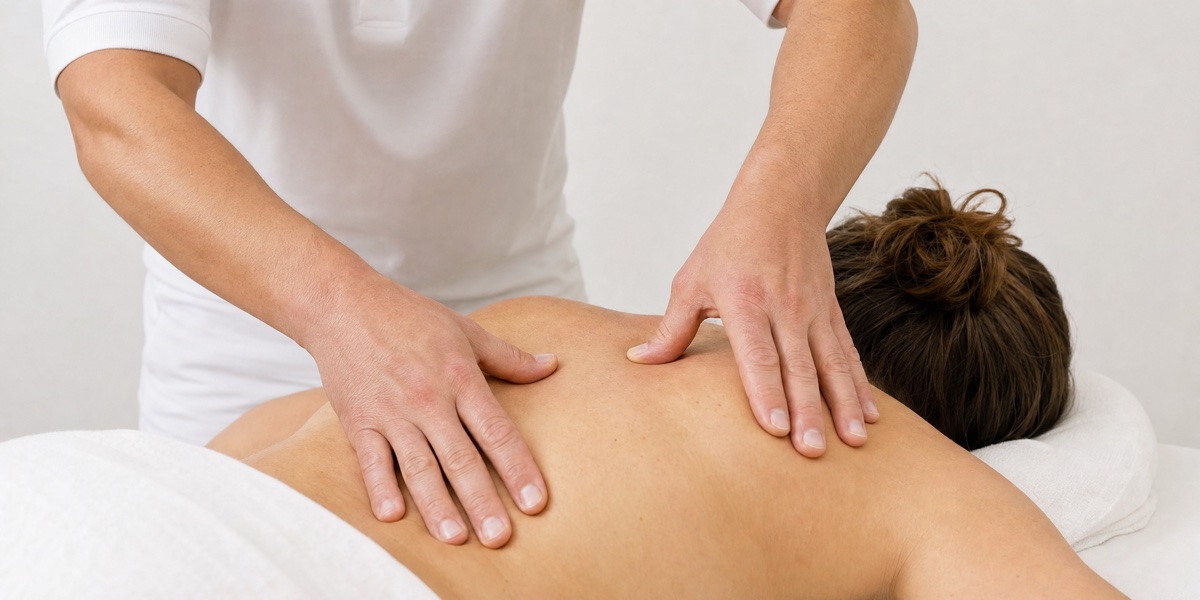
If you are searching for Richmond RMT vs spa massage, you are weighing a real and legitimate decision — and the honest answer is that these are two different services designed for two different goals, not a “better vs worse” comparison. A spa massage is a perfectly valid choice when relaxation is the goal; a Registered Massage Therapist is the right choice when clinical assessment, treatment planning, or insurance reimbursement is involved. This guide explains the regulatory, scope-of-practice, insurance, technique, and cost differences so you can pick the service that actually fits your situation. Artemis Wellness Clinic at 5911 No. 3 Rd #130, Richmond BC — steps from Brighouse SkyTrain — provides RMT services delivered by Director Dave Tam and team. Phone 604-242-2233 or book online at artemis.janeapp.com.
The Legal and Regulatory Difference
This is the single most important distinction, because it shapes everything else.
A Registered Massage Therapist (RMT) in British Columbia is a regulated health professional. RMTs are governed by the College of Health and Care Professionals of British Columbia (CHCPBC), which sets minimum education standards (typically a 2-3 year accredited program with roughly 2,200+ instructional hours), administers licensing examinations, requires ongoing continuing education, maintains a public registry where you can verify any RMT’s standing, and enforces a code of ethics with a complaints process. The “RMT” title is legally protected — only registrants of the College may use it.
A spa massage therapist is not regulated as a health professional. Spa employees who provide massage may have completed any number of training paths — from short certificate programs of 100-300 hours, to no formal training at all in some venues. There is no provincial licensing examination, no public registry, no required continuing education, and no professional college oversight. This is not a comment on the individual’s skill — many spa therapists are talented at what they do — it is simply a different regulatory category.
The practical consequence: when you book an RMT, you know the minimum baseline of training, the scope of practice, and the recourse path if something goes wrong. When you book a spa massage, those guarantees do not apply.
The Scope of Practice Difference
Because RMTs are health professionals, their scope of practice is broader and clinically defined:
- Assessment and clinical reasoning: An RMT performs an intake, takes health history, conducts orthopedic and palpation assessment, identifies musculoskeletal conditions, and forms a treatment plan
- Documentation: An RMT keeps clinical records (SOAP notes), which are the legal documents required by insurers and ICBC
- Treatment planning: An RMT recommends a session frequency, modality combination, and home-care plan over a multi-week course
- Referral when appropriate: An RMT recognizes red flags outside scope and refers to a physician, physiotherapist, or chiropractor when needed
Spa massage operates in a different lane: the goal is the experience itself — relaxation, ambiance, time out — not assessment or treatment of a clinical condition. Spa staff are not trained or permitted to diagnose musculoskeletal conditions, document for insurance, or design clinical treatment plans. That is not a flaw of the spa model; it is simply not what spas are built for.
The Insurance Difference
This is where the practical difference becomes financial.
Extended health insurance (Pacific Blue Cross, Sun Life, Manulife, Canada Life, Green Shield Canada, and others) only reimburses sessions delivered by a Registered Massage Therapist with valid CHCPBC registration. Spa massage receipts are not eligible for reimbursement, regardless of how high-end the spa is or how long the massage lasted.
ICBC Enhanced Care active rehabilitation following a motor vehicle accident only covers RMT massage — never spa massage — because ICBC requires the treating professional to hold a regulated health-profession credential and to file SOAP-note documentation.
WorkSafeBC claims follow the same rule: RMT-only.
For a typical extended-health plan with $500-$1,500 annual massage benefit + direct billing at clinics like Artemis, the practical out-of-pocket cost per RMT session for an insured patient runs $0-$30. A spa massage at $90-$150 is paid 100% out of pocket. We break this down in detail in our Richmond RMT direct billing cost guide covering the real cost after direct billing.
The Technique and Training Difference
RMT training in BC typically includes coursework and supervised clinical hours in:
- Anatomy, physiology, pathology, kinesiology
- Orthopedic assessment and clinical reasoning
- Swedish, deep tissue, trigger point, myofascial release, sports massage, manual lymphatic drainage
- Joint mobilization within scope, hydrotherapy, hot/cold application
- Treatment of specific conditions (low back pain, frozen shoulder, sciatica, post-MVA recovery, athletic injuries)
- Documentation, ethics, communication, consent
Spa training programs vary widely but typically focus on relaxation modalities — Swedish-style strokes, aromatherapy, hot stone, body wraps, scrubs, lomi lomi, and similar experience-oriented services. Many spa programs cover deep tissue at a basic level, but rarely with the assessment-and-treatment-plan framework an RMT brings.
For chronic pain, post-injury work, or anything where you want truly clinical deep tissue RMT, the depth of the RMT toolkit is the practical difference.
When a Spa Massage Is the Right Choice
We want to be clear: a spa massage can be a wonderful experience and is the right choice in several scenarios:
- Pure relaxation is the only goal — you want ambiance, music, ambiance, candlelight, and a soothing experience
- It’s a gift — a spa package is a meaningful gift; a clinical RMT receipt is not
- You have no specific clinical issue — no chronic pain, no recent injury, no condition needing assessment
- You are not relying on insurance — you’re paying out of pocket and that is fine for the value you are getting
- It’s an occasional treat — a destination spa, a hotel spa on vacation, a birthday indulgence
- You enjoy the additional spa amenities — sauna, steam room, pool, lounge, refreshments
None of this requires the regulatory or clinical infrastructure of an RMT visit. If relaxation is the goal, a spa is purpose-built for it.
When an RMT Is the Right Choice
Conversely, here is when you should book an RMT — not a spa:
- Chronic pain or persistent muscular tension that hasn’t responded to occasional massage
- Post-injury recovery — sprains, strains, post-surgical rehabilitation (with surgical clearance)
- An active ICBC claim following a motor vehicle accident — only RMT visits qualify for Enhanced Care active rehab coverage
- A WorkSafeBC claim — same rule, RMT only
- You have extended health benefits with a massage allowance you’d like to actually use
- You want an ongoing treatment plan — multi-session course of care for a specific issue
- You need documentation — for insurance reimbursement, employer claims, or a legal process
- You want assessment — you’re not sure exactly what’s wrong and want a trained eye to look at it
For the broader picture of what RMT visits at Artemis cover, see our Richmond RMT services overview and the Dave Tam RMT director spotlight.
The Price and Real-Cost Picture
Sticker prices look similar on the surface but the real out-of-pocket math is very different:
| Service | Sticker price (60 min) | Out-of-pocket for insured patient |
|---|---|---|
| Spa massage | $90-$130 | $90-$130 (100% out of pocket — no reimbursement) |
| Richmond RMT | $130-$150 | $0-$30 with direct billing on most extended plans |
| Richmond RMT — ICBC active rehab | $130-$150 | $0 (covered under Enhanced Care) |
| Richmond RMT — WorkSafeBC | $130-$150 | $0 (covered under accepted claim) |
For an insured patient, the RMT visit is often the cheaper option in real-cost terms — even though the sticker is higher — because direct billing absorbs most or all of the fee. Full breakdown in our direct billing cost guide and broader context at the complete clinic guide.
Frequently Asked Questions
Can a spa massage be just as good as an RMT session?
For pure relaxation, often yes — a skilled spa therapist can deliver a wonderful relaxation experience. For clinical work — chronic pain, injury recovery, treatment planning, assessment — an RMT’s training and scope of practice are designed for those goals in a way spa training is not.
Do I need a doctor’s referral to see an RMT in BC?
No. RMTs are direct-access providers in BC — you can book directly. Some extended health plans require a doctor’s referral for reimbursement; check your specific plan booklet.
What about hotel spas or destination spas on vacation?
Hotel and destination spas are excellent for relaxation as part of a vacation experience. They are not clinical environments and their massage services are not eligible for BC extended health or ICBC reimbursement. Enjoy them for what they are.
Can the same person be an RMT and also work at a spa?
Yes. Some RMTs hold their CHCPBC registration and also work some hours at spa venues. In that case, the question is whether your specific session is being billed and documented as RMT scope (with a SOAP note and an RMT-receipt) or as a spa service. If you need an insurance-eligible receipt, ask before booking — even at a spa, an RMT may or may not be available to deliver an RMT-billed session.
Does ICBC ever pay for spa massage?
No. ICBC Enhanced Care active rehabilitation requires a regulated health-profession credential. Spa massage is not eligible regardless of the practitioner’s skill or the spa’s reputation.
Will my extended health pay for any kind of “massage”?
Most extended health plans specify “Registered Massage Therapist” as the eligible practitioner. Always check your plan booklet — but for the major BC carriers (Pacific Blue Cross, Sun Life, Manulife, Canada Life, Green Shield), the answer is RMT-only.
My friend says her spa does “deep tissue” — is that the same as RMT deep tissue?
The terminology overlaps but the clinical depth typically differs. Spa “deep tissue” usually means firmer-pressure Swedish massage; RMT deep tissue is a slow, focused, assessment-driven modality applied to specific tissue regions. Both are valid services for different purposes — see our Richmond RMT deep tissue massage guide for the clinical version.
If I just want relaxation, am I “wasting” an RMT visit?
Not at all. RMTs deliver relaxation-style sessions when that’s what the patient asks for. The advantage is that the session is still RMT-scope and insurance-eligible if you have benefits. So you get the relaxation experience plus the reimbursement — best of both.
Book Your Richmond RMT Session
For clinical Richmond RMT care at Artemis Wellness Clinic — 5911 No. 3 Rd #130, Richmond, BC V6X 0K9 (steps from Brighouse SkyTrain) — book online at artemis.janeapp.com or call 604-242-2233. Direct billing for ICBC, WorkSafeBC, Pacific Blue Cross, Sun Life, Manulife, Canada Life, and Green Shield Canada. For more on the broader practice see our Richmond RMT services overview and complete clinic guide.