
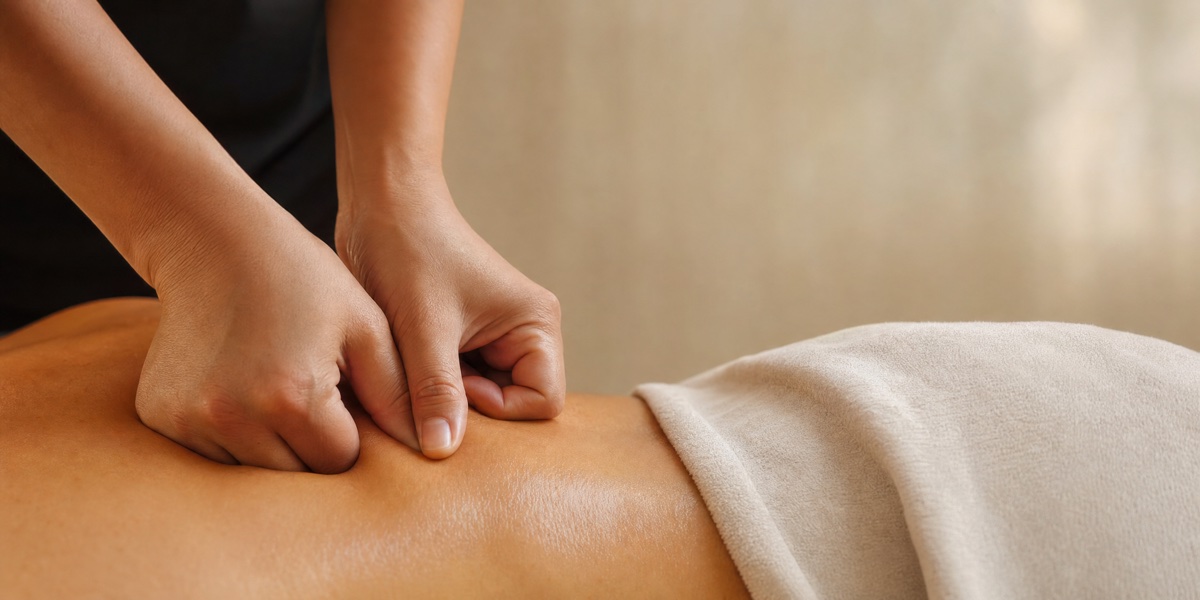
If you are searching for Richmond RMT deep tissue massage, you are in one of two situations: you have chronic muscle tension or pain that hasn’t responded to lighter massage approaches, or you are an active person who wants the kind of focused soft-tissue work that maintenance-only massage doesn’t deliver. Either way, this guide explains what deep tissue massage actually is from a Registered Massage Therapist’s clinical perspective, what to expect, who it is right for, and how it differs from Swedish, sports, or trigger-point work. Artemis Wellness Clinic at 5911 No. 3 Rd #130, Richmond BC — steps from Brighouse SkyTrain — offers deep tissue RMT delivered by Director Dave Tam and team. Phone 604-242-2233 or book online at artemis.janeapp.com.
What “Deep Tissue Massage” Actually Means (Clinically)
The term “deep tissue” is widely overused — many spa massages calling themselves “deep tissue” are simply firmer Swedish massage. Done by a Registered Massage Therapist licensed with the College of Complementary Health Professionals of BC (CCHPBC), deep tissue work has a specific clinical definition: targeted manual pressure into the deeper layers of muscle and fascia, applied slowly enough to release adhesions in the tissue rather than just compress them.
Three operational characteristics distinguish clinical deep tissue work from “firm Swedish”:
1. Slow stroke speed. Deep tissue work is delivered at roughly 25-50% the speed of Swedish massage. The slowness lets fascia and muscle tissue release under sustained pressure rather than bracing against fast strokes.
2. Targeted not generalized. A clinical deep tissue session focuses on 2-4 specific tissue regions rather than working the whole body lightly. The RMT identifies the highest-priority tissues at intake and concentrates the session there.
3. Sensation is “productive” not just painful. Patients describe deep tissue work as “an ache that feels like it’s getting somewhere” rather than sharp pain. If a session is purely painful with no sense of progress, the technique is being applied wrong — communicate immediately.
Who Deep Tissue Work Is Suited To
Deep tissue is not the right answer for every body or every condition. Patients for whom deep tissue work is often considered:
- Chronic muscle tension that hasn’t responded to lighter work — months or years of upper-trap, low-back, or hip tightness
- Adhesion-pattern recovery post-injury or post-surgery (with surgical clearance), where scar tissue is restricting movement
- Athletes in maintenance and pre-event preparation — often paired with sports massage protocols (see our Dave Tam RMT Director spotlight for the practice profile)
- ICBC active-rehab patients with persistent muscular guarding patterns post-MVA — see from ICBC discharge to performance for the kinesiology-bridged context
- Lower back pain patients for whom physiotherapy alone has plateaued — paired well with our broader lower back pain approach
Who deep tissue is NOT right for:
– First-trimester pregnancy patients (lighter work indicated)
– Patients with bleeding disorders or on blood thinners (medical clearance required first)
– Patients in acute injury phase (the first 48-72 hours post-injury — gentler approaches first)
– Patients seeking pure relaxation (Swedish or relaxation-style massage is the better choice)
What to Expect at Your First Deep Tissue Session
Plan for 60 minutes. Sessions of 30 or 45 minutes are possible but typically too short to deliver clinical deep tissue work effectively across more than one tissue region. Most patients book 60 minutes for their first deep-tissue-focused session.
First 10 minutes: history, condition mapping, identification of priority tissues. The RMT asks about pain patterns, prior treatment history, current activity load, and goals for the session.
Middle 40-50 minutes: the focused work. The patient is typically face-down for back/glute/hamstring work, then face-up for front-of-body work. Communication during the session is encouraged — “more pressure,” “less pressure,” “this spot feels productive,” “this spot has gone past my tolerance.”
Final 5-10 minutes: integration strokes (smoother work to “land” the deep work into the broader tissue), discussion of post-session expectations, and a recommended next-session timeline.
Post-session: it is normal to feel slightly sore for 24-48 hours after a deep tissue session, similar to the day after a hard workout. Drink extra water, do gentle movement, avoid heavy training the next day. By 48-72 hours the soreness usually settles, and many patients find the treated area feels easier; individual results vary.
How Deep Tissue Differs From Other RMT Techniques
| Technique | What it targets | Stroke style | When to choose |
|---|---|---|---|
| Swedish massage | Surface circulation, relaxation, light tension | Long flowing strokes, light-to-medium pressure | Stress relief, general wellness, no specific tissue target |
| Deep tissue | Deep muscle and fascia adhesions, chronic tension | Slow, focused, sustained pressure | Chronic pain or persistent restriction |
| Sports massage | Sport-specific muscle groups + recovery | Mix of strokes, often timed pre/post event | Athletic recovery and event preparation |
| Trigger point therapy | Specific palpable knots (“trigger points”) | Direct sustained pressure on individual points | Referred pain, headaches, focal pain patterns |
| Myofascial release | Fascia restrictions across wider tissue planes | Slow sustained holds, broader contact | Whole-system fascial restriction patterns |
| Cupping | Tissue mobilization via negative pressure | Stationary or moving cups with suction | Stubborn adhesions, localized tightness |
A skilled RMT typically blends several of these within a single session based on what the body needs. For more on the full technique range see our Richmond RMT techniques explained guide.
How Often Should I Get Deep Tissue Work?
Depends on your situation:
- Short focused course (specific issue like a stubborn shoulder knot): 3-4 sessions every 1-2 weeks, then maintenance every 4-6 weeks if needed
- Chronic ongoing tension (long-standing patterns): 6-8 sessions over 8-10 weeks, then maintenance every 3-4 weeks
- Athletic maintenance: every 2-3 weeks during heavy training, every 4-6 weeks during base/maintenance phases
- Stress/desk-worker maintenance: every 4-6 weeks ongoing
These patterns reflect what we see clinically. Your specific cadence will be discussed at your first appointment.
Direct Billing for Deep Tissue Work
Deep tissue is RMT scope of practice — billed identically to any other RMT modality. Direct billing applies across:
– ICBC under Enhanced Care
– WorkSafeBC for active claims
– Pacific Blue Cross, Sun Life, Manulife, Canada Life, Green Shield Canada
For specifics on cost see our Richmond RMT direct billing cost guide. We can bill many insurers directly; you pay only the part your plan does not cover (co-pay, deductible or amounts above your plan maximum).
Frequently Asked Questions
Will deep tissue massage hurt?
There is sensation — described as “productive ache” or “good hurt” — but it should never be sharp pain. If you communicate “less pressure” the RMT immediately adjusts. A skilled RMT works at the edge of your tolerance, not past it.
What is the difference between deep tissue and “just a firmer Swedish massage”?
Stroke speed and intent. Deep tissue is slow and targets specific tissue layers; firm Swedish is faster and works the whole body more generally. Both have their place — deep tissue is better for chronic tension, firm Swedish is better for general relaxation with extra pressure.
Can I do deep tissue if I’m pregnant?
First trimester: not recommended — lighter prenatal massage is the better choice. Second/third trimester: deep tissue can be appropriate for non-abdominal areas (low-back, hips, shoulders), with positioning adjustments. Discuss at booking.
Will I be sore after a deep tissue session?
Often yes — similar to next-day soreness after a hard workout, lasting 24-48 hours. By 48-72 hours the soreness usually settles, and many patients find the treated area feels easier; individual results vary. If soreness lasts beyond 72 hours, contact us — the technique may have been too aggressive for your current tissue tolerance.
How is this different from a sports massage?
Sports massage is sport-context-aware: timing relative to events, addressing sport-specific muscle patterns, sometimes faster paced for circulation pre-event. Deep tissue is not sport-context-bound — it’s about getting into deeper layers regardless of activity context. They can overlap, especially for athletes in maintenance phases.
Should I do deep tissue every week?
For most patients, no. Once-per-week is fine during a short focused course but typically too frequent for ongoing maintenance. Most patients land at every 3-6 weeks for ongoing care.
Does ICBC cover deep tissue work?
Yes — RMT is RMT regardless of technique used within the session. ICBC’s Enhanced Care benefits include RMT treatments (up to 12 pre-approved RMT treatments); what specific technique the RMT uses is at clinical discretion. We bill ICBC directly for your pre-approved treatments. If part of a fee is not covered by ICBC (a user fee), we tell you before your treatment.
Do I need a doctor’s referral for deep tissue RMT in BC?
No. Direct booking is available. Some extended health plans require referral for reimbursement; check your plan booklet.
Book Your Richmond RMT Deep Tissue Session
For clinically-focused Richmond RMT deep tissue massage at Artemis Wellness Clinic — 5911 No. 3 Rd #130, Richmond, BC V6X 0K9 (steps from Brighouse SkyTrain) — book online at artemis.janeapp.com or call 604-242-2233. Direct billing for ICBC, WorkSafeBC, Pacific Blue Cross, Sun Life, Manulife, Canada Life, Green Shield Canada. For more on the broader RMT practice see our Registered Massage Therapy in Richmond guide and Dave Tam RMT Director spotlight.