

By Dave Tam, RMT · Director, Artemis Wellness Clinic Richmond BC
I see hundreds of desk workers a year in my clinic. Most of them stretch — some of them stretch a LOT. And yet the same neck tension, the same upper back tightness, the same low back ache keeps coming back week after week. So why isn’t the stretching working?
After watching thousands of patients demonstrate their daily stretches on my treatment table, the answer is almost always the same: technique matters more than time. A 30-second stretch done right beats a 3-minute stretch done wrong, every time. Most stretches that “don’t work” aren’t ineffective — they’re being performed in a way that misses the target tissue, or worse, irritates a different tissue instead.
Here are the 5 stretches I actually recommend to my desk-worker patients in Richmond — and the specific mistake I see in nearly every one of them. If you’ve been stretching for months without results, the fix probably isn’t a new exercise. It’s getting these five right.
Pre-flight: 3 Things to Know Before You Start
Before you do a single stretch, three principles will save you a lot of wasted effort:
1. Pain is not progress. Stretching should feel like productive tension — a slow, breathable pulling sensation in the muscle belly. Sharp pain, burning, or tingling means back off immediately. The “no pain, no gain” mentality belongs in the gym, not in your stretching routine.
2. Frequency beats duration. Thirty seconds twice a day will move the needle more than three minutes once a day. Your nervous system needs repeated, gentle exposure to learn a new resting length.
3. Stretch what’s tight, activate what’s weak. Stretching alone is half the equation. The reason your upper traps are tight is often that your deep neck flexors and lower traps are weak. Any stretch you have to do daily, forever, with no progress is usually pointing at a weakness somewhere else in the chain.
Stretch 1: Chin Tuck (NOT a Neck Stretch)

The chin tuck is the single most useful office movement I teach, and the most misunderstood. It’s not really a stretch — it’s a postural reset. Hours at a screen pull your head forward of your shoulders, and every centimetre forward multiplies the load on the muscles at the back of your neck. The chin tuck reverses that drift. (For the deeper “why” behind upper-neck and shoulder tension, see my companion article: Why Are My Shoulders Always Tight?)
How to do it right: Sit or stand upright with your shoulders relaxed. Imagine a string pulling the crown of your head straight up. Now slowly draw your chin straight back, as if making a double chin. Eyes stay level with the horizon — head doesn’t tilt down. Hold 5 seconds. Release. Repeat 10 times.
The mistake most people make: tilting the head DOWN instead of drawing it BACK. Looking down compresses the cervical spine and pulls the head further forward — the opposite of what you want. Patients tell me they “do chin tucks every day” and demonstrate something that looks like a slow nod toward their chest.
What to feel: a gentle stretching sensation at the base of the skull and along the back of the neck. The muscles under your jaw should feel slightly engaged. You should NOT feel a strain at the front of your throat or a sharp pinch at the back of your neck.
When to do it: every 30 to 60 minutes during desk work. Takes 15 seconds.
Stretch 2: Doorway Pec Stretch

If you spend hours typing, your shoulders are rolling forward and your chest muscles are quietly shortening. Tight pecs pull the shoulders forward, which forces the upper back muscles to work overtime trying to hold you upright. Stretching the pecs is one of the best things you can do for upper-back tension — even though the upper back isn’t where you’re stretching.
How to do it right: Stand in a doorway. Place your forearm flat against the frame with your elbow bent to 90 degrees, slightly above shoulder height. Keeping the forearm pinned to the frame, step forward gently with the same-side leg. You should feel a long, broad stretch across the front of the chest near the armpit. Hold 30 seconds. Switch sides.
The mistake: rotating the body too far forward, which dumps all the load into the front of the shoulder joint instead of stretching the pec. I also see people doing only the side that hurts — but bilateral asymmetry is a problem in itself, so do both. And finally, almost everyone holds their breath. Breathe slow and steady through the whole 30 seconds.
What to feel: a long, even stretch across the front of the chest, near the armpit. Broad and pulling, not pinpoint. If you feel a sharp pinch at the front of the shoulder joint, back off.
When to do it: 2 to 3 times per day, especially mid-morning and mid-afternoon when your shoulders have had time to creep forward.
Stretch 3: Seated Spinal Rotation

Most desk workers slowly lose rotation through the thoracic spine — the middle of the back. When the mid-back can’t rotate, the lumbar spine and shoulders compensate. This is one of the most overlooked drivers of low back pain in office workers: the low back is doing the rotating the mid-back has forgotten how to do.
How to do it right: Sit upright in your chair with your feet flat on the floor. Place your right hand on the outside of your left thigh. Inhale and grow tall through the crown of your head. As you exhale, gently rotate to the left, looking over your shoulder. Let the breath drive the movement — not the arm. Hold for 5 full breaths. Switch sides.
The mistake: yanking on the thigh with the arm to force more rotation. When you crank with the arm, the rotation happens at the lumbar spine — which is built for stability, not rotation — instead of at the thoracic spine. The arm is a guide, not a lever.
What to feel: a gentle twisting sensation through the mid-back and rib cage. The low back should feel calm and stable. If you feel a yank or strain in the lower back, you’re forcing it — soften the arm pressure and let the rotation happen on its own.
When to do it: every 60 to 90 minutes. It pairs perfectly with a chin tuck for a 30-second desk reset.
Stretch 4: Levator Scapulae Stretch (Side-Neck)

The levator scapulae runs from the upper neck down to the inside of the shoulder blade. It’s the source of most of the “knot at the base of the neck” tension I see in clinic. When you cradle a phone, hunch over a laptop, or hold a mouse at an awkward angle for hours, this little muscle takes the hit.
How to do it right: Sit upright. Drop your right ear toward your right shoulder. Now slightly turn your face toward your right armpit, so your nose is pointing diagonally down toward the floor. Place your right hand gently on top of your head — and here’s the key — DO NOT pull. Just let the weight of your arm add a tiny bit of gravity. Hold for 30 seconds. Switch sides.
The mistake: pulling hard with the hand. The levator’s attachments are small and the muscle is overworked already; yanking can strain the very tissue you’re trying to release. I also see patients stretch only the side that hurts — the other side is usually almost as tight. Do both sides, every time.
What to feel: a long stretch from the base of your skull, down the side of your neck, ending at the top inside corner of your shoulder blade. That endpoint is the giveaway — if the stretch travels to the shoulder blade, you’ve found the levator. If you only feel it in the side of the neck, angle your face slightly more toward the armpit.
When to do it: 1 to 2 times per day, especially after long screen sessions or after you’ve been on the phone.
Stretch 5: Hip Flexor Lunge
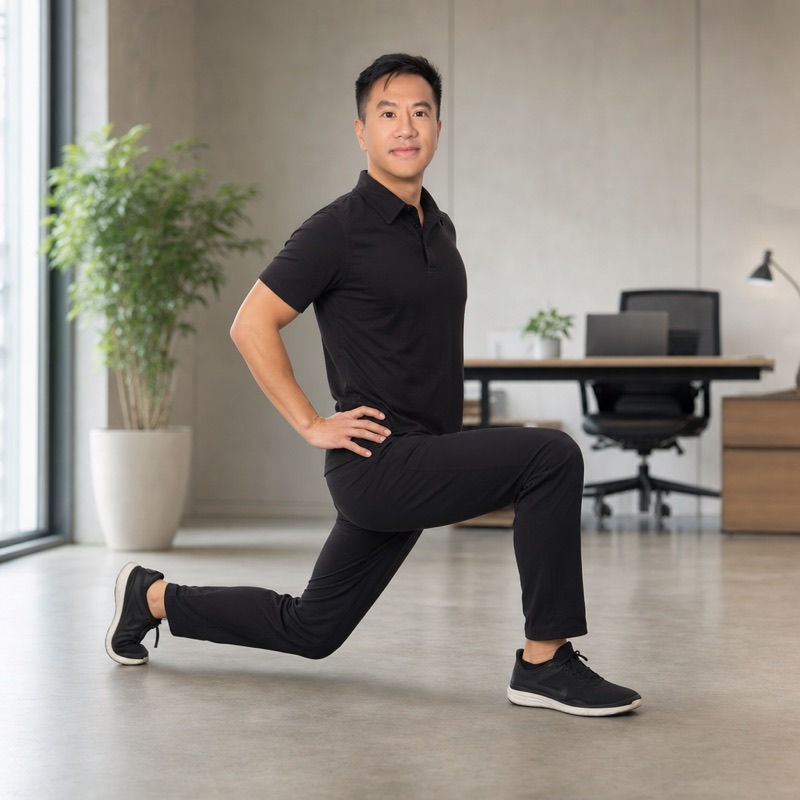
Here’s the one most desk workers skip — and the one I most wish they wouldn’t. Hours of sitting shorten the hip flexors at the front of the hip. Tight hip flexors tilt the pelvis forward, putting a constant low-grade strain on the lumbar spine. Most desk workers think their problem is “low back” when really their problem is “tight hip flexors pulling on the low back all day long.”
How to do it right: Get into a half-kneeling lunge — right knee on a folded towel or cushion, left foot forward with the knee at 90 degrees. Before anything else, gently tuck your pelvis under, like you’re pointing your tailbone down. THEN slowly shift weight forward, keeping the lower back long and neutral. You should feel the stretch high up at the front of the right hip and thigh. Hold 30 seconds. Switch sides.
The mistake: leaning forward by arching the lower back. When you arch, the pelvis tips forward — which actually shortens the hip flexor MORE while compressing the lumbar spine. You’ll feel a stretch, but it’ll be in your low back, not your hip flexor, and you’ll be making the problem worse. The pelvic tuck before the forward lean is non-negotiable.
What to feel: a deep stretch at the front of the hip and top of the thigh on the kneeling side. The lower back should feel neutral. If you feel anything in the lower back, stop, re-tuck the pelvis, and try again with less forward lean.
When to do it: 2 times per day, especially after long sitting sessions. End of workday is ideal.
Putting It All Together: The 5-Minute Routine
Here’s the routine I actually give my desk-worker patients:
Round 1 (mid-morning):
– Chin tuck × 10 reps
– Doorway pec stretch × 30 seconds each side
– Seated spinal rotation × 5 breaths each side
Round 2 (mid-afternoon or end of workday):
– Levator scapulae stretch × 30 seconds each side
– Hip flexor lunge × 30 seconds each side
Roughly five minutes total, split across the day. No mat, no equipment, no changing clothes.
If you do this consistently for three weeks with the corrected technique above, you may notice meaningful change — such as better neck range, less afternoon shoulder tension or less lower-back ache. Individual results vary. If you don’t, the tension probably has a root cause stretching alone can’t address.
When Stretching Isn’t Enough
Stretching has a ceiling. If you’ve been doing these correctly for three weeks and your tension still feels stuck, something else is going on — usually a chronically gripping muscle that needs hands-on release, a weakness elsewhere in the chain pulling the tight muscle into a guarding pattern, or an underlying postural issue that needs assessment.
If your tension hasn’t responded to consistent daily care, an RMT assessment can help identify what’s driving the pattern and give you a treatment plan that combines hands-on work with the corrective movement you actually need. Book at artemis.janeapp.com or call 604-242-2233. We’re at 5911 No. 3 Rd #130, Richmond BC, steps from Brighouse SkyTrain. Related reading: Why Are My Shoulders Always Tight?, Richmond RMT Deep Tissue Massage Guide, and our hybrid worker neck and back guide.
About the Author

Dave Tam, RMT is a Registered Massage Therapist licensed with the College of Complementary Health Professionals of BC (CCHPBC). He is the Director of Artemis Wellness Clinic in Richmond, BC, where he leads the RMT team and focuses on chronic tension patterns, post-injury recovery, and athletic performance care. Dave co-founded Artemis with his sister Mandy Tam in 2025.
Reviewed by Dave Tam, RMT · Published 2026-05-13
Educational content only. If you have an existing injury, neck/back diagnosis, or chronic condition, consult a regulated practitioner before starting any stretching routine. Stop any stretch that causes sharp pain, tingling, or numbness.