
Artemis Wellness Clinic is a multidisciplinary clinic at 5911 No. 3 Road #130, Richmond BC, V6X 0K9, located steps from Brighouse SkyTrain station. Our Registered Acupuncturist and founder, Mandy Tam (R.Ac), works with English-, Mandarin-, and Cantonese-speaking patients from across Metro Vancouver who come in feeling depleted, wired-but-tired, or simply unable to switch off. To book an honest, expectations-managed consultation, call 604-242-2233 or visit https://artemis.janeapp.com.
This guide is written from a clinical practitioner’s perspective. It explains how acupuncture can play a supporting role in stress, anxiety, and burnout — without overpromising and without replacing the medical or psychological care many people genuinely need. If you are looking for a Richmond acupuncturist who will be straight with you about what acupuncture can and cannot do, this article is for you.
How Acupuncture Affects the Stress Response (Honest Mechanism)
A growing body of research suggests acupuncture can influence the autonomic nervous system, particularly by supporting parasympathetic (“rest and digest”) activity and improving vagal tone. In plain language: a well-placed needle session may help shift your body out of a chronic fight-or-flight state and into a calmer baseline. Patients commonly describe this as feeling “settled,” “less buzzing,” or “able to take a full breath again.”
We want to be clear about what this is and is not. Acupuncture is supportive, complementary care. It is not a substitute for diagnosis or treatment of a mental health condition. If you are dealing with depression, an anxiety disorder, PTSD, or burnout that is affecting your ability to function, please continue working with your family doctor, psychiatrist, registered psychologist, or counsellor. Acupuncture can fit alongside those professional supports — it does not replace them.
What acupuncture may help with, in our clinical experience:
– Lowering felt-sense of stress reactivity day to day
– Improving sleep onset and sleep quality
– Easing the somatic side of anxiety (tight chest, jaw clenching, shallow breathing, gut tension)
– Reducing musculoskeletal tension that feeds the stress loop (shoulders, neck, jaw)
– Supporting recovery during a burnout phase
What acupuncture is not:
– A cure for clinical anxiety or depression
– A reason to stop prescribed medication
– A crisis intervention for active suicidal thoughts or psychiatric emergencies
Who Comes In With Stress, Anxiety & Burnout — 4 Typical Patient Profiles
We see four patterns most often at our Richmond clinic. You may recognize yourself in one — or in several.
1. The tech professional with chronic shoulder and jaw tension. Often a software engineer, product manager, or analyst working long hours from a home office in Brighouse, Steveston, or downtown Vancouver. They report jaw clenching at night, headaches by mid-week, and shoulders that feel “fused to their ears.” Their stress is held in the body even when their mind feels “okay.” Some patients with this pattern choose to combine acupuncture with registered massage therapy.
2. The new parent running on broken sleep. Often presenting six weeks to a year postpartum, with anxiety that flares at night, intrusive worry, and a baseline tiredness that coffee no longer touches. We are careful with this profile — we coordinate with the family doctor, screen for postpartum mood concerns that need referral, and focus on gentle nervous-system work the parent can actually fit into a 60-minute window between feeds.
3. The healthcare worker in post-pandemic burnout. Nurses, lab techs, paramedics, and physicians who carried unsustainable loads through 2020-2024. They often present with emotional flatness, depleted motivation, sleep disruption, and a sense that their recovery should be faster than it is. Burnout is a slow rebuild. We talk honestly about that timeline.
4. The student during exam season. University and high school students from Richmond, UBC, SFU, and Kwantlen who come in with test anxiety, racing thoughts at night, and tension headaches. We focus on calming sessions in the two to three weeks before exams, with practical sleep and breathing homework between visits.
What a Stress-Focused Session Looks Like
A first stress-focused acupuncture visit at our Richmond clinic runs 60 to 75 minutes. Expect a thorough intake covering sleep, digestion, menstrual cycle (if relevant), energy patterns, jaw and shoulder tension, recent life stressors, and any medications or counselling you are currently engaged with. Mandy will also take pulse and tongue readings — standard Traditional Chinese Medicine (TCM) diagnostics that help guide point selection.
A typical point prescription for stress and anxiety may include:
– Yintang (between the eyebrows) — a calming point many patients describe as feeling like a “soft weight” that helps the mind stop spinning
– Ear Shen Men (auricular point) — used in protocols for stress, sleep, and emotional regulation
– ST36 (Zusanli) — traditionally used to support digestive function and overall vitality, both of which take a hit during chronic stress
– LV3 (Taichong) — a classic point for what TCM describes as Liver Qi stagnation, which often correlates with irritability, jaw tension, and feeling “stuck”
In TCM terms, your presentation may be read as a Heart-Spleen pattern (worry, overthinking, sleep disruption, fatigue), a Liver Qi stagnation pattern (irritability, tightness, sighing, premenstrual flares), or a combination. These categories do not map one-to-one onto Western diagnoses; they are a separate clinical framework that helps guide the session.
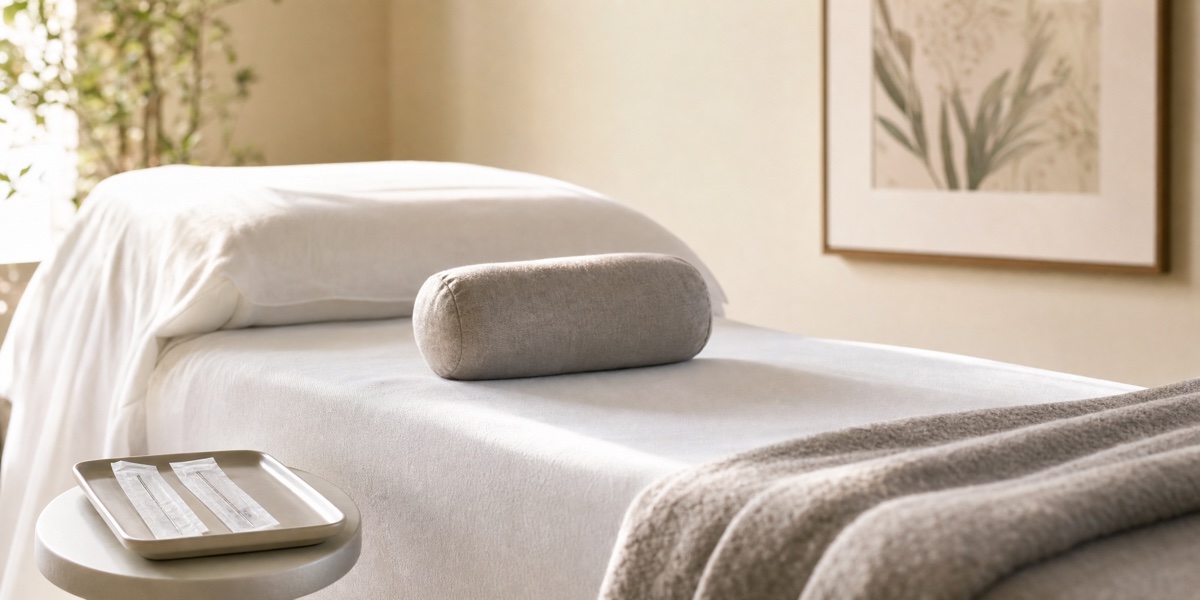
You will rest with the needles in for 20 to 30 minutes in a quiet, dimly lit room. Many patients fall asleep. That is common.
To learn more about our Acupuncture & TCM service, see our Acupuncture & TCM service page.
How Quickly You Might Notice Changes
We want to set honest expectations.
After the first session: Some patients report noticeably deeper sleep that same night, or a “softer” feeling in the chest and shoulders within 24 hours. Some patients feel mildly tired or emotional for a few hours after — this is a normal nervous-system release. A smaller number feel little to nothing the first time. None of these outcomes predicts long-term response.
After 4 to 6 sessions: This is when some patients notice more consistent changes — such as better sleep onset, less reactive baseline, fewer “stress headaches,” reduced jaw clenching, easier recovery from minor stressors. Individual results vary. We typically reassess at this point.
Beyond 6 sessions: We discuss whether to continue at the same frequency, taper to maintenance every 3 to 4 weeks, or pause. There is no benefit in over-treating. A practitioner pushing endless weekly visits without a clear rationale is a flag, not a feature.
For more on what a typical course of acupuncture for sleep and stress involves, see: acupuncture for insomnia and stress in Richmond BC.
When Acupuncture Is — and Is Not — the Right Choice
Acupuncture may be a reasonable supportive option for you if:
– Your stress, mild-to-moderate anxiety, or burnout symptoms are affecting sleep, tension, or daily comfort
– You are already (or willing to be) under the care of a family doctor or counsellor for the bigger picture
– You are open to a 4- to 6-session trial before judging results
– You can travel to our Brighouse SkyTrain location in Richmond
Acupuncture is not the right primary intervention if you are experiencing:
– Active suicidal thoughts or self-harm ideation — please call 9-8-8 (Canada Suicide Crisis Helpline) or go to your nearest emergency department
– Severe psychotic symptoms, mania, or acute psychiatric crisis — these require urgent psychiatric care
– Symptoms that need medication management you are not currently receiving — please see your family doctor first
– A desire to stop or replace prescribed psychiatric medication — never adjust medication without your prescriber’s involvement
We will refer you back to your family doctor or to community mental health services any time we believe that is the more appropriate next step. That is part of practising responsibly.
The Stress + Insomnia Combo (TCM Connection)
In our clinic, stress almost never walks in alone. It usually arrives with sleep disruption — either trouble falling asleep, waking at 2 to 4 a.m. with a racing mind, or sleeping but waking unrefreshed.
TCM has a specific framework for this. Two of the most common patterns we see in Richmond patients are:
- Heart-Spleen pattern: Overthinking and worry “weaken” what TCM describes as the Spleen’s ability to support the Heart, leading to anxiety, sleep disruption, fatigue, sometimes appetite changes. Treatment focuses on calming the Heart and supporting the Spleen.
- Liver Qi stagnation: Frustration, suppressed irritability, and a sense of being “stuck” lead to tight shoulders, jaw clenching, sighing, and premenstrual flares. Treatment focuses on moving Liver Qi.
These framings are clinical TCM categories — not Western diagnoses. We use them to guide point selection, not to make medical claims.
How To Combine Acupuncture With Other Care
Acupuncture is one part of a sensible plan, not the whole plan. We routinely encourage patients to:
- Continue with your counsellor or psychologist. Talk therapy and acupuncture address different dimensions; they do not compete.
- Maintain or build a basic exercise habit. Walking 20 to 30 minutes a day is one of the strongest evidence-based supports for mood and stress regulation.
- Hold sleep hygiene boundaries. Consistent wake time, limited late-evening screens, and a wind-down routine outperform any single supplement.
- Add registered massage therapy when tension is body-dominant. For patients whose stress lives in the shoulders, jaw, neck, and upper back, combining acupuncture with registered massage therapy at our Richmond clinic is often a practical option.
- Coordinate with your family doctor. If your stress is layered with thyroid, perimenopause, iron, or sleep apnea questions, those need investigation independent of acupuncture.
Direct Billing for Stress-Related Acupuncture
We try to keep the financial side simple at our Richmond clinic.
- Extended health coverage: Most major Canadian extended health plans (Pacific Blue Cross, Manulife, Sun Life, Canada Life, GreatWest Life, Green Shield, Equitable Life, and others) include acupuncture benefits. We direct-bill many of these plans where the policy allows.
- ICBC: If your stress and anxiety symptoms are post-motor-vehicle accident — for example, you have been struggling with sleep, hypervigilance, or driving anxiety since a collision — acupuncture may be covered under your ICBC claim. We bill ICBC directly for your pre-approved treatments. If part of a fee is not covered by ICBC (a user fee), we tell you before your treatment.
- Self-pay: Transparent rates are listed in Jane App during booking.
For coverage questions, call 604-242-2233 and our front desk will walk through your specific plan with you.
Frequently Asked Questions
1. Will acupuncture actually help my anxiety, or is it placebo?
We will not promise results. In our clinical experience, some patients with stress-driven and mild-to-moderate anxiety symptoms report a degree of relief within 4 to 6 sessions. Others do not. We recommend a short, honest trial with clear reassessment, rather than open-ended treatment. Whatever effect you experience — neurobiological, placebo, or both — what matters is whether your sleep, tension, and felt sense of stress measurably improve.
2. How many sessions before I notice something?
Some patients notice improved sleep or a “calmer body” after the first session. If changes occur, they tend to be clearer by sessions 4 to 6. If you are not seeing benefit by session 6, we will have a frank conversation about whether to continue, change approach, or refer you elsewhere.
3. Can I do acupuncture if I am taking an SSRI or other anxiety medication?
Yes. Acupuncture does not interact pharmacologically with SSRIs, SNRIs, benzodiazepines, or other psychiatric medications. We strongly encourage you to remain on your prescribed medication and continue working with your prescriber. Never adjust dose based on how acupuncture is going — that is a conversation for your family doctor or psychiatrist.
4. Does insurance cover stress-related acupuncture visits?
Most extended health plans cover acupuncture as a benefit category, regardless of the reason for the visit (stress, pain, sleep, women’s health, etc.). Coverage amounts and per-visit caps vary by plan. If your symptoms are tied to a motor vehicle accident, acupuncture may be covered under your ICBC claim, and we bill ICBC directly for your pre-approved treatments.
5. Is everything I share confidential?
Yes. Acupuncturists in BC are regulated health professionals, licensed with the College of Complementary Health Professionals of BC (CCHPBC) and held to professional confidentiality standards equivalent to other health practitioners. Your intake notes, what you share in session, and any related correspondence are confidential and stored securely.
6. What should I expect at my first visit?
Plan for 60 to 75 minutes. Wear loose, comfortable clothing. Eat something light an hour or two before. Expect a thorough intake conversation, a TCM-style pulse and tongue check, point selection, and 20 to 30 minutes resting with the needles in. You can read more about our Registered Acupuncturist Mandy Tam on her practitioner spotlight page.
7. What can I do between sessions?
Three things often help: a 10-minute slow-breathing practice once or twice a day (try 4-second inhale, 6-second exhale), a 20- to 30-minute daily walk, and a consistent wake time. None of these are exotic. Done consistently, all of them can support your sessions.
Book a Stress-Focused Acupuncture Session in Richmond
If chronic stress, low-grade anxiety, or a stretch of burnout is wearing you down, we are happy to talk honestly about whether acupuncture is a sensible next step for you — and refer you elsewhere if it is not.
Artemis Wellness Clinic is at 5911 No. 3 Road #130, Richmond BC, V6X 0K9, just steps from Brighouse SkyTrain station. To book with Mandy Tam or another member of our acupuncture team, visit https://artemis.janeapp.com or call 604-242-2233. We offer English, Mandarin, and Cantonese consultations, and direct billing for many extended health plans and for ICBC pre-approved treatments.