Artemis Wellness Clinic sits at 5911 No. 3 Road, Suite #130, Richmond BC, V6X 0K9, a few minutes’ walk from the Brighouse SkyTrain station and the bus loop at Richmond-Brighouse. We house all three modalities under one roof — acupuncture and Traditional Chinese Medicine, Registered Massage Therapy, and physiotherapy — alongside chiropractic and kinesiology. That puts us in a slightly unusual position when patients call asking, “which one should I book?” We don’t earn anything by steering you toward the wrong service, so this guide is written to help you make the right call even if that means booking something we offer less of.
If you’re not sure which modality to book, this guide compares the three on what they actually do, what they’re best for, and when it makes sense to combine them.
What Each Modality Actually Is (Honest Definitions)
Before the decision matrix, here’s a plain-English definition of each. The labels get used loosely online, and that’s part of why people end up booking the wrong thing.
Acupuncture (R.Ac, Registered Acupuncturist)
Acupuncture involves the insertion of fine sterile needles into specific points along the body’s meridian system. In British Columbia, acupuncturists are regulated health professionals and use the protected title R.Ac (Registered Acupuncturist) under the College of Complementary Health Professionals of BC (CCHPBC). Research on acupuncture has focused mainly on pain modulation (especially chronic and neuropathic pain) and nervous system regulation, and it is also commonly used as supportive care for internal patterns that other modalities don’t directly address — sleep, stress, digestion, menstrual irregularities, and fertility support. A skilled acupuncturist also reads pulse and tongue and offers Traditional Chinese Medicine guidance on diet and lifestyle as part of the visit.
What acupuncture does not do well: it doesn’t directly mobilise a stiff joint, it doesn’t teach you how to load a tendon back to running, and it doesn’t substitute for hands-on soft tissue work when a muscle is mechanically locked up.
Registered Massage Therapy (RMT)
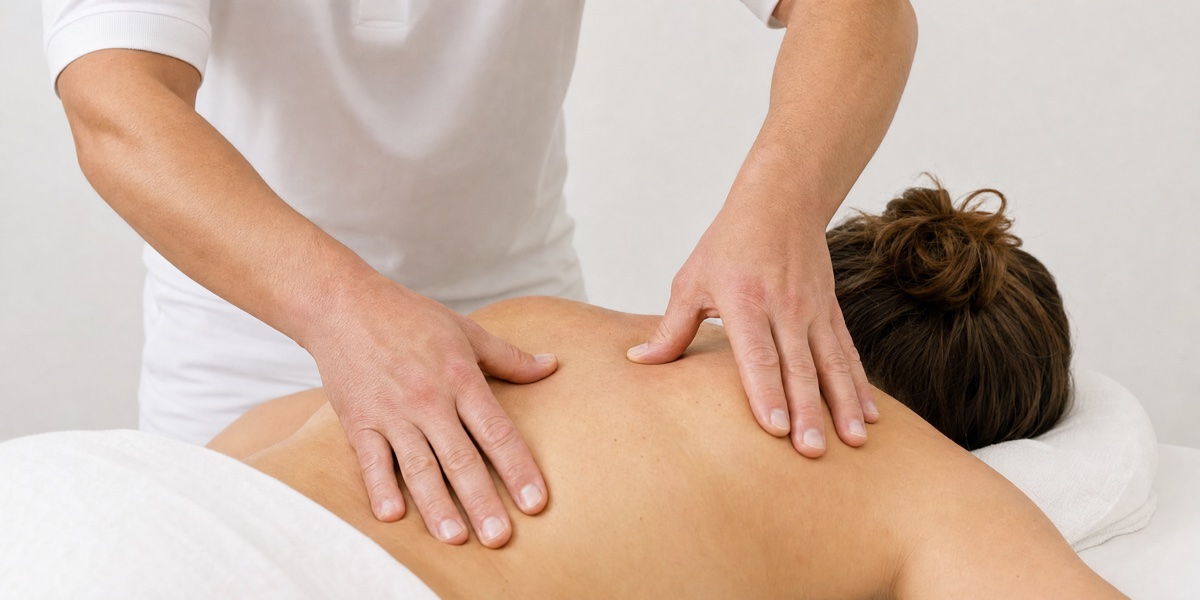
Registered Massage Therapists in BC complete a 3,000-hour college program and are regulated by CCHPBC. RMT is hands-on manual therapy of soft tissue — muscle, fascia, tendon, ligament, and the nervous system through skin and pressure receptors. The strongest evidence is for muscle tension, fascial restriction, post-exercise recovery, headache of muscular origin, and the soft-tissue component of chronic pain. RMT is also the modality most patients find most subjectively relaxing, which matters more than people give it credit for — downregulating the sympathetic nervous system has real downstream effects.
What RMT doesn’t do: it doesn’t give you a graded loading program for a torn rotator cuff, and it isn’t the most efficient tool for deep internal-system patterns like insomnia or digestive issues.
Physiotherapy (Registered Physiotherapist)
Physiotherapists in BC are regulated by the College of Health and Care Professionals of BC (CHCPBC) and combine clinical assessment, manual therapy, exercise prescription, and modalities (IFC, ultrasound, dry needling, etc.). The strongest evidence is for movement dysfunction, post-injury rehabilitation, post-surgical recovery, return-to-sport progressions, and any case where you need a structured plan to get a joint or limb back to a measurable level of function. Physio is also the gateway modality for ICBC and WorkSafeBC funded care in most claim pathways.
What physio is not the best tool for: passive symptom relief on its own. Physio works best when the patient is willing to do homework between sessions.
Decision Matrix — Which One for Which Situation
This is the table we wish more patients had before they called us. None of these are absolute rules — your specific case may differ — but as a starting point:
| Situation | Where to start | Why |
|---|---|---|
| New acute injury, first 72 hours | Physiotherapy | Assessment, ruling out red flags, early loading guidance |
| Chronic muscle tension (neck/shoulders/back) | RMT | Direct manual release of the tissue causing the problem |
| Persistent pain that hasn’t responded to other care | Acupuncture | Different mechanism — neuromodulation rather than mechanical |
| Sleep, stress, anxiety, digestive complaints | Acupuncture | A common reason patients choose acupuncture |
| Post-MVA whiplash | Physiotherapy + RMT combo | Physio for ROM and reactivation, RMT for guarding |
| Pre-IVF or fertility support | Acupuncture | Can be used as supportive care alongside fertility treatment |
| Tension-type headache | RMT or acupuncture (any of the three may help) | Cervical soft tissue is usually the driver |
| Knee osteoarthritis | Physiotherapy + acupuncture combo | Loading and pain modulation complement each other |
| Sciatica / lumbar nerve pain | All three; start with physio | Physio for movement, RMT for tension, acupuncture for pain |
| Post-surgical recovery | Physiotherapy | Rehab progression is physio’s core competency |
| Pregnancy-related pelvic or back pain | RMT (with prenatal-trained therapist) or physio | Both safe; choose by primary symptom |
| Frozen shoulder | Physio + RMT + acupuncture | Stubborn condition that may benefit from a layered approach |
If your situation isn’t on that list, the simplest rule is this: if it’s primarily mechanical (a joint won’t move, a muscle won’t release, a movement hurts), start with physio or RMT. If it’s primarily systemic (you don’t sleep, your stomach is off, your cycle is irregular, the pain has no clear mechanical pattern), start with acupuncture.
When To Combine (And Why)
The honest reality is that most chronic problems sit across modality lines. Many patients layer treatments rather than picking just one. Two composite cases from the kinds of treatment plans we coordinate at Artemis:
“Sarah” — ICBC whiplash, six weeks post-collision. She came in with limited cervical rotation, daily headaches, sleep that broke at 3 a.m., and a baseline anxiety she didn’t have before the crash. The physiotherapy plan handled the assessment, the graded ROM work, and the documentation for ICBC. RMT addressed the protective muscle guarding through her upper traps and suboccipitals — which a physio’s hands-on portion can touch but RMT can dedicate a full hour to. Acupuncture took on the sleep disruption and the nervous-system overlay that wasn’t going to resolve from movement work alone. This is a composite example; individual results vary.
“Tom” — chronic lower back pain, three years. Standard low-back history: long sitting at work, occasional gym, flares every few months. Physio built a graded core and hip strengthening program and corrected his hinge pattern. RMT worked on the chronic paraspinal tightness that flared between sessions and gave him short-term relief while the strength work caught up. Acupuncture focused on the sleep disruption his pain had caused, since rehab is harder when you are recovering on five hours of broken sleep. He’s now in maintenance — RMT every six weeks, occasional physio check-ins, acupuncture for stress flares.
For more on how the disciplines integrate, see our 5-discipline coordinated care model.
Cost Comparison (2026 Rates)
| Modality | Practitioner | Rate |
|---|---|---|
| Acupuncture | Mandy (R.Ac) | $150 initial visit (65 min); $130 follow-up (40 min) |
| RMT | Dave Tam, Samuel, Jonae | $90 (30 min), $110 (45 min), $135 (60 min) |
| Physiotherapy (initial or follow-up) | Registered Physiotherapist | $110 (30 min), $145 (45 min), $170 (60 min) |
Direct billing applies equally across all three modalities for most extended health plans (Pacific Blue Cross, Manulife, Sun Life, GreenShield, Equitable, and others), and we direct bill ICBC, WorkSafeBC, and First Nations Health Authority where coverage applies. Cost is not usually the right axis on which to choose between modalities — the rates are close enough that clinical fit should drive the decision.
How Practitioners Coordinate at Artemis
Because all five disciplines share one location and one chart system, your physiotherapist can read what your RMT noted last Tuesday and what your acupuncturist found in your pulse on Friday. That sounds basic, but it is clinically meaningful. When the chart is shared, your acupuncturist sees that physio is currently focused on left-side gluteus medius weakness and adjusts the supporting points accordingly; your RMT sees that you had needling in the suboccipitals on Wednesday and may go gentler in that region on Friday.
We also hold informal case discussions when a patient is being seen by multiple disciplines and progress isn’t tracking the way we’d expect. That coordination doesn’t cost the patient anything extra.
Frequently Asked Questions
1. Can I do all three on the same day?
Yes, and many patients do — particularly ICBC and WorkSafeBC patients with funded multi-modality care. The usual order is physio first (assessment and active work), then RMT (passive soft tissue), then acupuncture (nervous system downregulation to finish). Block 3.5 to 4 hours if you’re stacking all three.
2. Will my insurance cover each one?
Each modality has its own coverage line in most extended health plans. So having $500 of RMT coverage doesn’t mean you’re out of physio coverage. Bring your card to the first visit and our front desk will check eligibility and direct bill where possible.
3. Which one should I start with if I genuinely don’t know?
Phone us at 604-242-2233 or use the contact form. Our front desk can do a brief intake and route you to the modality most appropriate for your presentation. We’d rather book you for the right service the first time than have you do the wrong one and lose faith.
4. Do I need a doctor’s referral?
For private-pay and most extended health plans, no referral is required for any of the three. For ICBC active claims, no referral is needed for the first 12 weeks. For WorkSafeBC and some employer-mandated plans, a referral may be required — check with your adjuster or HR.
5. Can I switch between modalities partway through care?
Yes. If you started with RMT for a tension headache and after three sessions you’re not getting durable relief, your therapist will often suggest trying acupuncture or physio for the cervical mechanical component. We see switching as a sign of good clinical judgment, not failure.
6. What if my first choice doesn’t help?
Three to four sessions is usually enough to know whether a given modality is the right fit for your specific issue. If you’re not seeing meaningful change by then, the answer is rarely “more of the same” — it’s a reassessment, and often a different modality or a combination. We’ll tell you that honestly rather than book you for ten more sessions of something that isn’t working.
7. Is there a discount for combined or package bookings?
We don’t run bundle discounts or packages (price is set per modality at the rates above). We can bill many insurers directly; you pay only the part your plan does not cover (co-pay, deductible or amounts above your plan maximum).
Booking and Visiting
Artemis Wellness Clinic is at 5911 No. 3 Road, Suite #130, Richmond BC, V6X 0K9, a 5-minute walk from Brighouse SkyTrain. Free parking behind the clinic (stalls 47–48, weekdays) and 3-hour free parking at the PriceSmart plaza on Ackroyd Road. Online booking across all modalities is at https://artemis.janeapp.com — or call 604-242-2233 if you’d like to talk through which service is the right starting point for your specific situation. Same-week availability is usually possible across acupuncture, RMT, and physiotherapy. We’d rather spend two minutes on the phone helping you choose right than have you book the wrong service and not come back.