By Mandy Tam, R.Ac · Founder, Artemis Wellness Clinic Richmond BC
Reviewed by: Mandy Tam, R.Ac · Date: [PENDING]
May in Richmond and Vancouver is a strange season. The cherry blossoms are over, the spring rain is heavy, allergies are peaking, and most of my patients arrive in May saying some version of the same thing: “I feel tired but wired, like I can’t fully relax.” They are sleeping enough hours but waking unrefreshed. Their shoulders feel like granite. Small things irritate them more than usual. And they cannot explain why.
In Traditional Chinese Medicine, this is not a coincidence. Spring is the season of the Liver, and BC’s particular spring — long stretches of cool rain punctuated by sudden warm days, with everything blooming at once — puts a unique kind of pressure on Liver function in the TCM sense. The body is trying to expand outward like the trees, but the weather keeps pulling it back in. Add in the lingering aftermath of daylight saving, screen-heavy work indoors, and a pollen count that hits hard along the Fraser River corridor, and you have a recipe for what we call Liver qi stagnation.
Here is how I help my patients adjust their daily routine in May to work with the season instead of against it. None of this is exotic, none of it requires a clinic visit, and most of it can be done with what is already in your kitchen or available at any Asian supermarket on No. 3 Road.
Why TCM Says Spring Is Liver Season
In TCM theory, every season is associated with one of the five elements and one of the major organ systems. Spring belongs to the Wood element, and Wood governs the Liver and Gallbladder. Wood energy is the energy of growth, upward movement, and expansion — think of how a seed pushes through soil, or how a young branch reaches toward light. This is the dominant energetic quality of spring.
The Liver in TCM is not the same thing as the anatomical liver your family doctor talks about. It is a functional system. Specifically, the TCM Liver is responsible for the smooth flow of qi (which encompasses both physical energy and emotional regulation), the health of the tendons and overall flexibility, the brightness and clarity of the eyes, the regulation of anger and frustration, and the smoothness of menstrual flow.
When Liver qi gets “stuck” — which is more common in spring because the season is asking the Liver to do more work — patients tend to notice a recognizable cluster of symptoms: irritability that comes out of nowhere, tension headaches across the temples or behind the eyes, neck and shoulder tightness that does not respond to massage alone, irregular or painful menstrual cycles, eye fatigue and blurred vision after screen work, and a tendency to sigh or yawn frequently throughout the day.
I want to be honest about something. The TCM concept of Liver qi stagnation maps remarkably well onto what modern medicine calls sustained sympathetic nervous system activation — the chronic low-grade stress response that creates muscle tension, sleep disruption, digestive irregularity, and emotional reactivity. You do not have to “believe in” TCM theory to benefit from these recommendations. They work because they downregulate the stress response, support the body’s natural detoxification, and gently move the parasympathetic nervous system back online.
Five Liver-Supporting Foods for BC’s May
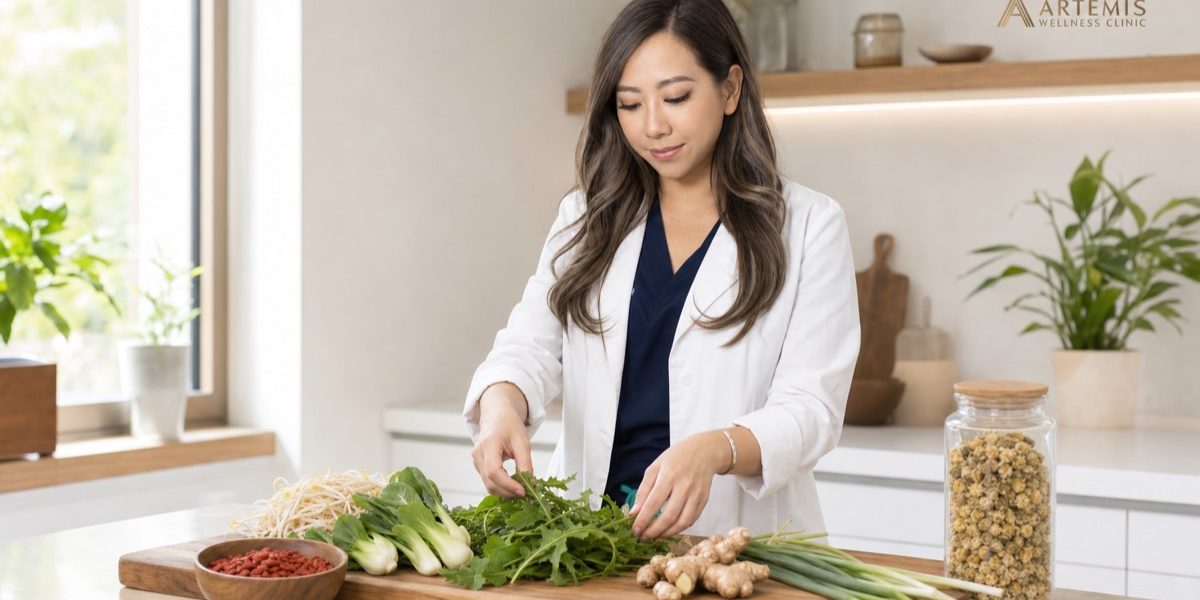
Food therapy is the gentlest and most accessible TCM intervention. These five are what I personally rotate through my own kitchen every spring, and what I most often recommend to patients in Richmond — most of these are easy to find at any Asian supermarket near Aberdeen Centre or along No. 3 Road.
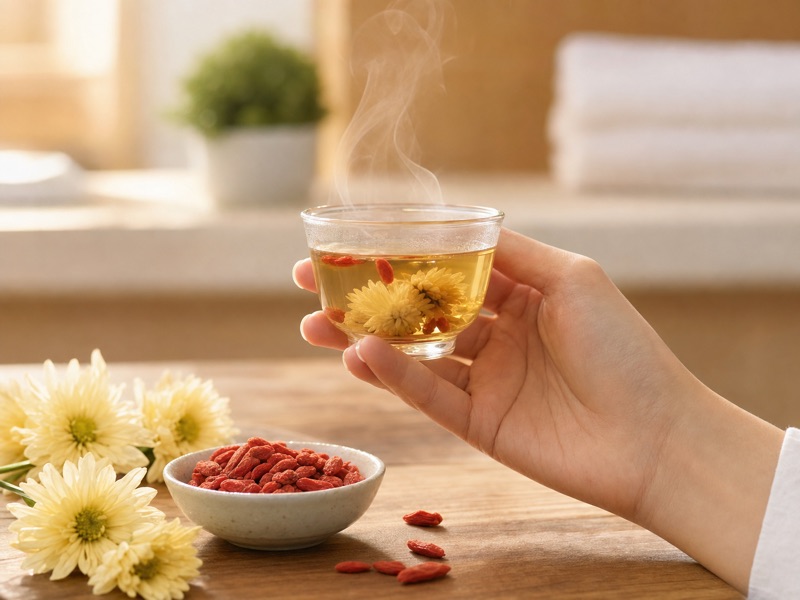
1. Goji berries (枸杞). In TCM, goji berries nourish Liver blood and brighten the eyes. They are especially helpful for anyone doing significant screen work. You will find them at any Asian supermarket on No. 3 Road, and at TaT, Aberdeen Centre, and most Chinese herbal shops in the Lower Mainland. The simplest way to use them is to add one tablespoon of dried goji berries to your morning oats, soak them in warm water for ten minutes, or steep them with chrysanthemum tea. They have a mild sweetness, so most kids will accept them too.
2. Chrysanthemum tea (菊花茶). This one clears Liver heat — the kind of internal warmth that shows up as red, dry, tired eyes after a long day at the computer. I recommend it to almost every patient who works in tech or finance. You can buy loose dried chrysanthemum flowers at TaT or any Chinese grocer, or pre-bagged versions. Steep three to five flowers in hot water for five minutes. The best time to drink it is the 3 to 4 PM window, when most people experience their afternoon energy dip.
3. Mung bean (绿豆). Mung bean is gently cooling and helps the body adjust as spring heat starts pushing into early summer. Mung bean soup (绿豆汤) is a Cantonese spring and early-summer staple for good reason. Soak half a cup of mung beans for an hour, simmer in four cups of water for forty-five minutes with a small piece of dried tangerine peel (陈皮), and sweeten lightly with rock sugar at the end. It will keep in the fridge for four days.
4. Leafy greens (菠菜, 苋菜, 鸡毛菜). Direct Liver-blood nourishment. Whatever leafy green is in season at Aberdeen Centre or your local Chinese produce market is a good choice — spinach (菠菜), Chinese amaranth (苋菜), baby bok choy, and the small tender shoots labelled 鸡毛菜 are all excellent. A simple stir-fry with garlic and a splash of Shaoxing wine takes four minutes and works as a side dish at any meal.
5. Sour-flavored foods. In TCM theory, the sour flavor “anchors” Liver qi and helps prevent it from rising upward into headaches and irritability. You do not need much. Small amounts of vinegar in a salad dressing, a pickled plum (酸梅) eaten as a snack, or a sour plum drink (酸梅汤) on a warm day are all therapeutic. A teaspoon of apple cider vinegar in a glass of warm water before lunch is a reasonable Western adaptation.
Four Acupressure Points You Can Do at Home
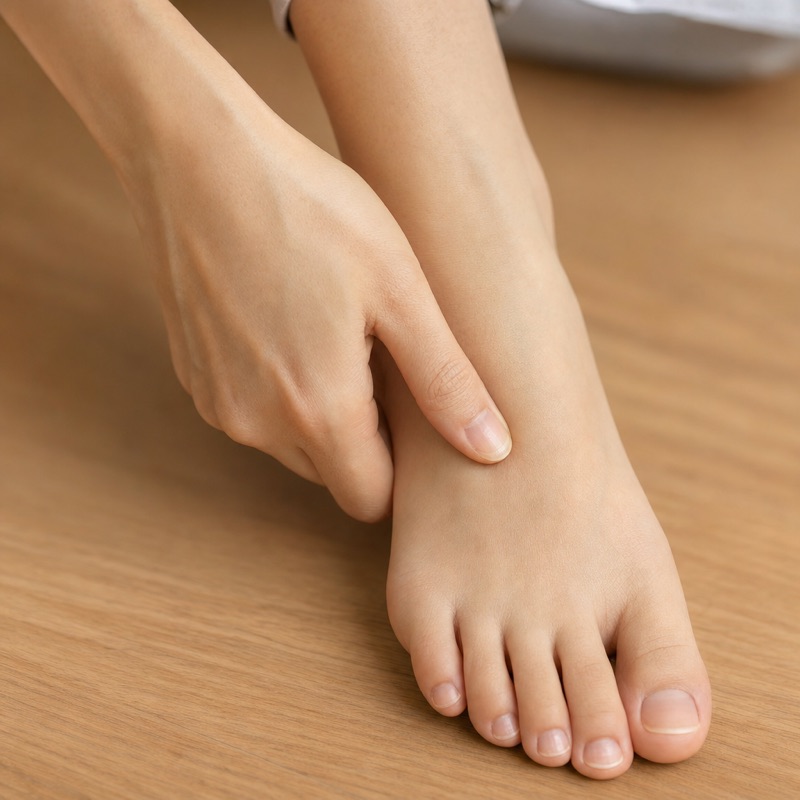
You do not need needles to benefit from the acupuncture point system — for the deeper background on how meridians work, see my companion article What Is a Meridian? A Practical Explanation. Firm finger pressure on the right points, held for thirty to sixty seconds, can meaningfully shift how you feel within minutes. These are the four I teach almost every patient who wants something to do at home.
1. Liver 3 — Tai Chong (LV3, 太冲). Located on the top of the foot, in the soft depression between the first and second toes, about two finger-widths back from the webbing. This is the single most powerful Liver-soothing point in the body. When you find it, it often feels slightly tender. Press firmly with your thumb for thirty to sixty seconds on each foot whenever you feel irritable, tense, or stuck in your head. I recommend doing both feet before bed.
2. Gallbladder 20 — Feng Chi (GB20, 风池). Located at the base of the skull, in the two hollows on either side of the spine where the neck muscles meet the skull. This is the go-to point for tension headaches, neck tightness, eye strain, and the early stages of seasonal allergies. Use both thumbs to press up and slightly inward, toward the centre of the skull, for thirty seconds. Excellent during a screen break.
3. Yintang (印堂, “Hall of Impression”). Located between the eyebrows, in the small depression at the bridge of the nose. This is a deeply calming and grounding point. Press lightly with your index finger or middle finger for one full minute when you feel overwhelmed, scattered, or unable to settle. Many of my anxious patients keep a sticky note on their monitor to remind them to do this point three times a day.
4. Liver 13 — Zhang Men (LV13, 章门). Located on the side of the body, where the bottom of the rib cage ends — roughly under your elbow when your arm is relaxed at your side. This point is excellent for digestive complaints linked to stress: bloating after eating, irregular appetite, the feeling that food is “stuck.” Press lightly for thirty seconds on each side. Do not press hard here — this is a sensitive area near the spleen.
Daily Spring Rituals: A Five-Minute Morning Routine

TCM teaches that spring is a season for early rising. The body wants to mirror the season’s expansive, upward energy, and for most of us that means waking by 6 to 6:30 AM if your work and family schedule allow it. Even a thirty-minute earlier wake time in spring can change how the rest of your day feels. Here is the five-minute morning routine I do myself in May.
Two minutes: gentle full-body stretching. The Wood element loves stretching, and the tendons need lengthening after a winter of contraction. Focus on the side of your body — both the Liver and Gallbladder meridians run along the sides of the torso and legs. Reach one arm up and over your head, lean to the opposite side, and breathe into the stretch for five slow breaths. Repeat on the other side. Add a gentle forward fold and a slow neck roll.
One minute: massage GB20 and Yintang. Thirty seconds on the base of the skull with both thumbs, then thirty seconds on the point between your eyebrows. This wakes up the head and clears the morning fog without coffee.
One minute: six deep breaths. Inhale through the nose for a count of four, exhale through the mouth for a count of six. The longer exhale activates the parasympathetic nervous system and sets a calmer baseline for the day.
One minute: drink warm water. A full mug of warm water with either a slice of lemon or a small handful of goji berries dropped in. Cold water in spring shocks the digestive system. Warm water gently wakes it up.
I do this routine myself every morning in spring. It takes five minutes. The difference in my own irritability, focus, and physical comfort across the day is meaningful enough that I have not skipped it in three years.
When To Skip Self-Care and See a Practitioner
These suggestions are intended for generally healthy adults who want to feel more in tune with the season. They are not a treatment plan for any medical condition.
Please see your family doctor first if you are experiencing severe or persistent headaches, sudden vision changes, jaundice (yellowing of the skin or whites of the eyes), unexplained weight loss, or any new symptom that worries you. TCM and Western medicine work best as complements, not replacements, and a proper Western workup should always come first when something is clearly wrong.
Acupuncture and a personalized TCM consultation become more appropriate than self-care alone when you are dealing with ongoing menstrual irregularity that has lasted more than two cycles, chronic insomnia of more than two weeks, severe stress or anxiety that is affecting your work or relationships, postpartum recovery, or any condition where you have already tried general wellness measures and need targeted support.
Closing Thoughts
Spring is the season I love most as an acupuncturist. The body is more responsive in spring, change happens faster, and small daily adjustments compound quickly. The patients who commit to even one or two of the practices above for the full month of May almost always tell me they feel a shift by early June — calmer, less reactive, sleeping better, with more steady energy through the afternoon.
If you would like a personalized seasonal acupuncture session — for stress and burnout, sleep, allergies, women’s health and fertility, or simply to feel more like yourself — you can book online at artemis.janeapp.com or call 604-242-2233. We are at 5911 No. 3 Rd #130 in Richmond, just steps from Brighouse SkyTrain Station. I see patients in English, Mandarin, and Cantonese. Learn more about our broader Acupuncture & TCM service.
About the Author

Mandy Tam, R.Ac is the Founder and Lead Acupuncturist at Artemis Wellness Clinic in Richmond, BC. She is a Registered Acupuncturist with the College of Health and Care Professionals of British Columbia (formerly CTCMA), with more than ten years of clinical experience treating women’s health, stress and sleep, pain conditions, and seasonal wellness. Mandy practises in English, Mandarin, and Cantonese, and serves patients throughout Richmond, Vancouver, Burnaby, and the broader Lower Mainland.
Reviewed by Mandy Tam, R.Ac · Published 2026-05-13
Educational content only. Food therapy and acupressure suggestions are not a substitute for medical care. If you are pregnant, taking medications, or have a chronic condition, consult your physician before significant dietary changes.