After a car accident in British Columbia, most patients move smoothly through the early phases of ICBC-funded recovery — registered massage therapy, physiotherapy, acupuncture, sometimes chiropractic. Then, somewhere around session 25, coverage tightens, the formal “rehab” ends, and patients are sent back to ordinary life. This is the moment progress can quietly leak away. At Artemis Wellness Clinic in Richmond BC — 5911 No. 3 Rd #130, steps from Brighouse SkyTrain — we built our kinesiology service specifically to bridge that gap, taking patients from discharge through reconditioning all the way to performance. Book online at artemis.janeapp.com or call 604-242-2233 to start your active-rehab phase.
What Discharge Actually Looks Like After ICBC Coverage Ends
By the time most ICBC clients are discharged from their formal physiotherapy and massage course, three things are usually true: pain levels are down, basic mobility has returned, and you are no longer thinking about the accident every day. That looks like a successful recovery — and in clinical terms, it is. But the part that does not show up on any discharge note is the strength deficit, the asymmetry, and the deconditioning that accumulated during weeks or months of guarded movement. If you do nothing about that, three things often happen over the following six to twelve months:
- Old pain returns under load. The day you try to lift your toddler awkwardly, push a heavy cart, or carry groceries up two flights of stairs, the original pain pattern re-fires. Most patients assume they have re-injured themselves; usually they have simply demanded more from a body still operating at 70 percent of its pre-accident capacity.
- Compensation patterns calcify. The way you learned to walk while protecting a sore hip, the way your shoulder hikes when you reach overhead, the way your breathing shallows when stress arrives — these patterns become the new default unless someone deliberately retrains them.
- Activities you used to enjoy quietly drop off the calendar. Running, hiking, ski trips, weekend hockey — none of it feels safe, so it disappears. Patients rarely register this as a recovery problem; they call it “getting older.”
This is the ICBC discharge cliff. It is not anyone’s fault. The funded portion of recovery is built around symptom resolution, not return-to-performance. Closing the gap requires a different discipline.
Why Kinesiology Is the Bridge
Kinesiology is the science of human movement. In British Columbia a kinesiologist (BCAK member) is trained specifically in exercise prescription, biomechanics, and progressive loading — exactly what the post-discharge phase calls for. While physiotherapy and massage therapy treat tissue and pain, kinesiology treats capacity: how much load your body can safely produce, absorb, and recover from across the activities that matter to you.
At Artemis Wellness Clinic our kinesiologists work alongside our physiotherapists, registered massage therapists, acupuncturists, and chiropractor as one coordinated team. That coordination matters because kinesiology done in isolation can stall when an old soft-tissue restriction or a joint mechanical issue blocks progress. With five disciplines under one roof, your kinesiologist can ask the RMT to release a tight quadratus lumborum on Tuesday so the deadlift progression can resume on Thursday. That kind of in-clinic handoff is one advantage of having several disciplines in one clinic.
A Three-Phase Progression: Rehab → Reconditioning → Performance
We organize post-ICBC kinesiology into three named phases. They are not rigid timelines — every client moves at their own pace — but the framework makes it easy to know where you are and what comes next.
Phase 1 — Active Rehab (Weeks 1–6)
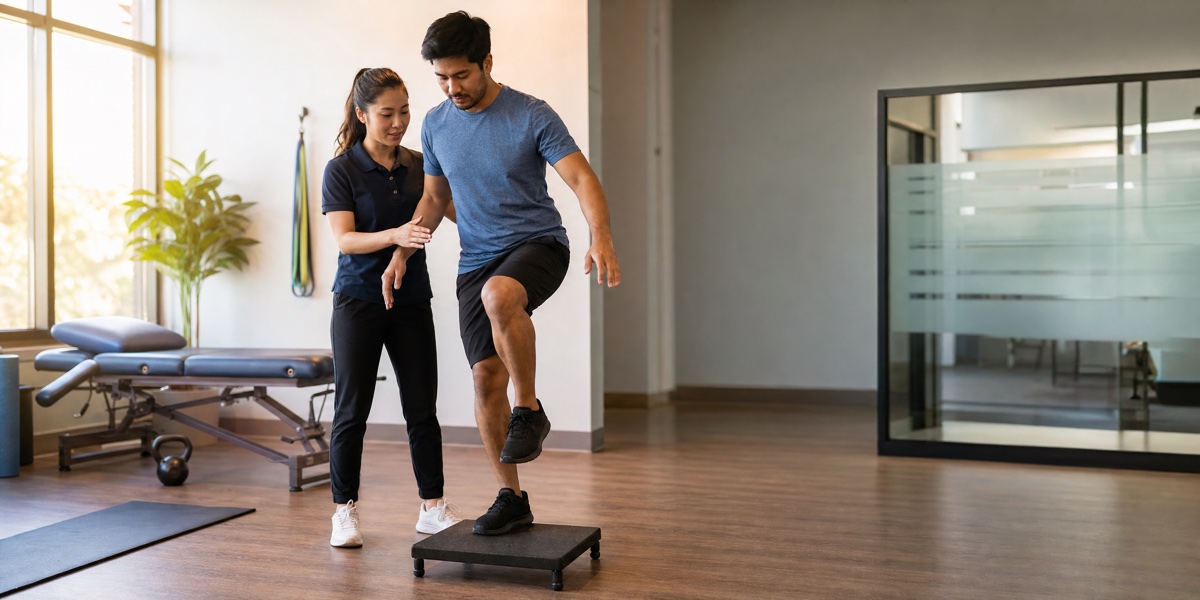
Goal: rebuild baseline movement quality without provoking the original injury pattern. In this phase the kinesiologist takes over from the physiotherapist while still coordinating with them. Sessions look more like guided exercise than treatment, with emphasis on movement screens, posture work, breathing mechanics, and very gradual loading of previously painful patterns. We are not chasing PRs — we are clearing the pathway. Expected attendance: one to two sessions per week.
If you are still receiving partial ICBC coverage at this point, kinesiology may be billed under your active rehab benefit (more on that below).
Phase 2 — Reconditioning (Weeks 6–14)
Goal: rebuild general work capacity. Now the loading becomes systematic — strength training in the major movement patterns (squat, hinge, push, pull, carry), aerobic conditioning matched to your goals, and targeted asymmetry work for whatever the accident left behind. Many clients in this phase also start home programming, with the kinesiologist providing a written plan and checking in weekly to progress it.
This is also the phase where we coordinate with our RMT and physiotherapy team to keep tissue quality up while volume increases. A typical cadence is one kinesiology session plus one massage or one physiotherapy tune-up every two weeks.
Phase 3 — Performance (Weeks 14+)
Goal: return to your specific activity at or above pre-accident capacity. By this stage the kinesiologist is essentially a strength and conditioning coach with a deep medical history. Programming becomes activity-specific — running gait drills for the marathon trainer, single-leg power for the skier, anti-rotation core for the office worker who plays weekend hockey, hip mobility for the cyclist on Burnaby Mountain. Some clients keep coming weekly; others taper to monthly check-ins with home programming in between.
The handoff out of Phase 3 is the win condition: you do not need us anymore for that activity, and you have the tools to handle whatever the next season throws at you.
Example Programs
Concrete is more useful than abstract. Here are four illustrative phase-progression sketches based on common post-accident profiles we see in Richmond. Every recovery is different, and individual results vary.
The marathon trainer. Whiplash and lower back pain after a rear-end collision in Lansdowne. Six months of physio and RMT had eased the pain. Returns wanting to train for the BMO Vancouver Marathon. Phase 1 focused on hip-hinge re-education and breathing under aerobic stress. Phase 2 added structured running progressions starting from walk-runs at Garry Point Park, building to a 16-week training block. Phase 3 was race-specific — hill work on Mountain Highway, long-run recovery protocols, taper management. See our running and marathon injury treatment guide for the symptom-side detail.
The cyclist. Right-shoulder injury and wrist sprain from a side-impact at Westminster Highway. Cleared for daily life within three months. Wanted to return to weekend road riding plus winter spin classes. Phase 1 rebuilt scapular control and grip endurance. Phase 2 introduced bike-specific positional drills and core anti-rotation work. Phase 3 added power on the trainer plus a graded outdoor return — short flat loops first, then Iona Beach causeway, then Sea-to-Sky climbs. See our cycling injury treatment guide for the related rehab content.
The recreational skier. ACL sprain (non-surgical) and ribcage bruising from a low-impact T-bone collision. Walked normally within six weeks but lost confidence in the right knee. Phase 1 was knee proprioception and pain-free quad reactivation. Phase 2 was full-body strength with bilateral and unilateral squat progressions. Phase 3 introduced ski-specific patterns — skater bounds, single-leg landings, lateral plyometrics — with the goal of being ready for opening day at Cypress in October. See our ski and snowboard knee injury treatment guide for the seasonal context.
The office worker. Concussion plus neck and upper-back pain from a low-speed collision near Aberdeen Centre. Returned to remote work after eight weeks but with chronic afternoon headaches and a sense that everything was harder than it used to be. Phase 1 was breath retraining, vestibular-aware strength work, and cervical mobility. Phase 2 added general aerobic capacity plus deskside posture re-engineering. Phase 3 was return to recreational tennis on the weekends, paced over four months. Office workers with this profile often pair kinesiology with RMT — see our registered massage therapy in Richmond guide for the soft-tissue side.
How to Add Kinesiology to Your Existing ICBC Plan
The logistics here trip up most patients. A few key points:
ICBC Enhanced Care includes kinesiology under the pre-approved treatment list. The default funded session count is 12 within the first 12 weeks of your claim, with extensions available on physician or treating-clinician recommendation. If you are within 12 weeks of your accident date, you can usually start kinesiology without a doctor’s referral or ICBC approval; bring your claim number and BC PHN. We bill ICBC directly for your pre-approved treatments. If part of a fee is not covered by ICBC (a user fee), we tell you before your treatment. If you are beyond 12 weeks, your existing extended-health benefits may cover kinesiology (many plans do), or you can pay privately.
Active rehab and kinesiology are slightly different billing categories under ICBC. Active rehab is broader and can include exercise therapy delivered by other clinicians; kinesiology is the specific discipline delivered by a kinesiologist. At Artemis we provide both pathways and choose whichever fits your authorization and goals best. For the broader ICBC mechanics, see our ICBC physiotherapy in Richmond BC guide and our how long does ICBC cover treatment explainer.
Coordination with your physiotherapist matters. If you are already being treated by an Artemis physiotherapist for your ICBC claim, the handoff to kinesiology is internal — same chart, same communication channel, no repeated history-taking. If your physiotherapy was at another clinic, bring discharge notes if available; we will start with a movement assessment and build from there.
You do not need a doctor’s referral for kinesiology in BC. You can book directly. If you want kinesiology specifically billed under your ICBC claim and you are past the initial pre-approved window, we may need a brief letter from your treating physician — we will coordinate that for you.
What an Initial Kinesiology Session at Artemis Looks Like
Plan for 60 minutes. The first half is conversation and movement assessment: your accident timeline, what your old activity baseline looked like, what your current activity baseline is, what specifically you want to be able to do six months from now, plus a head-to-toe screen of the major movement patterns. The second half is hands-on programming — your kinesiologist walks you through your starting set of exercises, films a couple for technique reference, and gives you a written or app-based home plan. You leave with a clear next-session date and an honest answer to “how long is this going to take?”
We are located at 5911 No. 3 Rd #130, Richmond, BC V6X 0K9, two minutes’ walk from Brighouse SkyTrain station, with bike storage, free parking behind the clinic (stalls 47–48, weekdays) and 3-hour free parking at the PriceSmart plaza on Ackroyd Road. Direct billing for ICBC, WorkSafeBC, Pacific Blue Cross, Sun Life, Manulife, Canada Life, and most major insurers. Languages spoken at the clinic include English, Mandarin and Cantonese.
Frequently Asked Questions
Do I need a doctor’s referral to start kinesiology?
No. Kinesiology in British Columbia does not require a physician referral. You can book directly through artemis.janeapp.com or by calling 604-242-2233.
Will ICBC pay for my kinesiology?
Usually yes within the first 12 weeks of your claim under Enhanced Care pre-approved treatments. We bill ICBC directly for your pre-approved treatments. If part of a fee is not covered by ICBC (a user fee), we tell you before your treatment. After 12 weeks, extension is possible with treating-clinician recommendation; otherwise extended health benefits may cover it.
How many sessions will I need?
Most clients move through the three-phase model in 12 to 16 weeks of regular sessions, then taper to monthly check-ins. Athletic clients with specific return-to-sport goals sometimes extend Phase 3 across an entire training season. Office and family clients often graduate sooner.
Is kinesiology the same as personal training?
No. Kinesiologists hold a kinesiology degree and BCAK membership, are trained in exercise prescription for medical populations, and can coordinate with your physiotherapy and massage therapy team inside the clinic. Personal training and kinesiology are complementary; many of our clients use a personal trainer for general fitness while seeing our kinesiologist for the rehab-to-performance bridge.
Do you offer evening or weekend appointments?
Yes. The clinic is open 7 days a week, 8 am – 8 pm, and availability varies by practitioner. Check live availability at artemis.janeapp.com.
Can I do kinesiology and massage therapy in the same visit?
Often yes. Many of our clients book a 45-minute kinesiology session followed by a 30-minute targeted RMT session, especially in Phase 2. We coordinate the schedule so you only make one trip to the clinic.
What if I am dealing with a workplace injury, not an MVA?
Kinesiology is also covered by WorkSafeBC for active rehab phases. The mechanics are similar — pre-approval, direct billing, coordination with your treating physiotherapist. Call 604-242-2233 and we will walk you through it.
I am beyond ICBC coverage entirely. Is it worth coming?
It can be. The discharge cliff can happen regardless of how the bill was paid. A structured reconditioning block with a kinesiologist gives you a clear, progressive plan, which many clients find easier to follow than exercising on their own. Individual results vary.
Book Your Active-Rehab Phase
If you have wrapped up the early phases of your ICBC recovery and you can feel that something is still not quite right — capacity, confidence, the activities you used to take for granted — kinesiology can help you close the gap. Book a 60-minute initial kinesiology session at Artemis Wellness Clinic, 5911 No. 3 Rd #130, Richmond, BC V6X 0K9, two minutes from Brighouse SkyTrain. Direct bill ICBC, WorkSafeBC, Pacific Blue Cross, Sun Life, Manulife, Canada Life, Green Shield. Online booking at artemis.janeapp.com or call 604-242-2233.