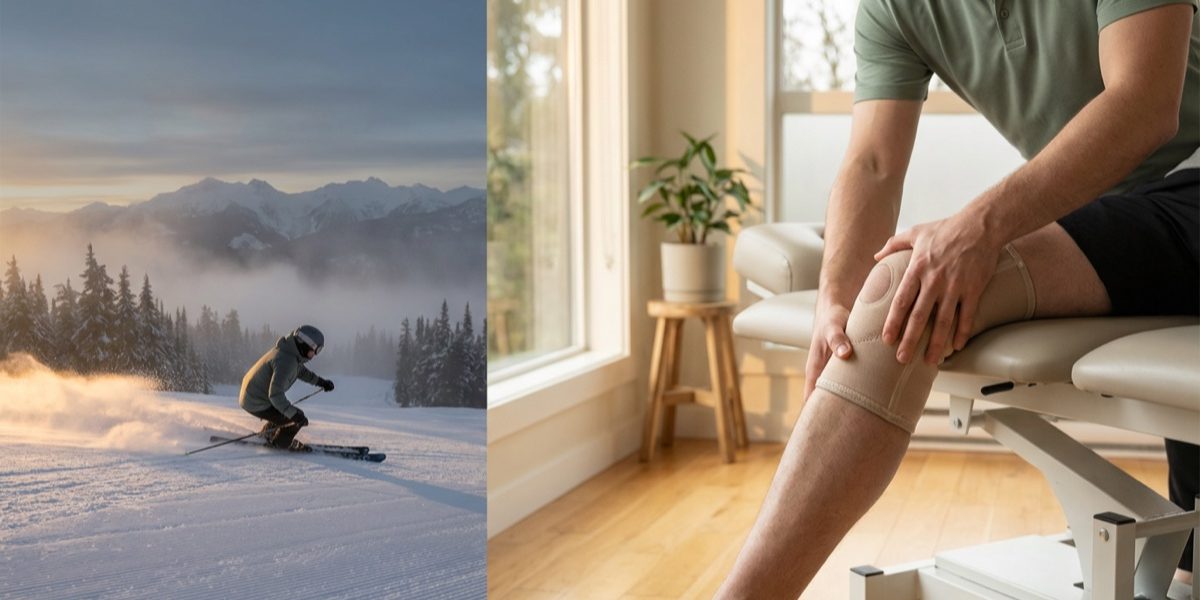
A bad fall on Whistler’s Saddle, a flat-light run on Cypress, or a beginner-day twist on Grouse Mountain — knee injuries are the single most common reason BC skiers and snowboarders end up in a clinic. At Artemis Wellness Clinic at 5911 No. 3 Rd #130, Richmond, BC — steps from Brighouse SkyTrain — we treat ski and snowboard knee injuries every winter through a coordinated team of registered massage therapists (RMTs), physiotherapists, acupuncturists, chiropractors, and kinesiologists. Book directly online at artemis.janeapp.com or call 604-242-2233.
This article walks through the most common ski and snowboard knee injuries we see, when to come in, how our multidisciplinary team coordinates your recovery, and how our on-site rehabilitation gym is used in knee rehab.
Why Ski and Snowboard Knee Injuries Are Different
Skiing and snowboarding load the knee in ways everyday life never does. Bindings hold the boot rigid, edges grip and release, and a twist that would be harmless on flat ground becomes a torsional event the knee absorbs alone. The four most frequent winter knee injuries we see at our Richmond clinic are:
- ACL sprain or tear — the “phantom foot” mechanism on skis (back seat, inside edge catches, tibia drives forward) accounts for the majority of severe alpine knee injuries. Snowboarders are much less prone to ACL tears than skiers because both feet are locked to one board, but front-knee ACL strain still happens during awkward landings.
- MCL sprain — pizza-wedge snowplowing, beginner falls, and side-impact tumbles produce valgus stress on the inside of the knee. MCL is by far the most common injury we see in first- and second-season skiers.
- Meniscus tear — twisting under load (a half-completed turn at speed, a crash where the ski stays planted) shears the cartilage discs that cushion the joint. Meniscus injuries can mimic mild sprains for days before swelling and locking signals appear.
- Patellofemoral pain — long days at Whistler or back-to-back Cypress night sessions can flare up “skier’s knee” in anyone with quad-strength deficits. This is overuse, not trauma, and often responds well to rehab.
Snowboarders also bring us a fifth pattern: front-knee bone bruising and patellar tendon strain from hard-pack landings, plus the classic snowboarder’s ankle (lateral talus fracture) that often shows up alongside knee complaints because the rider compensated all the way down the run.
When to Come In — and When to Go to ER First
If your knee shows any of the following after a fall, please go to a hospital or urgent care first:
- Visible deformity or inability to bear any weight
- A loud “pop” followed by rapid massive swelling within 30 minutes
- Numbness or loss of pulse in the foot
- Knee that locks completely and will not extend
For everything else — pain, mild swelling, instability that comes and goes, stiffness the day after a hard ski day, a “tweak” you can walk on — our Richmond clinic is the right next step. Coming in within 72 hours of the injury gives the best window for early swelling control, joint protection, and a baseline assessment before scar tissue and compensatory patterns set in.
You do not need a doctor’s referral to see an RMT, physiotherapist, acupuncturist, chiropractor, or kinesiologist in BC. We can bill most extended health plans, ICBC (if the injury was vehicle-related) and WorkSafeBC (if the injury was work-related and your claim is accepted) directly.
How to Get to Artemis from the Mountain
Most North Shore skiers drive home through Vancouver. From Cypress, Grouse, or Seymour, the simplest route to our Richmond clinic is south on Highway 99 to Bridgeport Road, then west to No. 3 Road. From Whistler the Sea-to-Sky into the Massey Tunnel and Steveston Highway will land you here in about two hours. If you’ve been told not to drive after a fall, the Canada Line from Vancouver Waterfront to Brighouse SkyTrain drops you across the street from our clinic at 5911 No. 3 Rd #130 — no need to park, no stairs to the platform, elevator down to street level.
We’re open seven days a week, 8 am – 8 pm, so evening and weekend appointments are available for ski and snowboard injury follow-up. Sunday and Monday are the highest-demand days, so book ahead if you can.
Our Multidisciplinary Approach to Knee Recovery
Artemis offers five disciplines that matter for a knee injury in one building, with a shared chart so your team can coordinate your care:
- Physiotherapy — orthopaedic assessment, manual therapy, taping, and the progressive loading program that determines your return-to-sport timeline.
- Registered Massage Therapy (RMT) — aims to ease the quad, IT band, hamstring, and calf tension that often builds up around an injured knee. Our RMTs do focused sports massage for active patients.
- Acupuncture — needling around the knee (local ashi points and points such as ST34, ST35, GB34 and SP9) may help ease pain and swelling in the early stage of healing. For long-standing knee pain, cupping may be added.
- Chiropractic — aims to address the hip and lumbar compensations that develop when one leg has been guarded for weeks.
- Kinesiology / active rehabilitation — supervised gym-based progressions in our on-site rehabilitation gym: closed-chain quad work, single-leg stability, agility ladders, and sport-specific carving and edge-control drills before you return to the hill.
This is the idea behind a multidisciplinary approach: for a skier or snowboarder who wants to be back on edges by next powder day, each discipline covers a different part of recovery within one shared plan.
The On-Site Rehab Gym — Why It Matters for Knee Recovery
Knee rehab is not a passive process. After the first 1–2 weeks of swelling control, recovery is driven by progressive loading: bodyweight squats, then resistance, then plyometric and rotational work. With a rehab gym on site, these progressions can be supervised in the clinic rather than only done from a home handout.
Our on-site rehabilitation gym opened with the new 2025 build-out and contains:
- Squat rack and Olympic platform for closed-chain knee loading
- Cable column and resistance bands for controlled rotation work
- Slide board, BOSU, and balance trainers for proprioception
- Plyometric boxes for return-to-sport jump training
- Floor space for agility ladder and lateral cutting drills
Your kinesiologist supervises every session, progresses load week by week, and signs off on return-to-skiing once landing mechanics, single-leg control, and quad strength symmetry hit threshold. The aim is to take you from “the swelling is gone” to being ready to carve hard turns at Whistler again with a lower risk of re-injury.
Insurance and ICBC — How Treatment Is Covered
Many patients use one of three pathways to help pay for treatment:
- Extended health plans — Pacific Blue Cross, Sun Life, Manulife, Green Shield, Canada Life, and most other major insurers cover RMT, physiotherapy, acupuncture, and chiropractic up to your plan limits. We can bill many insurers directly.
- ICBC — if the knee injury happened in a motor vehicle accident (e.g., you were driving home from skiing and were rear-ended), ICBC’s no-fault benefits pre-approve up to 12 RMT, 25 physiotherapy, 12 acupuncture, 25 chiropractic and 12 kinesiology treatments in the first 12 weeks, with no doctor’s referral or ICBC approval needed (bring your claim number and BC PHN). We bill ICBC directly for your pre-approved treatments. If part of a fee is not covered by ICBC (a user fee), we tell you before your treatment.
- WorkSafeBC — if the injury happened during work-related travel or a work-sponsored activity, with an accepted claim we bill WorkSafeBC directly, and approved services (physiotherapy, RMT and active rehab) are not charged to you; massage therapy needs a doctor’s referral.
Direct billing means you do not have to file the claim form yourself. With extended health, you pay only the part your plan does not cover (co-pay, deductible or amounts above your plan maximum).
Recovery Timeline by Injury Type
These are realistic ranges based on what we see at our Richmond clinic. Yours may be faster or slower depending on injury severity, age, baseline fitness, and adherence to your home program.
- Mild MCL sprain (Grade 1) — back to easy skiing in 2–4 weeks, full carving in 6 weeks
- Moderate MCL sprain (Grade 2) — return to skiing in 6–10 weeks with bracing
- Meniscus strain without locking — 4–8 weeks of physio + active rehab, often no surgery needed
- Patellofemoral overuse — 4–6 weeks of focused quad and glute strengthening
- ACL partial tear (no surgery) — 12–16 weeks of structured rehab to restore stability
- ACL reconstruction (post-op) — 6–9 month structured program, return to skiing typically at month 7–9
- Snowboarder’s ankle (lateral talus fracture) — surgical case, 12+ weeks before return; we manage the rehab side after orthopaedic clearance
Frequently Asked Questions
Do I need a doctor’s referral to come in?
No. In BC you can see an RMT, physiotherapist, acupuncturist, chiropractor, or kinesiologist directly. ICBC (within the first 12 weeks after a crash) and most extended health plans accept self-referral; under WorkSafeBC, massage therapy needs a doctor’s referral.
Do you direct bill ICBC?
Yes — we bill ICBC directly for your pre-approved treatments. If part of a fee is not covered by ICBC (a user fee), we tell you before your treatment. Bring your claim number and BC PHN.
How many sessions will I need?
Mild ski-day knee tweaks often need 3–5 sessions. A Grade 2 MCL sprain typically needs 8–12 visits across physio + rehab gym + RMT. ACL reconstructions are a 6–9 month program. We assess at visit one and give you a realistic plan, not an open-ended package. Individual results vary.
Do you have evening or weekend appointments?
Yes — we’re open seven days a week, 8 am – 8 pm, so evening and weekend appointments are available; availability varies by practitioner. Sunday evenings book up first during ski season; book a week ahead if you can.
Can I come in before going to a doctor?
Yes, unless the red-flag signs in the section above are present (deformity, no weight-bearing, foot numbness, locked knee). If we see anything orthopaedically urgent during assessment we’ll refer you immediately.
I tweaked my knee at Whistler last weekend — should I wait until it stops hurting before coming in?
No. The first 2–3 weeks are the most important window for swelling management, joint protection, and preventing compensatory patterns. Coming in early may help shorten total recovery time.
Can you treat both knees if I’m already favouring my good leg?
Yes — we routinely treat the “good” leg, the hip, and the lower back at the same time. Compensatory pain in the contralateral leg is one of the most common second injuries we see in skiers.
Do you offer kinesiology sessions long-term, or only post-injury?
Both. Many of our skiers and snowboarders come in for pre-season conditioning in October and November and again for return-to-sport rehab after winter. Pre-season strength and balance work can help lower the risk of in-season injury.
Book Your Knee Assessment
If skiing or snowboarding has put your knee on the bench, book online at artemis.janeapp.com or call 604-242-2233. We’re at 5911 No. 3 Rd #130, Richmond, BC, two minutes from Brighouse SkyTrain, with direct billing for ICBC, Pacific Blue Cross, Sun Life, Manulife, Green Shield, Canada Life, and WorkSafeBC. Open seven days a week, 8 am – 8 pm, with an on-site rehab gym and the full team — RMT, physio, acupuncture, chiropractic, kinesiology — under one roof.
For related guidance see our complete Sports Injury Treatment in Richmond BC, Kinesiology and Active Rehabilitation guide, Physiotherapy in Richmond BC complete guide, and Sports Massage Therapy in Richmond.