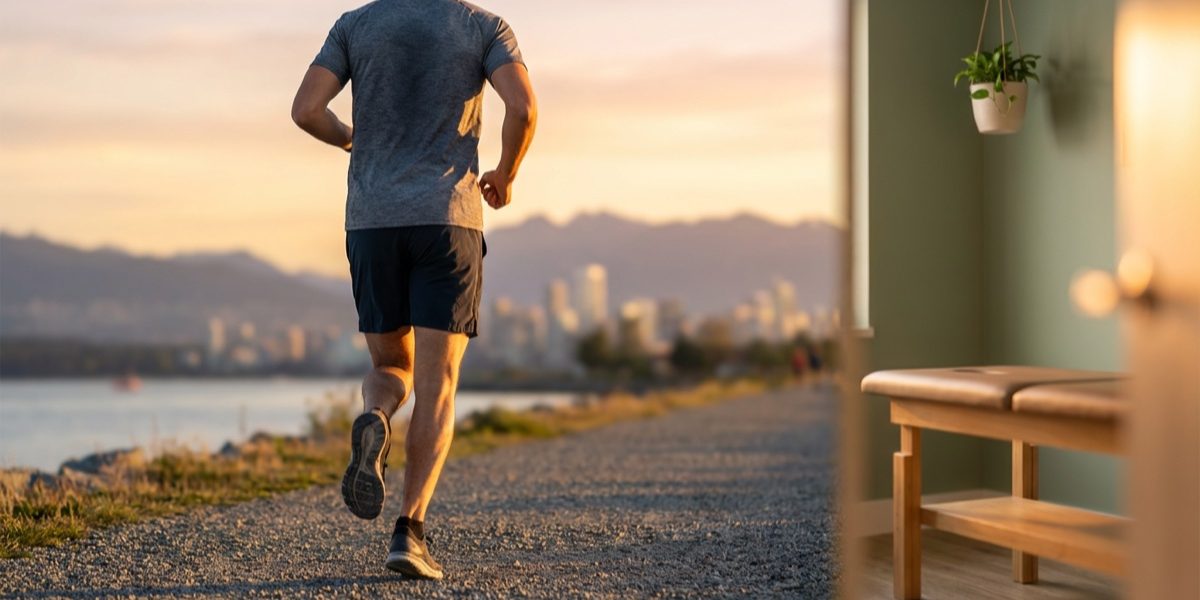
Every year on the first Sunday of May, approximately 17,000 runners take on the BMO Vancouver Marathon, half marathon, 8K, and marathon relay. The course winds through Stanley Park, crosses the Burrard Bridge, and finishes downtown — a beautiful but physically demanding route that asks a lot of knees, calves, hips, and lower back. Whether you are training for the full 42.2 km, the half, or the 8K, Artemis Wellness Clinic at 5911 No. 3 Rd #130, Richmond BC — steps from Brighouse SkyTrain — supports BMO Vancouver Marathon runners through every phase: taper week, race-day prep, immediate post-race care, and the recovery weeks that follow. Book online at artemis.janeapp.com or call 604-242-2233.
Why BMO Vancouver Marathon Demands a Specific Recovery Approach
Most generic marathon recovery advice is built around flat, hot-weather races. The BMO Vancouver course is neither — and that changes the recovery protocol meaningfully. Three course features specifically affect what your body needs in the days and weeks afterwards:
Rolling early hills through Stanley Park load the calves and posterior chain in the first 10 km, when most runners are still settling into pace. Calf strain and Achilles tightness are the most common complaints we see in the days following BMO.
The Burrard Bridge climb comes around the half-marathon mark for full marathoners — late enough that quads are already fatigued. This stretch tends to surface IT-band irritation, lateral knee pain, and gluteus medius soreness in the days afterwards.
The long downhill finish into downtown is faster than the rest of the course. Quad eccentric load peaks here. Two days after the race, that quad soreness translates into stairs being painful and sit-to-stand patterns feeling foreign — both predictable and resolvable with proper post-race care.
Combine all three with the typical Lower Mainland weather (cool, often damp) and the post-race window calls for a coordinated multidisciplinary plan, not a single massage and hopes-for-the-best approach.
The Week Before BMO: Taper Week Recovery Protocol
The week before any marathon is recovery week as much as it is preparation week. The training is done; the goal now is to arrive at the start line fresh, sleeping well, and free of any new tightness. We typically see runners book one or two visits during taper week. Recommended pairings:
A 60-minute taper-week massage, scheduled 4 to 7 days before race day. The goal is not deep work — that risks creating soreness — but moderate flushing and circulation work focused on calves, IT bands, glutes, and lower back. Save the deepest work for at least two weeks before the race.
A 60-minute acupuncture session focused on sleep and nervous system downregulation, scheduled 2 to 4 days before race day. Many runners struggle with pre-race insomnia; acupuncture protocols for sleep + anxiety help measurably. This pairs especially well for first-time marathoners or anyone with a history of pre-race anxiety. See our acupuncture and TCM service overview.
A 30-minute physiotherapy assessment, if you arrive at taper week with any specific niggle (a sore Achilles, a tight piriformis, an IT band that has been complaining). The goal is risk reduction — confirming the niggle is unlikely to become an injury during the race, and giving you a small in-race protocol if needed.
What we do NOT recommend during taper week: deep tissue massage, dry needling on weak/inflamed tissue, chiropractic adjustments to areas you have not been treated in, or any new exercise modality. Race week is a “do less” week clinically.
Race Day: What to Do (and Not Do)
Race day clinical care is largely passive. A few specifics:
- Arrive early to the start area — give yourself 90 minutes minimum if traveling from Richmond. SkyTrain to downtown is reliable; transit will be busy.
- Dynamic warm-up only — no static stretching pre-race for distances over 10K
- No new gels, no new shoes, no new clothing — race day is the wrong time to test anything new
- If you experience sharp pain in the first 5 km that does not subside with pace adjustment, it is almost always better to drop out and recover than to push through and create a 6-week injury. The race comes back next year.
- At the finish line, walk for 10 to 20 minutes before sitting down. Sitting immediately after a marathon is a leading cause of next-day stiffness.
The First 48 Hours After Crossing the Finish Line
This is the highest-leverage window for recovery. What you do in the first 48 hours influences how the next two weeks feel.
Sunday afternoon (race day): light walking, hydration with electrolytes, real food (carbohydrate + protein), elevation of legs for 20-minute blocks. Skip the post-race beer if you can, or limit to one — alcohol disrupts the inflammation/repair cycle that needs to start immediately.
Sunday evening: a warm bath or hot tub, gentle stretching only (no aggressive holds), and an early bedtime. Most marathon recovery is sleep-driven.
Monday (race day +1): light walking 20 to 40 minutes, gentle yin-style stretching, more hydration. Avoid running, lifting, intense yoga, or anything that loads the quads. Many of our patients book a Monday lunchtime acupuncture session for general recovery + soreness modulation — this is a good day for it.
Tuesday (race day +2): the soreness peak. Stairs are unpleasant; sit-to-stand is awkward. This is the right day for a 60-minute post-marathon massage focused on quads, calves, and glutes — moderate pressure, lots of flushing, no deep trigger point work yet. See our registered massage therapy in Richmond guide for more.
Days 3 to 7: The Recovery Week
By Wednesday the quad soreness usually subsides; by Thursday or Friday most runners feel functional again. The temptation in this window is to start running again. Resist it. The micro-damage from a marathon takes 10 to 14 days to fully repair at the cellular level even when you feel fine.
What to do instead during recovery week:
- Easy cycling, swimming, or elliptical — non-impact cardio at conversational pace
- A second deeper massage on day 5 to 7 — now you can tolerate trigger point and deep tissue work; this is when the real adhesion-resolution happens
- Mobility and yin-style stretching daily — 15 to 20 minutes
- Continue sleeping more than usual — your body is still rebuilding muscle protein
If you have a recurring weak spot — IT band, plantar fascia, hip flexor, lower back — book a physiotherapy assessment in this window. Recovery weeks are the best time to address chronic patterns because tissue is in a regenerative state.
When to Coordinate with Kinesiology
Many BMO runners stop training within a week or two of the race and never quite return to their previous form. This is the well-known “marathon hangover” — a combination of post-race lethargy, accumulated training fatigue, and the absence of a forcing function in the calendar. We often pair late-recovery-week massage with a single kinesiology session to plan the next 8 to 12 weeks. The kinesiologist looks at:
- What asymmetries showed up during your race-week recovery
- What fitness you want to maintain for the next race
- How to balance running with strength work to reduce future marathon risk
- A return-to-training timeline that respects your specific recovery quality
This is the same kinesiology service we provide to ICBC patients post-discharge — see our from ICBC discharge to performance guide for the full philosophy. Marathon recovery is, structurally, the same problem: how do you bridge from a finished phase back to fitness without losing what you built?
Common BMO-Specific Issues We Treat in the Two Weeks After
Patterns we see annually in the days after BMO Vancouver Marathon:
- Lateral knee pain (IT band syndrome) — usually from the Burrard Bridge climb plus the downhill finish. Responds well to a combination of physiotherapy (manual release + glute strengthening) and RMT.
- Anterior shin pain or calf strain — from the rolling early hills. Cupping, massage, and short-course acupuncture work well.
- Lower back stiffness — from the cumulative postural fatigue of 3+ hours of running. We see this most in masters-age runners and first-timers. See our lower back pain treatment in Richmond BC guide for the broader approach.
- Plantar fasciitis flare — usually a pre-existing issue made acute by race-week mileage. Conservative care is highly effective.
- Generalized exhaustion + sleep disruption — the autonomic nervous system stays activated for several days post-race. Acupuncture for nervous system regulation helps measurably.
If any of these arrive in the first week post-race, book early. Catching them at day 2 to 5 is much faster to resolve than catching them at day 14.
Booking Pre-Race or Post-Race Care at Artemis
Our pre-race and post-race protocols are available in the windows above. Most disciplines (RMT, acupuncture, physiotherapy, kinesiology) have weekday-evening and weekend availability — important since most marathoners are training around full-time jobs. Direct billing for ICBC, WorkSafeBC, Pacific Blue Cross, Sun Life, Manulife, Canada Life, and Green Shield. No physician referral required.
We are at 5911 No. 3 Rd #130, Richmond, BC V6X 0K9 — two minutes from Brighouse SkyTrain station. Easy SkyTrain access from anywhere in Metro Vancouver, which matters when your legs are sore. Bike storage on-site for runners who want to combine appointments with a recovery cycle.
Frequently Asked Questions
When should I book my post-marathon massage?
Aim for race day +2 (Tuesday after a Sunday marathon). That is the soreness peak and the best window for moderate-pressure flushing work. Book a deeper second session for day 5 to 7.
Should I get a deep tissue massage the day before BMO?
No. Deep tissue work less than 72 hours before the race risks creating new soreness. Save the deepest work for at least two weeks before the race; race week should be moderate flushing work only.
Do you direct bill for marathon-related visits?
Yes for extended health insurance (Pacific Blue Cross, Sun Life, Manulife, Canada Life, Green Shield) under the standard physiotherapy / RMT / acupuncture line item. No ICBC or WorkSafeBC unless your visit is for a separate covered claim.
Can acupuncture help with pre-race anxiety and sleep?
Yes — there are well-evidenced acupuncture protocols for nervous system downregulation and insomnia. Book a 60-minute session 2 to 4 days before the race for best effect.
I have IT band pain from training. Should I run BMO anyway?
Book a physiotherapy assessment 7 to 10 days before the race. Mild IT band irritation can usually be managed through the race with appropriate adjustments; severe pain that limits training should make you reconsider. We will give you an honest assessment.
How long until I should run again after BMO?
Light walking from day 1. Easy non-impact cardio (cycling, swimming) from day 3 to 4. First short easy run typically from day 7 to 10, depending on how recovery is going. Resume real training only when soreness is fully gone and easy runs feel normal again — usually week 3.
Do you offer Sunday hours for race-day or next-day care?
Limited Sunday availability — check live availability on Jane App. For Monday post-race care we usually have weekday lunchtime or evening slots.
My partner is running BMO and I am crewing — anything I should book?
A single 60-minute massage in the week after race day is a thoughtful touch. Crewing a marathon is physically tiring too — long hours on feet, mid-race sprints to handoff zones, post-race driving home with a stiffening runner in the passenger seat.
Recover at Artemis Wellness Clinic
Whether this is your first BMO Vancouver Marathon or your tenth, the recovery weeks decide whether you arrive at the next training cycle stronger or set back. Artemis Wellness Clinic, 5911 No. 3 Rd #130, Richmond, BC V6X 0K9 — steps from Brighouse SkyTrain. Five regulated disciplines coordinated under one roof: RMT, acupuncture, physiotherapy, chiropractic, kinesiology. Book online at artemis.janeapp.com or call 604-242-2233. Pre-race tune-ups and post-race recovery sessions available all week. Direct billing for ICBC, WorkSafeBC, and most major extended health plans.