
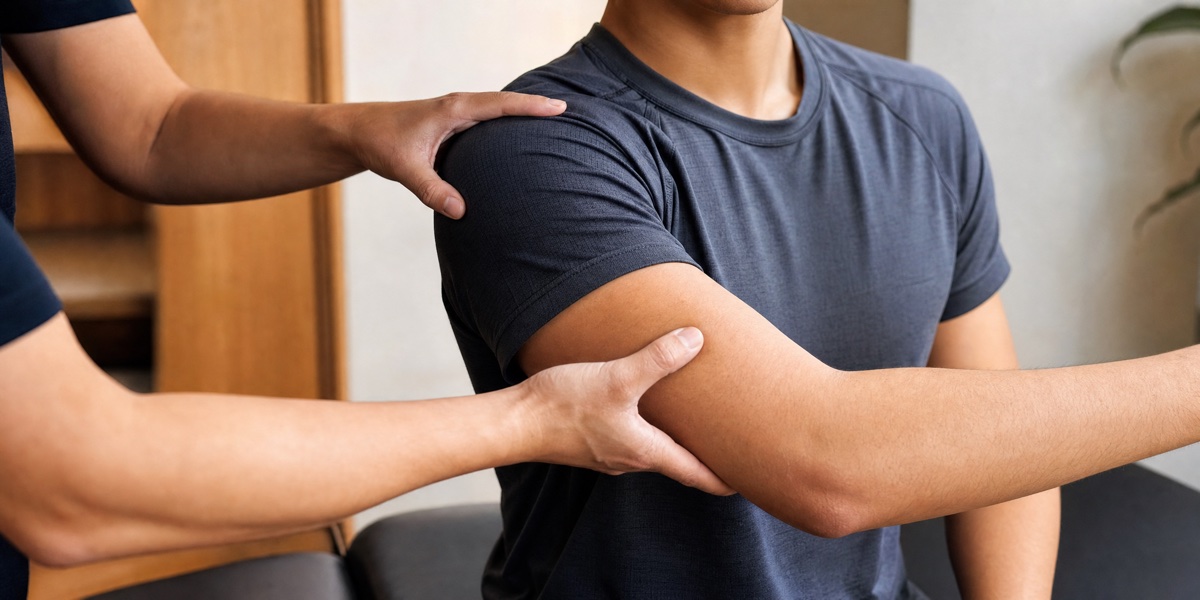
Author note: This article describes the real experience of two patients we will call Mr. M and Ms. W (pseudonyms used to protect privacy). Both patients subsequently left grateful five-star Google reviews for Artemis Wellness Clinic thanking lead acupuncturist Mandy Tam (R.Ac) — those reviews are publicly visible on our Google Business Profile and serve as their own attested confirmation of the experiences described below. Specific clinical details have been generalized; identifying details have been changed.
If you are an athlete, weekend warrior, or active person in Richmond BC dealing with a shoulder issue that is interfering with your training or daily life, this article walks through what acupuncture for shoulder pain can realistically look like — what mechanisms it targets, what a treatment course tends to feel like, and what an honest outcome looks like in the words of patients who have actually been through it. Book at Artemis Wellness Clinic, 5911 No. 3 Rd #130, Richmond BC, steps from Brighouse SkyTrain. Phone 604-242-2233 or artemis.janeapp.com.
Why Shoulder Pain Is So Common in Active People
The shoulder is the most mobile joint in the body. That mobility is paid for in stability — the joint relies on a network of small rotator cuff muscles, the scapular stabilizers, and surrounding fascia to hold the humeral head in the right place under load. When training volume goes up, when sport-specific repetitive motions accumulate, or when an old injury was never fully rehabilitated, that delicate balance starts to slip. The first sign is usually not a single dramatic injury — it is a low-grade ache that you can train through for a few weeks until you suddenly cannot.
The patterns we see most often at Artemis in athletic shoulders include rotator cuff impingement (overhead-pressing athletes, swimmers, throwing-sport players), AC joint irritation (contact-sport players, cyclists who bear heavy weight on the bars on long rides), biceps tendon irritation (lifters and racquet-sport players), and lingering scar-tissue restriction from old separations or dislocations. Many of these patients have already tried rest, ice, anti-inflammatories, and a YouTube rehab program. They come in when the pain has stopped responding to passive measures and is starting to dictate which lifts they skip, which sets they shorten, or which sport sessions they have to drop. The fundamental question they bring is the same: how do I get back to training the way I want?
How Acupuncture Addresses Shoulder Pain in Athletes
Acupuncture is not a magic intervention and Mandy is clear about that with every athletic patient. What it does well, in the shoulder specifically, is three things at once.
First, trigger-point release in the rotator cuff and surrounding muscles. Needling directly into a hyperirritable spot in the supraspinatus, infraspinatus, subscapularis, or teres minor produces a local twitch response that can release the contracted band of muscle fiber holding the joint in a compromised position. Most patients describe the sensation as a deep dull ache followed by a noticeable softening and broader range of motion within minutes.
Second, nervous system down-regulation. Athletes in pain usually carry a sympathetic nervous system that is stuck in a low-grade fight-or-flight idle. That global tension shows up as guarding around the shoulder girdle, shallow breathing, and disrupted sleep — all of which slow tissue recovery. A 30 to 40 minute acupuncture session calms that idle. Many patients fall asleep on the table by the second or third session.
Third, supporting return-to-training capacity. Mandy times treatments around training schedules — pre-session work to mobilize and prepare the joint, post-session work to manage soreness and inflammation, and rest-day deeper work for the deeper trigger points and fascial restrictions. Over a course of 4 to 8 sessions, the goal is not just pain relief in the room but a measurable return to the volume, intensity, and sport-specific movement the patient cares about.
Mr. M’s Shoulder and Return to Training
Mr. M came to see Mandy at Artemis with a shoulder issue that had been quietly worsening over a number of months. Like many athletic patients, he had been training around it — modifying his lifts, dropping certain ranges of motion, telling himself it would settle on its own. By the time he walked into the clinic, the shoulder was no longer just a training problem. It was bothering him during everyday life — reaching, sleeping on that side, the small daily movements that you only notice when they hurt.
The first consultation was longer than he expected. Mandy spent most of it asking questions and watching him move. His training history. His sport-specific patterns. His sleep. His stress. Which positions reproduced the pain and which positions were quietly fine. By the end of the consultation he had a treatment plan that fit around his training schedule rather than asking him to stop training entirely — one of the things he later told us mattered to him most. He did not want to be told to rest. He wanted to be helped to move better.
Across the treatment course, several things shifted. The acute pain pattern in the daily-life movements eased first — reaching overhead, sleeping on that side. The training-specific limitations took longer but came back in steps as Mandy worked deeper into the rotator cuff trigger points and the surrounding fascia. By the end of the course, Mr. M was, in his own words, back to moving and training the way he wanted. He recommended Mandy and Artemis highly in his Google review and credited Mandy specifically for the explanation, the partnership, and the result.
A Related Pattern: Ms. W’s Wrist
A related pattern worth mentioning, because the same active-person population sees it all the time, is upper-extremity irritation that is not strictly the shoulder but moves through the same kinetic chain. Ms. W came in with a wrist issue that had been bothering her for several weeks — the kind of low-grade chronic irritation that does not stop you from doing things but reminds you it is there every time you do them. After a single session with Mandy in which (in Ms. W’s own words from her Google review) Mandy knew exactly what to do, explained clearly, and made her feel super comfortable, she was feeling much better. She also subsequently left a five-star Google review thanking Mandy by name.
The reason we mention Ms. W in a shoulder article is that the upper-extremity kinetic chain — wrist, elbow, shoulder, neck — is one continuous system in active people. Wrist irritation often traces upstream to shoulder mechanics, and shoulder pain often traces downstream into wrist and elbow compensation. Treating the whole chain matters.
What This Means for Other Athletic Patients
Three honest takeaways from these two outcomes:
Do not push through it. Both Mr. M and Ms. W came in only after the issue had stopped responding to self-management. Most athletic patients we see could have come in earlier and saved themselves several weeks of compromise. If you have been training around a shoulder issue for more than a few weeks, that is the signal.
Time-to-response varies. Some patients feel meaningful change after a single session (Ms. W’s wrist). Others need a planned course of 4 to 8 sessions to walk a chronic shoulder issue back to full training capacity (Mr. M). Mandy will give you an honest expectation at the first consultation based on what she finds on examination — not a generic protocol.
Multi-discipline pairing helps for the harder cases. For deeper structural shoulder issues — old labral tears, post-surgical restrictions, persistent rotator cuff weakness — acupuncture pairs well with RMT (for the soft-tissue work around the joint) and physiotherapy (for the loaded rehab progression). Artemis has all three under one roof, which is part of why patients return for the multi-discipline coordination as much as for any single technique. See our weekend-warrior masters-athlete guide and hockey-season injury recovery overview for context on how those combinations work in practice.
When to Add RMT or Physiotherapy Alongside Acupuncture
Acupuncture works on its own for many athletic shoulder presentations. It works better in combination when:
- The issue is more than 8 weeks old and has multiple layers (acute pain plus chronic compensation)
- Post-surgical scar tissue is part of the picture
- The patient needs a loaded rehab progression to safely return to a specific sport (overhead lifting, throwing, contact sport)
- Sleep and overall stress recovery have been disrupted long enough that the nervous system needs deeper work
Reception or Mandy can advise on whether to add an RMT session alongside, or to bring in physiotherapy for the loaded rehab piece. For background on how the disciplines integrate, see our complete clinic guide and patient trust themes from Google reviews.
Frequently Asked Questions
How many acupuncture sessions does an athletic shoulder usually need?
Most athletic shoulder presentations respond meaningfully within 4 to 8 sessions, with the first noticeable change often inside the first 2 to 3 sessions. Chronic or post-surgical cases can take longer. Mandy gives an honest estimate at the first consultation.
Can I keep training during the treatment course?
In most cases yes, with modifications. Mandy will discuss which movements to keep, which to dial back, and how to time training around treatment sessions. Patients usually appreciate not being told to stop entirely.
Does acupuncture for shoulder pain hurt?
The needles themselves are very fine. The trigger-point work in tight rotator cuff muscles produces a deep dull ache and sometimes a brief twitch — most patients describe it as “uncomfortable but releasing” rather than sharp pain.
Is shoulder acupuncture covered by extended health benefits?
Acupuncture sessions at Artemis are direct-billed to most major extended health plans (Pacific Blue Cross, Sun Life, Manulife, Canada Life, Green Shield Canada). Coverage and per-visit caps vary by plan; reception can confirm before your first visit.
What if my shoulder injury is from a car accident — does ICBC cover acupuncture?
Yes. ICBC covers a set number of acupuncture sessions for active claims with no upfront cost to you. Mention the claim at booking.
Do I need a doctor’s referral?
No referral is needed for direct booking. If your extended health plan requires one for reimbursement, your family doctor can provide it.
Can I see Mandy in Mandarin or Cantonese?
Yes. Mandy speaks English, Mandarin, and Cantonese fluently. Discuss in whichever language feels most natural.
What if acupuncture is not enough on its own?
Mandy will say so honestly and recommend RMT, physiotherapy, or both as part of the same plan. The goal is the outcome, not the technique.
Booking Shoulder Pain Acupuncture in Richmond BC
If you are dealing with a shoulder issue that is interfering with your training or daily life, Mandy Tam (R.Ac) at Artemis Wellness Clinic, 5911 No. 3 Rd #130, Richmond BC (steps from Brighouse SkyTrain), provides acupuncture consultations in English, Mandarin, or Cantonese. Phone 604-242-2233 or book online at artemis.janeapp.com. Direct billing for major extended health plans and ICBC. For more on Mandy’s full practice, see her practitioner spotlight.
This article shares anonymized real-patient outcomes. Names and identifying details have been changed to protect privacy. Both patients subsequently left verified five-star Google reviews for Artemis Wellness Clinic on our public Google Business Profile. Acupuncture is a supportive complementary therapy and does not guarantee specific clinical outcomes. Individual results vary. Discuss any persistent shoulder pain with your family doctor or a qualified clinician.