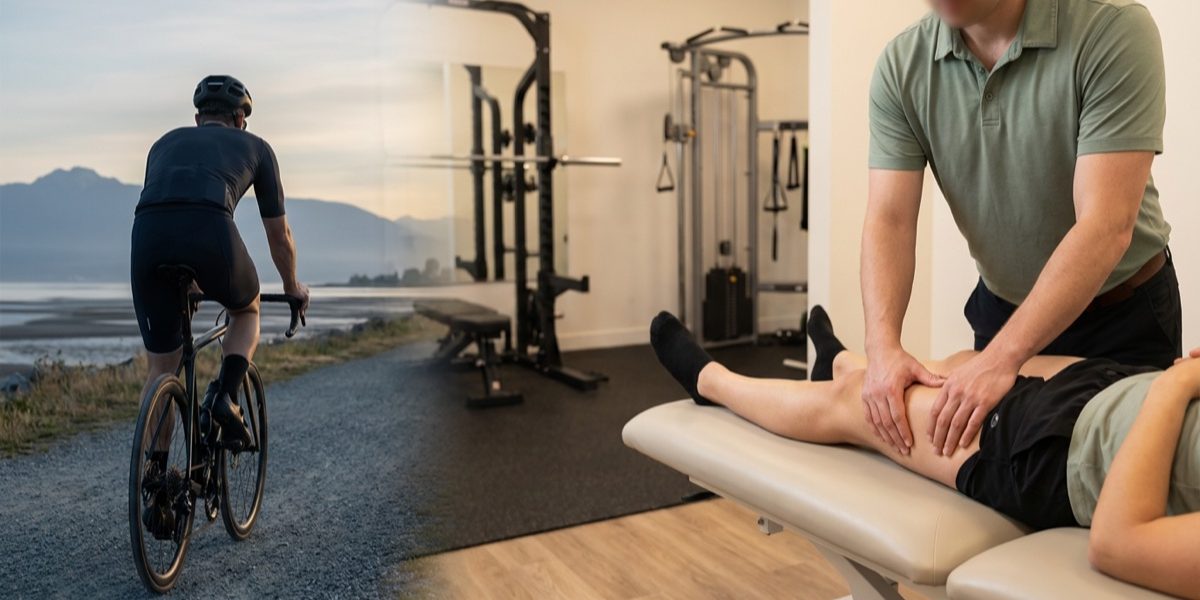
Whether you ride the Richmond dyke loop, climb Cypress Bowl Road, attack the North Shore on a long-travel bike, or just commute to your office on the Canada Line bike trail, cycling produces a very specific set of overuse and impact injuries. At Artemis Wellness Clinic at 5911 No. 3 Rd #130, Richmond, BC — two minutes from Brighouse SkyTrain — our team treats cyclists from every discipline through coordinated RMT, physiotherapy, acupuncture, chiropractic, and kinesiology. Book online at artemis.janeapp.com or call 604-242-2233.
This guide covers the most common cycling injuries we see across Vancouver and Richmond riders, when to come in, how our integrated approach accelerates recovery, and how our on-site rehab gym lets us do cyclist-specific position work most clinics can’t.
Why Cycling Injuries Are Different from Other Sports
Cycling is unique in that you spend hours in a fixed, slightly flexed posture, with very small ranges of motion, repeated tens of thousands of times per ride. The result is a different injury profile from running, hiking, or team sports. Three categories dominate:
- Position-driven overuse — neck pain from looking up on a road bike, low-back pain from a too-aggressive position, hand and wrist pain from bar pressure, knee pain from cleat or saddle position. These build slowly and are almost always solvable with bike fit + targeted treatment.
- Volume-driven overuse — IT band syndrome, patellofemoral pain, Achilles tendinopathy, and saddle-area soft tissue irritation. These appear during volume ramps (spring training, GranFondo prep) and respond to load management plus tissue work.
- Crash injuries — collarbone, AC joint, wrist, hip, and the universal “road rash + stiffness everywhere.” Mountain bikers add concussion and rib injuries from North Shore drops gone wrong.
We see all three patterns weekly throughout the BC riding season, with crash injuries spiking in the Whistler bike park summer and overuse spiking in the Sun Run-to-GranFondo training ramp.
When to Come In
Standard rules apply:
- Sharp localized pain that didn’t exist before this ride → come in this week
- Persistent dull pain that returns at the same point in every ride → almost always position or load related, come in within 2 weeks
- Numbness in hands, feet, or saddle area → nerve irritation from position, come in soon — these can become chronic if ignored
- Crash with possible rib, collarbone, or wrist injury → urgent care first, then us for rehab
- Concussion symptoms (headache, fogginess, balance issues) → physician first, then physio for vestibular rehab
For commuter cyclists riding the Canada Line bike trail or the Richmond dyke, we keep evening and weekend slots open during the spring ramp-up — this is when most commuter overuse injuries appear after a winter off the bike.
How to Get Here from Your Ride
We’re directly on the Brighouse SkyTrain–No. 3 Road corridor. From the Richmond dyke loop (West, Middle Arm, or South dyke) we’re 10 minutes by bike. From Stanley Park seawall, ride south through Vancouver to Bridgeport Station and ride one block to our door, or load your bike on the Canada Line. We have safe bike storage in the building lobby.
Open seven days a week with evening hours through cycling season (March through October).
Most Common Cycling Injuries by Discipline
Road and gravel cyclists:
– IT band syndrome (lateral knee)
– Patellofemoral pain (“cyclist’s knee”)
– Anterior knee pain from saddle too low
– Posterior knee pain from saddle too high
– Low back pain from too-aggressive position or weak core
– Neck and trapezius pain from looking up
– Ulnar nerve compression at the bar (handlebar palsy)
– Achilles tendinopathy
Mountain bikers (North Shore, Squamish, Whistler):
– Wrist and forearm fatigue from chunky terrain
– Lower back from sustained standing position
– Knee impact and ligament strains from drops and crashes
– Shoulder, AC joint, and collarbone from over-the-bar crashes
– Concussion (treat as urgent — see physician first)
– Quadriceps and hamstring strains from explosive efforts
Commuter cyclists:
– Neck and upper back from heavy backpacks plus poor position
– Knee tracking issues from poorly fit pedals
– Sit-bone discomfort from new saddles
– Wet-weather slip injuries (Vancouver winter commuting)
Our Multidisciplinary Approach
A cycling injury usually needs three things at once: tissue work to unload the painful structure, position correction to remove the cause, and progressive loading to rebuild capacity. A single discipline usually does one of those well. We do all three under one roof:
- Physiotherapy — orthopaedic assessment, manual therapy, ruling out structural issues, and the loading program. Our physios are experienced with cyclists and can identify position-driven issues without you needing a separate bike fit.
- Registered Massage Therapy (RMT) — focused work on the cyclist’s tight zones: ITB, TFL, glutes, hip flexors, quads, hamstrings, lats, and the cervical/upper trap region that always tightens from looking up at the road. Most of our serious cyclists book monthly RMT during heavy training.
- Acupuncture and TCM — particularly effective for cyclist-specific tendinopathies (IT band, patellar, Achilles) and for the neck and shoulder tension that bike fit alone can’t fully resolve.
- Chiropractic — addresses the thoracic and cervical mobility deficits that drive neck pain, and the lumbar/pelvic asymmetries that cause uneven knee tracking.
- Kinesiology / on-site rehab gym — supervised core and posterior chain strengthening, single-leg work, and injury-specific loading.
The On-Site Rehab Gym for Cyclists
Cyclists are notoriously under-strengthened off the bike. The same time investment in the gym pays disproportionate dividends in injury prevention and on-bike power. Our on-site rehabilitation gym — built out as part of the new 2025 facility — gives your kinesiologist:
- Squat rack and Olympic barbell — for the deadlifts, squats, and hip thrusts that cyclists need most
- Cable column for single-leg and rotational work
- BOSU and slide board for proprioception and frontal-plane stability (cycling is a sagittal-plane sport — you need cross-training in other planes to stay healthy)
- Plyo boxes for return-to-sport jump training after lower-limb injuries
- Open floor for Turkish get-ups, carries, and unilateral work
- Foam rollers and trigger-point tools you can use before or after sessions
A common pattern for our serious road cyclists: physio + RMT for the acute issue, then weekly kinesiology sessions through winter to build the strength base that prevents next year’s injury.
Bike Fit and the Difference It Makes
Many of the cyclists we treat assume they need a “real bike fit” before treatment can work. In our experience, the order is reversed: get the acute issue assessed and the major position errors corrected here first, then go to a dedicated bike fitter for the precision work if you’re a competitive cyclist. We can identify and correct most of the position issues that cause common cycling pain — saddle height, fore/aft, cleat rotation, and bar reach — within the assessment.
For competitive cyclists, racers, or anyone in serious GranFondo or Iron-distance triathlon training, we recommend pairing our rehab work with a session at one of Vancouver’s dedicated bike-fitting studios. We can refer.
Insurance and ICBC
- Extended health plans — RMT, physio, acupuncture, chiropractic. Direct billed for Pacific Blue Cross, Sun Life, Manulife, Green Shield, Canada Life, and most major insurers.
- ICBC — applies if your cycling injury was caused by a motor vehicle (a driver opened a door into you, struck you in an intersection, or you crashed avoiding a vehicle). Up to 25 sessions each of RMT, physio, acupuncture, and chiropractic with no doctor’s referral.
- WorkSafeBC — covers physio, RMT, and active rehab if cycling is part of your job (couriers, food delivery riders).
If you were hit by a vehicle while cycling, file the ICBC claim immediately — the no-fault benefits apply regardless of who was at fault. Bring your claim number to your first visit.
Realistic Recovery Timelines
- Position-driven overuse (knee, neck, low back) — 2–6 weeks once the position issue is corrected
- Volume-driven IT band syndrome — 3–6 weeks of physio + RMT + load reduction
- Patellofemoral pain — 4–8 weeks
- Achilles tendinopathy — 6–12 weeks of structured eccentric loading
- AC joint sprain (post-crash) — 4–8 weeks for Grade 1, 8–12 weeks for Grade 2, surgical referral for Grade 3
- Collarbone fracture (post-crash, after surgical/non-surgical management) — 8–16 weeks of progressive return
- Concussion — 2–6 weeks of vestibular and exertion-based rehab; longer if symptoms persist
Frequently Asked Questions
I just want a massage — do I need physio first?
No. You can book directly with an RMT. But for cycling-specific or persistent issues, we usually recommend a single physio assessment first to identify the cause (position, load, structure) so the RMT work targets the right tissue.
Do you direct bill ICBC and extended health?
Yes for ICBC and most major insurers — Pacific Blue Cross, Sun Life, Manulife, Green Shield, Canada Life.
Can I keep riding while being treated?
Almost always yes, with adjusted volume and intensity. Stopping completely usually delays recovery and erodes fitness. Your physio will give you specific volume limits.
I do the GranFondo Whistler in September — when should I come in?
Two or three sports massage sessions in the 6 weeks before the event reduces the risk of position-driven flare-ups during the long ride. One session in the week after for recovery. Any nagging issue from training should be assessed at least 4 weeks out.
I crashed on Mount Seymour but everything seems fine — should I come in?
If you took a hard fall, yes — even if pain is mild. Subtle whiplash, AC joint strains, and wrist injuries often present mild on day 1 and become worse on day 3–4. Catching them early shortens recovery and rules out anything more serious.
Can acupuncture help saddle-related numbness?
Yes, when combined with position correction. Saddle-related pelvic floor and pudendal nerve irritation respond well to acupuncture as part of an integrated approach.
Do you have evening or weekend appointments?
Yes — open seven days a week with evening slots most weekdays.
I’m a Vancouver bike commuter — can I ride to my appointment?
Yes. We have safe bike storage in the building lobby. Show up in your kit if you’ve come straight from a ride; we have a small change area.
Book Your Cycling Assessment
Don’t let a niggle become a missed event. Book online at artemis.janeapp.com or call 604-242-2233. We’re at 5911 No. 3 Rd #130, Richmond, BC, two minutes from Brighouse SkyTrain, with secure bike storage, on-site rehab gym, multidisciplinary team, and direct billing for ICBC, Pacific Blue Cross, Sun Life, Manulife, Green Shield, Canada Life, and WorkSafeBC.
For related guidance see our Sports Injury Treatment in Richmond BC, Neck and Back Pain Treatment, Sports Massage Therapy in Richmond, and Kinesiology and Active Rehabilitation guide.