By Ethan Choi, R.Ac, R.TCMP, DOMP, DO(Spain) · Osteopath & Registered Acupuncturist, Artemis Wellness Clinic Richmond BC
The conditions that bring people to osteopathy are remarkably consistent: persistent back pain, neck tension, headaches, jaw tension, and the general stiffness of a body shaped by desk work and screens. These are the everyday complaints of modern life — and they are exactly the kind of whole-body, root-cause problems osteopathy is designed to address.
The difficulty, until recently, has been access. With only a few dozen trained osteopaths across all of Metro Vancouver and almost none in Richmond, most local residents never had the option. This article explains how osteopathy approaches the most common conditions — and osteopathic treatment is now available at Artemis Wellness Clinic, Richmond BC. Book at artemis.janeapp.com or call 604-242-2233.
If you are new to osteopathy, What Is Osteopathy? A Complete Guide is a good starting point.
Osteopathy for Lower Back Pain
Lower back pain is the single most common reason people seek osteopathy. The osteopathic view is that the lower back is rarely the whole story.
A persistent low-back ache is often influenced by tight hip flexors pulling on the pelvis, by a thoracic spine (mid-back) that has lost rotation, by old injuries elsewhere that changed how you stand, or by a nervous system holding the area in a protective guard. An osteopathic assessment looks at this entire chain rather than treating only the sore spot.
Treatment combines gentle soft-tissue release, joint mobilization, and techniques to settle the nervous system — with the aim of restoring normal movement so the back is no longer compensating for a problem somewhere else. For a broader look at local options, see our lower back pain treatment guide.
Osteopathy for Neck Pain & Posture
Neck pain is the signature complaint of the screen era. Hours with the head drifting forward of the shoulders loads the muscles at the base of the skull and across the upper back, and the neck ends up doing postural work it was never designed to sustain.
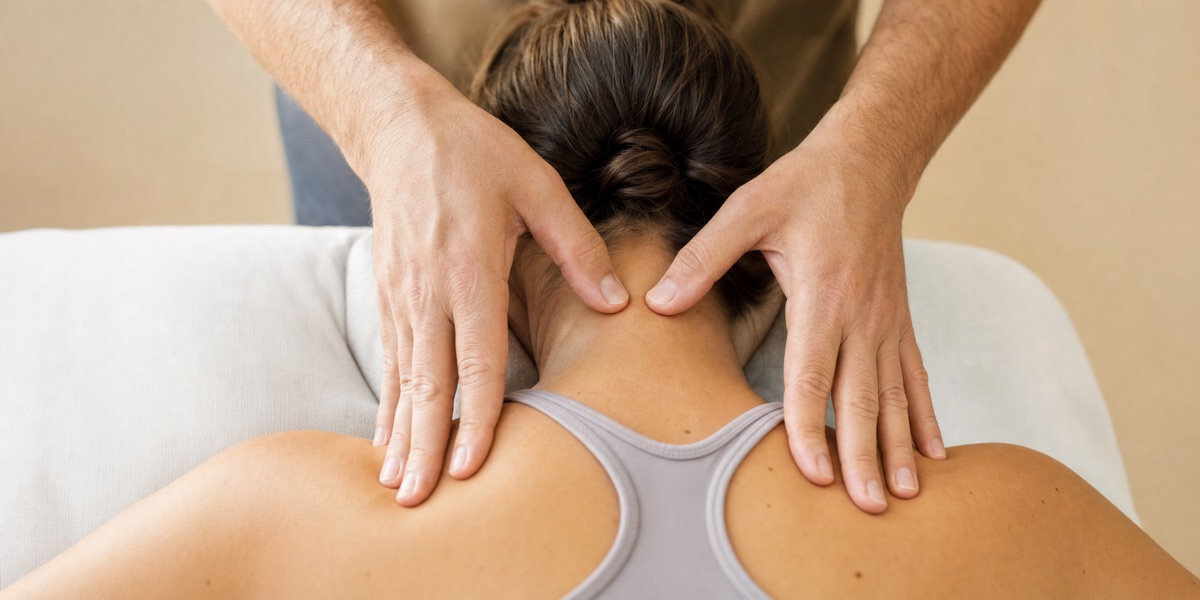
Osteopathy treats neck pain by looking beyond the neck. The position of the ribcage, the mobility of the upper back, breathing patterns, and shoulder mechanics all influence how much strain the neck carries. By restoring movement through that whole region — and addressing the postural and stress drivers behind it — osteopathic treatment aims for relief that lasts rather than returns by Wednesday.
If chronic shoulder and neck tension is your main issue, our RMT Director’s article Why Your Shoulders Are Always Tight explores the same root-cause thinking from a massage-therapy angle.
Osteopathy for Headaches & Migraines
Many headaches — particularly tension-type and posture-related headaches — have a strong musculoskeletal component. Tightness through the neck, the base of the skull, the jaw, and the upper back can all contribute to the pattern.
Osteopathic treatment for headaches uses gentle techniques to release tension through these structures, improve mobility in the neck and upper back, and calm an over-activated nervous system. The goal is to reduce both the frequency and intensity of headaches by addressing the physical contributors.
Headaches can have many causes, some of them medical. A responsible osteopath will always refer you for medical assessment if anything about your headache pattern warrants it — new, severe, or changing headaches should be checked by a physician first.
Osteopathy for TMJ & Jaw Tension
The jaw — the temporomandibular joint, or TMJ — is intimately connected to the neck, the base of the skull, and even breathing and stress patterns. Jaw clenching, grinding, and TMJ discomfort rarely exist in isolation.
Osteopathy approaches TMJ tension by treating the jaw in the context of the whole upper region: the neck, the cranial structures, the upper back, and the nervous-system state that often drives clenching in the first place. Gentle techniques aim to ease the tension pattern rather than only addressing the joint itself.
Osteopathy for Desk-Worker & Modern-Lifestyle Strain
Most of the conditions above share a common origin: the modern lifestyle. Long hours seated, constant phone use, low overall movement, and chronic low-grade stress combine to produce a predictable pattern of restriction — forward head posture, a stiff mid-back, tight hips, a guarded nervous system.
Osteopathy is well suited to this pattern precisely because it treats the body as one system. Rather than chasing each symptom separately, an osteopath can address the whole postural and movement picture, and give you a small number of targeted changes to carry into your day. To understand what a session involves, see What Happens During an Osteopathy Treatment Session.
Other Reasons People Choose Osteopathy
Beyond the conditions above, patients also seek osteopathy for:
- Sports injuries and the lingering restrictions left behind after them
- Pregnancy-related discomfort, treated with appropriate, gentle techniques
- Digestive discomfort linked to tension and restricted mobility
- Stress and fatigue, where the body will not seem to settle
- Repetitive strain from work and training
When to See an Osteopath — and When to See Someone Else
Osteopathy is a strong choice for persistent, whole-body, root-cause problems. But honest guidance matters:
- Acute injury or trauma, or any medical emergency → see a physician or go to hospital first
- A specific post-surgical rehab plan → physiotherapy is usually the right lead
- Purely muscular tension and recovery → registered massage therapy may be the simplest fit
- A persistent puzzle that has not resolved, or a problem you suspect is connected to posture, stress, or old injuries → osteopathy is well suited
One advantage of receiving osteopathy inside a multidisciplinary clinic is that this triage is easy. If your osteopathic assessment shows another discipline should lead, that handover happens internally.
Frequently Asked Questions
Can osteopathy help chronic lower back pain?
Osteopathy is one of the most common treatments people seek for persistent lower back pain. It addresses the whole movement chain — hips, mid-back, posture, nervous system — rather than treating only the sore area. Results vary by individual and cause.
Can osteopathy help with headaches?
Osteopathy can help tension-type and posture-related headaches by easing tension through the neck, jaw, and upper back and calming the nervous system. New, severe, or changing headaches should always be assessed by a physician first.
Is osteopathy good for neck pain from desk work?
Yes — desk-related neck pain is a very common reason patients book. Osteopathy addresses the posture, breathing, and upper-back drivers behind the neck strain, not only the neck itself.
Can osteopathy treat TMJ and jaw tension?
Osteopathy treats the jaw in connection with the neck, skull, and stress patterns that often drive clenching. Gentle techniques aim to ease the whole tension pattern.
Is osteopathy safe during pregnancy?
Osteopaths use appropriate, gentle techniques for pregnancy-related discomfort. Always tell your osteopath you are pregnant so the approach can be adapted.
How soon will I feel results from osteopathy?
Some patients feel looser immediately; longer-standing patterns take several sessions. Your osteopath will give a realistic estimate after the first assessment.
Book Osteopathy for Your Condition in Richmond
If a persistent ache, headache, or tension pattern has not resolved, osteopathy offers a whole-body, root-cause approach — now available in Richmond at Artemis Wellness Clinic, 5911 No. 3 Rd #130, three minutes from Brighouse SkyTrain. Book at artemis.janeapp.com or call 604-242-2233.
About the Author
Ethan Choi is a Registered Acupuncturist and TCM Practitioner and an Osteopath, specializing in acupuncture, osteopathic manual therapy, and sports rehabilitation. He combines clinical expertise, research, and education to deliver precise, patient-centered care. Ethan holds R.Ac and R.TCMP registration with the College of Health and Care Professionals of British Columbia, along with osteopathic qualifications including DOMP and a DO earned in Spain. He practises in English and Korean at Artemis Wellness Clinic in Richmond BC.
This article is educational and does not constitute medical advice. Osteopathy is a complementary manual therapy; for acute or serious medical conditions — including new, severe, or changing headaches — consult a physician.