Search for acupressure points for headaches and you will meet ten diagrams that disagree. I’m Ethan Choi, R.Ac, R.TCMP, DOMP, and headaches are a core focus of my clinical work at Artemis Wellness Clinic. Here are the four points I actually teach when patients ask about acupressure in Richmond, BC — clinic landmarks, honest research notes. Ground rule: any warning sign in the red-flag box below means medical care, not self-care.
What can acupressure realistically do for a headache?
Realistically, acupressure is a free, low-risk comfort tool that may take the edge off an everyday headache — never a treatment plan, never a substitute for assessment.
Why would pressing help? Three proposed mechanisms, none fully established: pressure on muscle- and nerve-rich points may influence local blood flow and pain signalling; gate-control theory suggests firm touch gives the nervous system competing input that may dampen pain messages; and sustained pressure may encourage endorphin release — the body’s own pain-modulating chemicals.
The evidence, honestly: acupressure research is limited and mixed — small studies, varied methods, difficult blinding. Needle acupuncture is better studied — trials for tension-type headache and migraine prevention are reasonably supportive, with moderate benefits on average — but needle results cannot be borrowed for finger pressure. No point removes triggers like dehydration, glare, or broken sleep; if heat sets you off, see our summer heat headaches guide.
The four points: where are they and how do I press them?
The four acupressure points I teach for headaches are LI4 (Hegu) on the back of the hand, GB20 (Fengchi) below the base of the skull, Taiyang at the temples, and Yintang between the eyebrows — all pressed the same way: thumb or fingertip, firm but comfortable, steady or in small slow circles, 30 to 60 seconds per point, breathing slowly.
1. LI4 — Hegu (合谷): the point on the back of the hand
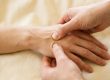
- Find it: on the back of the hand, in the bulge of muscle between thumb and index finger — precisely, on the thumb (radial) side of the midpoint of the second metacarpal, the long bone leading to the index finger. Squeeze thumb and index together; the highest point of the mound that rises is the spot.
- Press it: opposite thumb on top, index finger bracing under the palm; do both hands.
- When it’s used: at the first sign of a headache — the classic early, general-purpose choice.
- Traditional pairing: headaches across the forehead, face, or jaw — in TCM, the classic head-and-face point.
- Pregnancy caution: LI4 is traditionally avoided during pregnancy: skip it entirely, use the other three points, and clear any self-care with your prenatal provider.
2. GB20 — Fengchi (风池): the hollows below the skull
- Find it: just below the base of the skull (the occiput), in the two hollows between the upper ends of the sternocleidomastoid and trapezius muscles — roughly level with the earlobes, two to three finger-widths out from the midline. Slide both thumbs up the back of the neck until they settle into the natural depressions under the skull ridge; that settling is the landmark.
- Press it: thumbs angled up and in toward the skull ridge — never into the front or sides of the throat.
- When it’s used: mid-episode, when neck and shoulders feel tight or an ache creeps up from the neck.
- Traditional pairing: back-of-head headaches and headaches that start in the neck and wrap forward — the neck-driven, tension-type pattern I see weekly.
3. Taiyang (太阳): the temple point
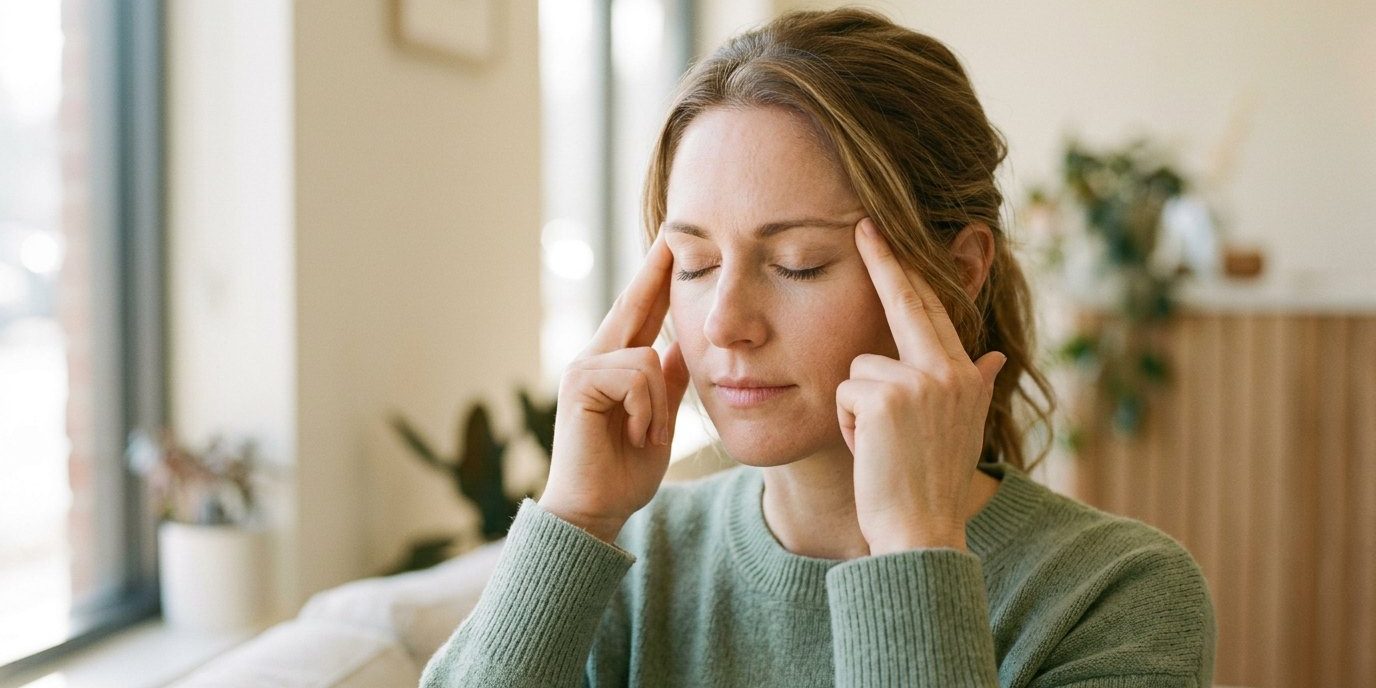
- Find it: in the shallow depression of the temple, about one thumb-width behind the midpoint between the outer end of the eyebrow and the outer corner of the eye. From that midpoint, slide a thumb-width back toward the ear until your fingertip drops into a slight dip.
- Press it: fingertips on both temples at once, eyes closed; temples need less force — keep it light to moderate.
- When it’s used: when pain concentrates at the temples or behind the eyes; a natural screen break.
- Traditional pairing: one-sided and temple-centred headaches — including the throbbing pattern many migraine patients describe — and eye-strain headaches.
4. Yintang (印堂): the point between the eyebrows
- Find it: on the midline, between the inner ends of the two eyebrows — the spot people instinctively pinch when tired.
- Press it: one fingertip, gentle steady pressure or tiny circles; light upward strokes toward the hairline also work.
- When it’s used: at the tail end of an episode, or as a wind-down when stress feeds the headache; many use it before sleep.
- Traditional pairing: frontal headaches and headaches that arrive with a furrowed brow and a racing mind; in TCM, as much a calming point as a headache point.
How hard should I press?
Hard enough for a dull, spreading ache that stays comfortable — patients call it “good pain” — never hard enough to be sharp. Aim for about 3 to 5 out of 10. Other rules:
- Hold each point 30 to 60 seconds with slow breathing; a full round takes under five minutes and can repeat a few times daily.
- Stop at anything sharp, shooting, tingling, or numb — a nerve complaining, not a point working.
- Skip broken skin and anywhere recently injured; bruising afterward means too much force.
- If pressing reliably worsens a headache, stop — that is assessment information, not something to push through.
When is a headache a medical emergency?
A headache is a medical emergency when it arrives with any warning sign below; pressure points then have no role.
Headache red flags — get medical care now for:
- A sudden, severe “worst-ever” headache that peaks within seconds to minutes
- Headache with fever and a stiff neck
- Headache with confusion, weakness, vision loss, or slurred speech
- Any significant headache after a head injury
- A new headache, or a clear change in headache pattern, in anyone over 50
This article is general information, not medical advice. Unsure? Call HealthLink BC at 811 or seek medical care.
What if acupressure is not enough?
Then the next step is an assessment, not more pressing: I map where the pain sits, what sets it off, and what your neck, jaw, and sleep are doing. My main tool is acupuncture, and because many stubborn headaches are neck-driven, I also use gentle osteopathic manual therapy for headaches — noting honestly that osteopathic manual practice is not a college-regulated profession in BC and I am not a physician. Many patients book a combined osteopathy and acupuncture session: one practitioner, one plan.
Dave Tam, RMT, our clinic Director, sees the same territory from the massage table: “The real estate these four points sit on — the suboccipitals under the skull, the upper trapezius, the jaw muscles — is exactly where massage therapy spends its time with headache patients. Home acupressure between appointments keeps that tissue settled; treatment and self-care reinforce each other.” Registered massage therapy pairs naturally with this routine — an RMT works deeper than thumbs can.
Persistent headaches deserve assessment: acupuncture for headaches and migraines at Artemis is provided by me or by Mandy Tam, R.Ac — and any red flag above belongs with a physician, not with any of us.
Still have questions about pressure points for headache relief?
Short answers, as given in clinic.
Where is the LI4 pressure point?
On the back of the hand, in the muscle bulge between thumb and index finger — on the thumb (radial) side of the midpoint of the second metacarpal bone. Squeeze thumb and index together and press the highest point of the mound.
Which acupressure points are safe during pregnancy?
LI4 is traditionally avoided in pregnancy, so skip it; use GB20, Taiyang, and Yintang instead, and clear any routine with your prenatal provider.
How do I massage my temples for a headache?
Find Taiyang — the shallow dip about one thumb-width behind the midpoint between your eyebrow’s outer end and the outer corner of your eye — and circle lightly, both sides, for 30 to 60 seconds.
What is the Fengchi GB20 pressure point good for?
Traditionally, back-of-head headaches and ones starting in the neck and wrapping forward. It sits in the two hollows below the skull, between the upper ends of the sternocleidomastoid and trapezius muscles.
Do pressure points actually work for headaches?
Research on acupressure is limited and mixed, so treat it as a free, low-risk comfort tool that may take the edge off — not as treatment. Recurring headaches deserve a proper assessment.
Can acupressure prevent migraines like acupuncture?
Not on current evidence: the reasonably supportive prevention research involves needle acupuncture over a course of care, and finger pressure has not been shown to do the same.
Ready to have your landmarks checked in person?
Book online at artemis.janeapp.com or call 604-242-2233. Artemis Wellness Clinic brings acupuncture and TCM, osteopathic manual therapy, massage therapy, physiotherapy, chiropractic, and kinesiology under one roof at 5911 No. 3 Road #130, Richmond BC V6X 0K9 — a 3-minute walk from Brighouse SkyTrain. We direct bill many extended plans; coverage varies and we never guarantee reimbursement. Bring your headache pattern — I would rather check your landmarks in person than leave you guessing at diagrams.