
Autumn Aches: Massage, Acupuncture, or Osteopathic Manual Therapy — Which One, and When?
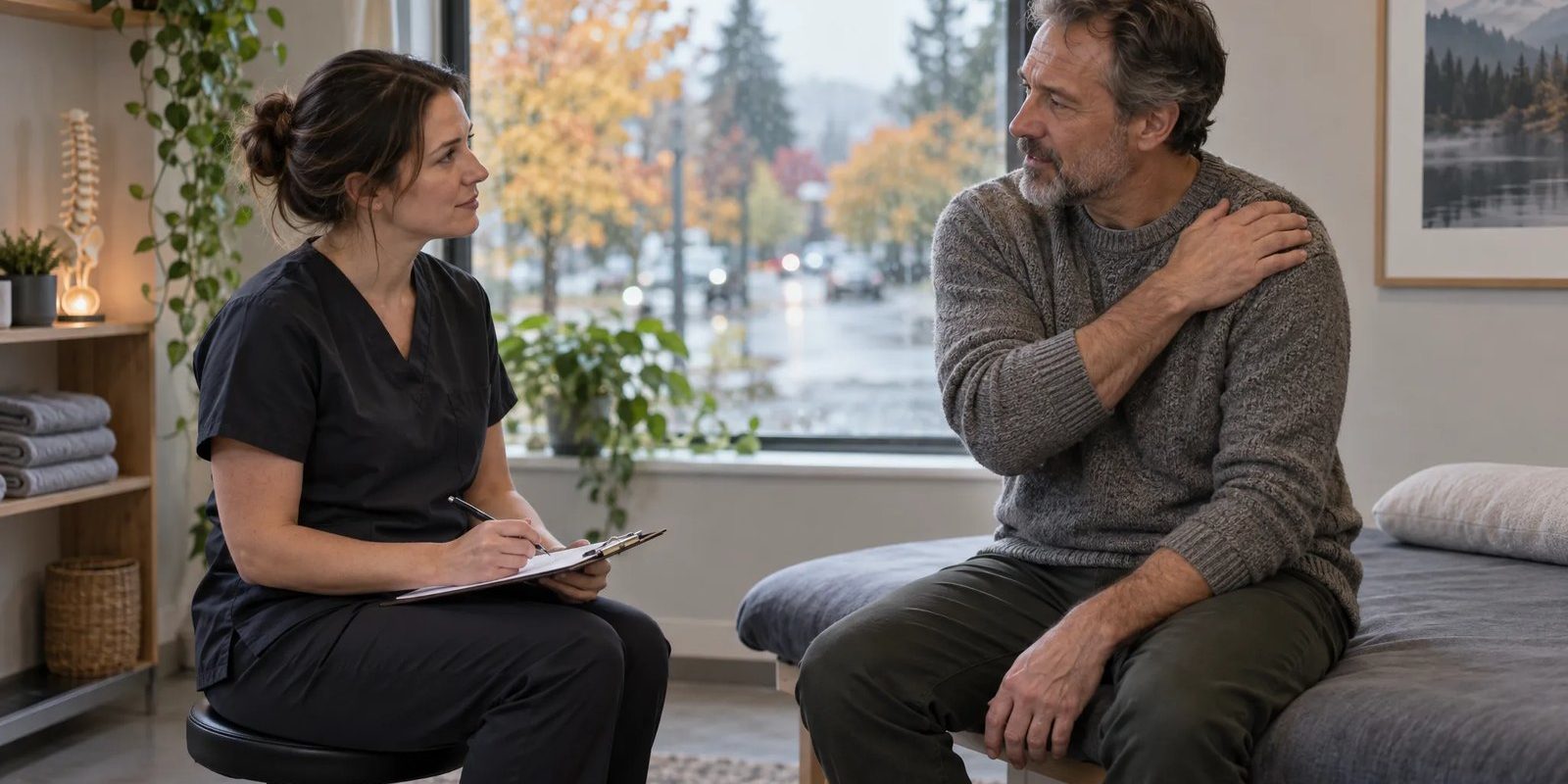
Every autumn the same question arrives at our front desk. The rain settles in over Richmond, the mornings turn dark, and a shoulder or a lower back that behaved all summer starts speaking up. Then: should I book massage, acupuncture, or that osteopathic thing?
I am Mandy Tam, R.Ac, a Registered Acupuncturist and one of the co-founders of Artemis Wellness Clinic. I could answer by saying acupuncture is the answer. That would be easy, and it would not be honest.
So I asked two colleagues to describe their own work in their own words. If you read this and book somewhere closer to home or closer to your budget, I will count it as useful. Everything here is general information, not medical advice, and this kind of care complements your medical care, does not replace it.
Why do old aches speak up in the autumn?
There is no single tidy reason, but there is a pattern. Cooler, damper weather makes people move less and hold themselves more tightly. Summer routines wind down — the dyke walk, the bike, the garden — and sitting hours go up.
Many patients find the autumn ache is not really new. It is a familiar problem that summer movement was quietly managing. That matters when you choose what to book, because the goal is to get you moving comfortably again, not to argue with the weather.
Should you get medical assessment first?
Some aches are not a booking question at all.
Get medical assessment first before you book massage, acupuncture or manual therapy if you have any of the following: pain after an accident or a fall; numbness, tingling or weakness; a hot, swollen or red joint; fever along with joint pain; unexplained weight loss; or pain that wakes you at night. If you are not sure who to call, HealthLink BC is available at 811 at any hour and you can speak with a registered nurse. This article is general information, not medical advice.
If none of that applies, and the ache is the familiar autumn kind, read on.
What does registered massage therapy do? (Dave Tam, RMT)
Dave Tam, RMT is our Clinic Director. In his words:
“Massage therapy is hands-on work with muscle and soft tissue. I use pressure, movement and stretch to ease tightness, and I spend much of a visit finding where the body is guarding — where it tightened up to protect something and then never let go.
“It suits people whose ache feels like tightness. A neck that feels like a band. Shoulders sitting up near the ears by three in the afternoon. It also suits people who need the nervous system to settle, because steady pressure tends to calm people down.
“Registered massage therapy is a regulated profession in BC. That matters, because massage means different things in different places. RMT after a name means set training hours, exams, and a college you can bring a complaint to.”
What is osteopathic manual therapy, and who does it suit? (Ethan Choi, R.Ac, R.TCMP, DOMP)
Ethan Choi, R.Ac, R.TCMP, DOMP practises both acupuncture and osteopathic manual therapy. In his words:
“Osteopathic manual therapy looks at how regions of the body move together, rather than at one sore spot. If a hip does not rotate well, the lower back often works harder to make up for it. My assessment is gentle: I move an area, feel how it responds, and work with what is restricted.
“It tends to suit stiffness and restriction more than raw muscular tightness: the ache that moves around, the back that is fine until you twist.
“My acupuncture and TCM registrations are with CHCPBC, and I am always glad to talk through my osteopathic training with anyone who asks.”
Where does acupuncture fit?
This is my own part of the clinic. Acupuncture uses fine, sterile, single-use needles placed at selected points and left in place while you rest.
The evidence is reasonably supportive for ongoing musculoskeletal pain such as low back pain and neck pain, and for reducing how often some recurring headaches turn up. It is thinner or unclear for many other things people ask me about. Acupuncture may help with those problems, but that is a maybe, not a promise, and results vary.
Acupuncture is a regulated profession in BC, overseen by CHCPBC. R.Ac means registered, examined and accountable.
In my experience, it suits people whose ache has lasted weeks or months rather than days, people whose pain comes bundled with poor sleep and tension, and people who have already tried the obvious things.
One more thing worth checking about any clinic: we offer acupuncture only. We do not prescribe Chinese herbal medicine here. People often assume the two come together, so ask before you book anywhere.
What about physiotherapy and kinesiology?
Two more parts of a multidisciplinary clinic in Richmond BC, described at service level.
Physiotherapy begins with assessment and then adds loading: exercise chosen and progressed so tissue gradually handles more. If your ache followed an injury, or returns every time you go back to running, assessment plus a loading plan is often the part that changes the pattern. Physiotherapy is regulated in BC.
Kinesiology is exercise programming and active rehabilitation — building an activity plan you can keep through a wet autumn, pitched at where your body is now. Coverage for kinesiology varies more between plans than it does for the other services, so it is worth checking yours.
How do these approaches compare?
Everyone responds differently, so read this as a starting point for a conversation rather than a sorting machine.
| Approach | What it mainly does | Often suits | A first visit usually includes |
|---|---|---|---|
| Registered massage therapy (RMT) | Hands-on work with muscle and soft tissue | Muscular tightness, guarding, tension-driven aches | Assessment, then hands-on treatment the same visit |
| Acupuncture (R.Ac) | Fine sterile single-use needles at selected points | Ongoing low back and neck pain, some recurring headaches | A full intake, then needling while you rest |
| Osteopathic manual therapy (DOMP) | Gentle assessment of how regions move together | Stiffness and restriction, aches that shift around | Hands-on assessment, then gentle technique |
| Physiotherapy | Assessment, then loading and exercise progression | Rebuilding strength and confidence after injury | Assessment and a starting exercise plan |
| Kinesiology | Exercise programming and active rehabilitation | Building an activity plan you can keep | A movement screen and a plan you can do at home |
When does combining treatments make sense, and when does it not?
Combining makes sense when two different things are going on at once. A stiff mid-back plus shoulders that never let go. Pain that needs settling plus strength that needs rebuilding. Pairing hands-on work with a loading plan, or combining osteopathic manual therapy with acupuncture, gives you two tools aimed at two problems.
It does not make sense simply to be thorough. Booking three disciplines in one week is the quickest way to learn nothing: if something changes, you cannot tell which visit did it. More treatment is not automatically better.
There is also a scheduling truth. A crowded plan you cannot keep is worse than two well-timed visits you actually attend. Most people can sustain about one appointment a week. Build around the calendar you really have and what you can afford; direct billing is not the same as full coverage.
How will you know if it is working?
Pick a review point before you start. Three or four visits is a fair trial for most ordinary aches. Judge by what you can do rather than by how the treatment felt: sleeping through the night, or shoulder-checking without turning your whole body.
Results vary, and the same plan can work quickly for one person and slowly for the next. If nothing has shifted by the review point, we change something — a different approach, a different pace, or a referral. Sometimes the plain answer is that we are not helping and someone else should look at it: your family doctor, or a discipline we do not offer. You should hear that clearly instead of being booked for a fifth visit and a hopeful shrug.
Where are we, and what about insurance?
Artemis Wellness Clinic is at 5911 No. 3 Road #130, Richmond BC V6X 0K9, about three minutes from Brighouse SkyTrain station. Call 604-242-2233 or book online at artemis.janeapp.com. I see patients in English, Mandarin and Cantonese, and you can read about the conditions we work with on our site.
We offer direct billing with many extended health insurers, which saves you paying up front. Coverage varies by plan, some services are not included at all, and no clinic can promise what your insurer will reimburse. Check your own plan first, especially the annual maximum.
What else is worth reading this autumn?
Each piece in this autumn series goes deeper on one question.
- Cold weather and aching joints — why joints often feel worse as the temperature drops.
- Autumn, TCM and the change of season — how traditional Chinese medicine frames this time of year, described honestly.
- Staying mobile through a rainy autumn — keeping movement going when the weather makes it easy to skip.
Frequently asked questions
I have no idea where to start. What should I book?
Call and describe what you notice: where it hurts, what makes it worse, how long it has been there. Every first visit starts with assessment, and if another discipline fits better we will say so.
Can I have massage and acupuncture on the same day?
Many people do, and it is reasonable if both address something real. Give them room rather than stacking a full week.
How do I know a practitioner is properly qualified?
Ask what their letters mean and where they trained — any good practitioner will answer happily. Our acupuncturists are registered with CHCPBC and our massage therapists with CMTBC, and you can look either up on the public register.
Do you prescribe Chinese herbal medicine?
No. This clinic provides acupuncture only and does not dispense or prescribe herbs. If herbal medicine is what you want, ask any clinic directly before booking.
How many visits before I should expect anything?
Set a review point at three or four visits and judge by what you can do. Everyone responds differently, so some people notice a change after one visit and others take longer.
Do I need a doctor’s referral?
Usually not, to book with us. Some extended health plans ask for one before they reimburse, so check before your first appointment.
What if the treatment is not helping?
Say so, and we will change the plan or refer you. Carrying on with something that is doing nothing wastes your time and coverage.
Is any of this a substitute for seeing my doctor?
No. This care complements your medical care, does not replace it, and anything in the red flag list above needs medical assessment first.